A water treatment system is a long-term investment — one that should protect your home, your appliances, and your water quality for many years. But how many years, exactly? And what determines whether a system reaches its potential lifespan or falls short of it?
The answers depend on the type of system, the quality of the equipment, the conditions it operates in, and how well it's maintained. Understanding what drives system longevity helps you make better purchasing decisions, set realistic expectations, and protect your investment through proper care.
Water Softeners: 15 to 20 Years With Proper Maintenance
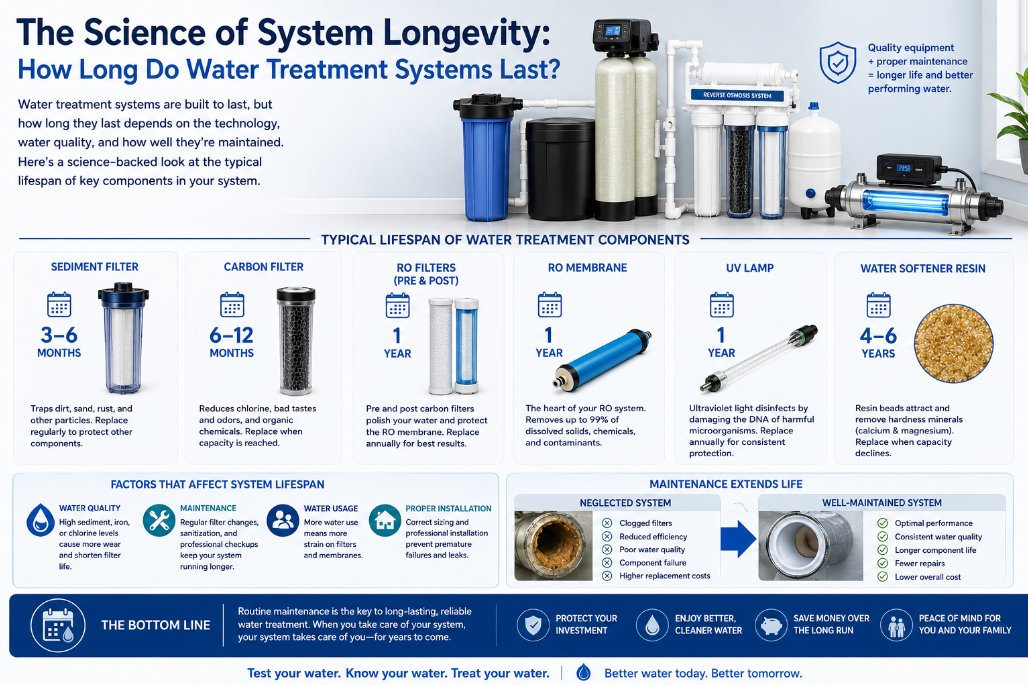
A quality water softener, properly sized for your household and well maintained, should last 15 to 20 years — sometimes longer. The two main components that determine softener lifespan are the resin bed and the control valve.
The resin bed. High-quality resin beads are designed to last the life of the softener under normal conditions. In Florida, two factors can shorten resin life significantly:
Chlorine and chloramines in municipal water degrade resin over time — oxidizing the bead structure and reducing ion exchange capacity. A whole-house carbon filter upstream of the softener removes these before they reach the resin, extending resin life considerably. As covered in our article on why some Florida homes need both a softener and carbon filter, this combination is beneficial for municipal water users beyond just the water quality improvement.
Iron fouling is the other major resin threat in Florida. When iron-containing water passes through a softener without adequate upstream iron treatment, iron coats the resin beads and reduces their effectiveness. Using a resin cleaner every 3 to 4 months and installing a dedicated iron filter before the softener in high-iron well water situations protects the resin and extends its useful life. For more on iron in Florida water, see our article on what iron in water does to your home.
The control valve. The control valve is the mechanical brain of the softener — managing regeneration cycles, tracking water usage, and controlling all automated functions. Quality control valves from reputable manufacturers are designed for 20+ years of service. Generic or off-brand valves may fail significantly sooner. When a control valve fails on an otherwise sound softener, replacing just the valve is often more cost-effective than replacing the entire system.
What shortens softener lifespan:
- Running without salt — allowing the resin to become exhausted and stay that way
- Untreated iron fouling the resin bed
- Chlorine or chloramine degradation of resin without upstream carbon filtration
- Chronic undersizing — a softener that regenerates too frequently wears out faster
- Lack of periodic maintenance and inspection
Carbon Filters: Media Replacement Every 3 to 5 Years
Whole-house carbon filter tanks themselves — the fiberglass or composite vessels — can last 20 years or more. What has a finite lifespan is the carbon media inside them.
As covered in our article on how carbon filtration works, activated carbon removes contaminants through adsorption — contaminants bond to the carbon surface until all available bonding sites are occupied. At that point the carbon is exhausted and needs replacement.
For whole-house catalytic carbon systems in Florida — where water often contains chloramines and other contaminants that load carbon faster than plain chlorine would — media replacement is typically needed every 3 to 5 years depending on water quality and household usage. A professional water test of the post-filter water can confirm whether the media is still performing adequately or needs replacement.
Point-of-use carbon filters — under-sink units, refrigerator filters — have much shorter replacement intervals because their smaller carbon volume is exhausted more quickly. These typically need cartridge replacement every 6 to 12 months.
Reverse Osmosis Systems: 10 to 15 Years for the Housing, Annual Filter Changes
The housing and components of a quality under-sink RO system can last 10 to 15 years or longer. Within that timeframe, the filters and membrane require regular replacement:
Pre-filters (sediment and carbon): Every 6 to 12 months, depending on source water quality. These protect the RO membrane — neglecting pre-filter replacement shortens membrane life.
RO membrane: Every 2 to 5 years, depending on source water quality, usage, and whether pre-filters have been changed on schedule. A TDS meter test comparing pre- and post-membrane readings tells you whether the membrane is still performing adequately. As covered in our article on what TDS means for Florida homeowners, rejection rates below 85 percent indicate membrane replacement is needed.
Post-carbon polishing filter: Every 12 months.
In Florida, where source water often has higher TDS and contaminant loads than national averages, pre-filters and membranes may need replacement at the shorter end of these ranges. Staying on schedule with filter replacements is the single most important factor in maintaining RO performance and protecting the membrane.
UV Disinfection Systems: Lamp Annually, System 10 to 15 Years
UV disinfection systems are mechanically simple — a lamp inside a chamber with a quartz sleeve and a controller. The system housing and chamber can last 10 to 15 years with proper maintenance. What requires regular replacement is the UV lamp.
UV lamps degrade over time — their UV-C output decreases even as they continue to emit visible light. A lamp that looks operational may no longer be delivering adequate germicidal dose. Annual lamp replacement is the standard recommendation regardless of whether the lamp appears to be working, because visible light output is not a reliable indicator of UV-C output.
The quartz sleeve — the protective barrier between the lamp and the water — should be cleaned when the lamp is replaced and replaced every 2 to 3 years. Mineral deposits or biofilm on the sleeve reduce UV transmission and therefore reduce effective dose delivery to the water.
As covered in our article on how UV disinfection works, a UV intensity sensor that monitors actual output — rather than just lamp age — provides real-time assurance that adequate dose is being delivered.
Iron Filters and Air Injection Systems: 10 to 20 Years
Iron filters and air injection oxidation systems are robust pieces of equipment with long service lives when properly maintained. The control valves on these systems follow similar longevity patterns to water softener control valves — quality valves from reputable manufacturers can last 15 to 20 years.
The filter media inside iron filters — greensand, Birm, or other oxidizing media — has a finite lifespan that depends on water chemistry, iron loading, and whether backwashing is correctly configured. Media replacement is typically needed every 5 to 10 years. A decline in iron removal performance — indicated by returning staining — signals that media inspection or replacement is needed.
Sediment Pre-filters: Cartridge Changes Every 1 to 6 Months
Sediment filter housings last many years. Cartridges need replacement when they become loaded with particles — which can range from monthly in high-sediment well water situations to every 3 to 6 months in cleaner source water. A pressure gauge before and after the sediment filter makes it easy to know when a cartridge change is needed — a significant pressure drop across the filter indicates it's time.
What Florida Conditions Do to System Longevity
Florida's water conditions create specific challenges for water treatment system longevity that are worth understanding:
High hardness. Florida's hard water means softeners work harder — regenerating more frequently and processing higher mineral loads than systems in lower-hardness areas. Proper sizing is important; an undersized softener in high-hardness Florida water will wear out faster than one correctly sized for the load.
Iron in well water. Iron is one of the most damaging contaminants for water treatment equipment — fouling softener resin, clogging UV quartz sleeves, and loading filter media faster. Proper iron treatment upstream of other equipment is the most effective way to protect system longevity in Florida well water situations.
Chloramines in municipal water. As noted above, chloramines degrade standard softener resin over time. A whole-house carbon filter upstream of the softener protects the resin and extends softener life — a meaningful benefit beyond the water quality improvement it also provides.
Florida's heat and humidity. Equipment installed in garages or utility areas in Florida experiences more temperature variation and humidity than in climate-controlled spaces. While modern water treatment equipment is designed to handle these conditions, ensuring adequate ventilation and protecting electronic components from direct moisture exposure is worth attention during installation.
The Maintenance Connection
The single most important factor in water treatment system longevity — across every type of system — is maintenance. Systems that are properly maintained consistently reach or exceed their designed lifespan. Systems that are neglected fail earlier, sometimes significantly so.
The maintenance requirements aren't onerous:
- Check and refill softener salt every 4 to 6 weeks
- Add resin cleaner every 3 to 4 months
- Replace UV lamp annually
- Replace RO pre-filters every 6 to 12 months
- Replace RO membrane every 2 to 5 years based on TDS testing
- Schedule professional service annually to inspect all components
For more detail on softener maintenance specifically, see our article on how often you should service a water softener.
When to Repair vs. Replace
As systems age, the question shifts from maintenance to whether repair or replacement makes more sense. A few general guidelines:
Repair makes sense when: The system is less than 10 years old, the failure is in a replaceable component (control valve, membrane, lamp), the rest of the system is in good condition, and repair cost is significantly less than replacement.
Replacement makes sense when: The system is 15+ years old, multiple components are failing, the technology is outdated and a replacement would be significantly more efficient, or repair cost approaches replacement cost.
For a detailed look at this decision, see our article on when to repair vs. replace your water treatment system.
The Bottom Line
Water treatment systems are long-lived investments when they're correctly sized, properly installed, and consistently maintained. A water softener that lasts 20 years, a carbon filter with media replaced on schedule, and a UV system with annual lamp changes provide decades of reliable water quality protection at a fraction of what deferred maintenance and premature replacement would cost.
Understanding how long each component of your system should last — and what affects that lifespan — helps you budget for maintenance, recognize when service is needed, and get the full return on your water treatment investment.
Dependable Water Treatment services and maintains water treatment systems throughout Florida — keeping systems performing correctly for their full designed lifespan. Contact us to schedule a service visit or system inspection.