If you've ever used a pitcher filter, a refrigerator filter, or a whole-house filtration system, you've almost certainly used activated carbon. It's the most widely used filtration media in residential water treatment — and for good reason. Activated carbon is exceptionally effective at removing the chemical contaminants, tastes, and odors that make tap water unpleasant. But understanding how it works, what it removes, and what it doesn't is essential for making the right decisions about your Florida home's water treatment setup.
What Is Activated Carbon?
Activated carbon is carbon that has been processed to create an enormous internal surface area covered with millions of tiny pores. The "activation" process — typically involving high heat and steam or chemical treatment — opens up these pores and creates a surface that is extraordinarily porous at the microscopic level.
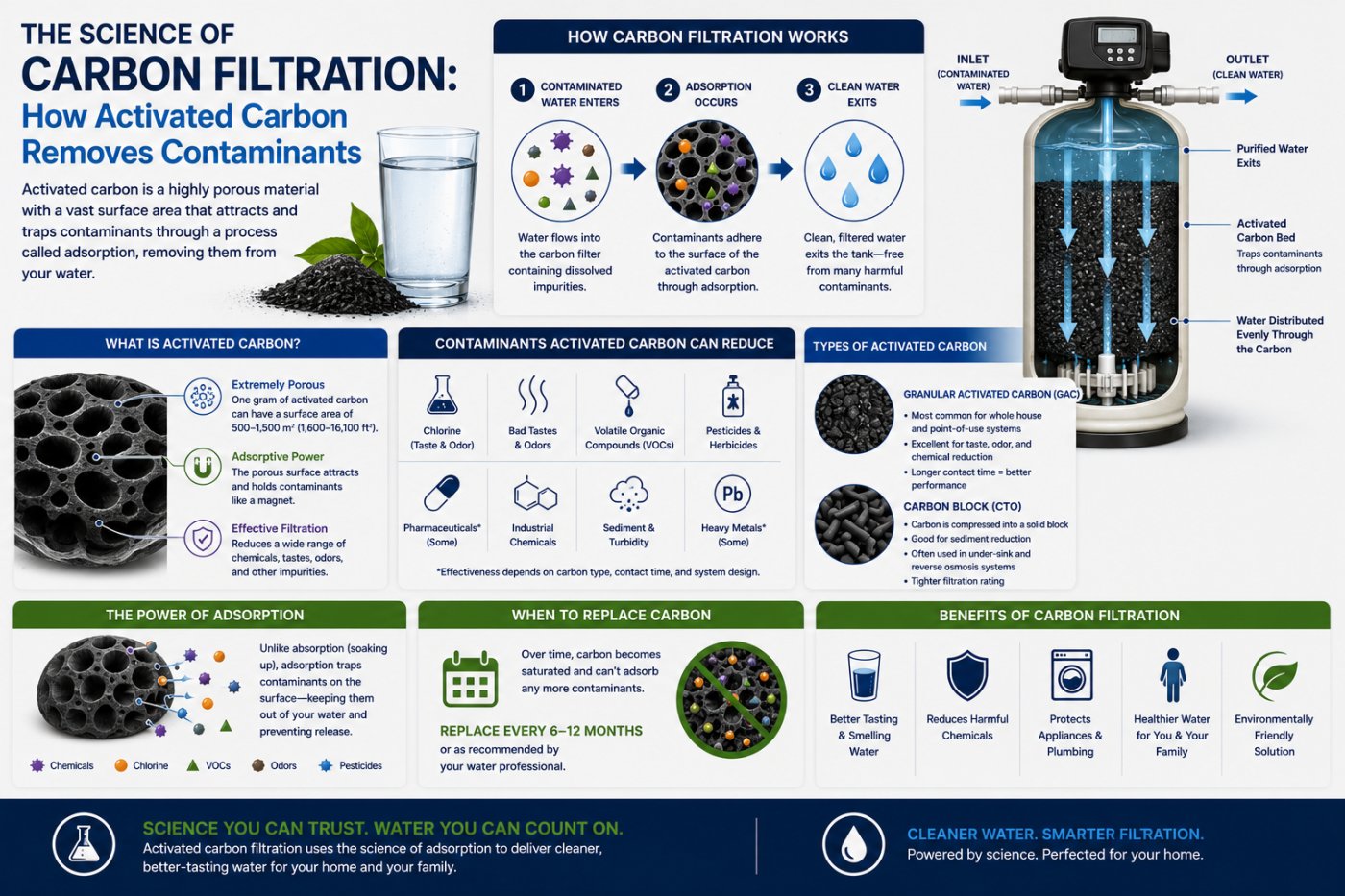
To put the surface area in perspective: one gram of activated carbon has a surface area of approximately 500 to 1,500 square meters — roughly the size of several tennis courts, packed into a material that fits in your hand. That vast internal surface area is what makes activated carbon such an effective filter media.
Activated carbon for water filtration is typically made from one of three source materials:
Coconut shell carbon. Considered the premium option for water filtration. Coconut shell carbon has a higher density of micropores — very small pores — that are particularly effective at removing chlorine, chloramines, and volatile organic compounds (VOCs). It's harder and more durable than other carbon types, making it longer-lasting in filtration applications.
Bituminous coal carbon. A widely used carbon type with a broad pore distribution. Effective for a wide range of contaminants and commonly used in whole-house systems.
Wood-based carbon. Has larger pores (macropores) that are effective for removing larger organic molecules and color compounds. Used in specific applications where those contaminants are the primary concern.
How Activated Carbon Removes Contaminants: Adsorption
The mechanism by which activated carbon removes contaminants is called adsorption — not absorption. The difference matters.
Absorption is when a substance is taken into the bulk of another material — like a sponge soaking up water. Adsorption is when a substance adheres to the surface of another material through molecular attraction. In activated carbon filtration, contaminant molecules are attracted to and bond with the carbon surface as water passes through the filter media.
The enormous surface area of activated carbon means there are an extraordinary number of bonding sites available. As water flows through the carbon, contaminant molecules come into contact with the carbon surface and stick — pulled there by the same van der Waals forces that cause molecules to attract each other. The clean water continues through; the contaminants remain bonded to the carbon.
This process continues until the carbon's available bonding sites are fully occupied — at which point the carbon is exhausted and needs to be replaced or regenerated. This is why carbon filters have a finite lifespan and must be replaced on a schedule to maintain effectiveness.
What Activated Carbon Removes Effectively
Activated carbon is highly effective at removing organic compounds and certain chemicals — particularly those that affect taste, odor, and the aesthetic quality of water.
Chlorine. Standard activated carbon is extremely effective at removing free chlorine from municipal water. Chlorine bonds readily to carbon surfaces and is removed almost completely in a properly sized carbon filter. This is the primary reason most pitcher filters and refrigerator filters use activated carbon — chlorine removal dramatically improves tap water taste and odor.
Chloramines. This is where carbon type matters significantly. Standard activated carbon removes chloramines, but much less efficiently than it removes free chlorine. Chloramines require significantly longer contact time with carbon to be adsorbed effectively. Catalytic carbon — a specially processed form of activated carbon with enhanced surface reactivity — is significantly more effective at chloramine removal. For Florida homeowners on municipal water supplies that use chloramines (which many Florida utilities do), catalytic carbon is the right choice rather than standard carbon. For more on chloramines in Florida water, see our article on what chloramine is and why it's in Florida water.
Volatile organic compounds (VOCs). Carbon is effective at removing a broad range of VOCs — organic chemicals that evaporate easily and can enter water supplies from industrial sources, agricultural runoff, and other contamination pathways.
Hydrogen sulfide (sulfur odor). At lower concentrations, activated carbon — particularly catalytic carbon — can effectively remove hydrogen sulfide, eliminating the rotten egg odor common in some Florida well water. At higher concentrations, more aggressive treatment like air injection oxidation is typically needed before carbon filtration.
Certain pesticides and herbicides. Many agricultural chemicals adsorb effectively to activated carbon, making it useful in areas with agricultural runoff concerns.
Taste and odor compounds. Beyond specific chemicals, activated carbon removes a broad range of compounds that affect water taste and smell — including the musty, earthy taste that can come from naturally occurring organic matter in some water sources.
Disinfection byproducts. Trihalomethanes (THMs) and haloacetic acids (HAAs) — byproducts formed when chlorine reacts with organic matter in water — are effectively removed by activated carbon.
What Activated Carbon Does Not Remove
Understanding carbon's limitations is just as important as understanding its strengths. Activated carbon does not effectively remove:
- Hardness minerals. Calcium and magnesium pass through carbon media completely unchanged. A carbon filter has no effect on water hardness — which is why Florida homes on city water typically need both a carbon filter and a water softener. For more on this, see our article on why some Florida homes need both a softener and carbon filter.
- Nitrates. Nitrates are not effectively adsorbed by activated carbon. Reverse osmosis is the appropriate treatment for nitrate removal.
- Heavy metals. Standard activated carbon has limited effectiveness against dissolved heavy metals like lead, arsenic, and mercury. Specialized carbon media and other treatment approaches are needed for reliable heavy metal removal.
- Bacteria and viruses. Activated carbon does not disinfect water. In fact, the moist, organic-rich environment of an exhausted carbon filter can actually support bacterial growth — which is one reason filter replacement on schedule is important.
- PFAS. Standard activated carbon has limited effectiveness against PFAS (forever chemicals). Reverse osmosis is currently the most reliable consumer-level treatment for PFAS removal.
- Total dissolved solids. Carbon filtration has minimal effect on TDS. Dissolved minerals remain in the water after carbon treatment.
Types of Carbon Filters for Residential Use
Activated carbon is used in several different filter configurations, each with different applications and performance characteristics.
Granular activated carbon (GAC). Loose carbon granules through which water flows. GAC filters offer good flow rates and are commonly used in whole-house systems. The granular form can allow water to channel through gaps between granules, potentially reducing contact time and effectiveness for some contaminants. GAC is very effective for chlorine and taste/odor removal.
Carbon block filters. Carbon particles compressed into a solid block. Water must pass through the entire block, ensuring full contact with the carbon media. Carbon block filters generally provide better contaminant removal than GAC for many compounds, including chloramines, because of the more consistent contact time. Used in under-sink systems, refrigerator filters, and point-of-use applications.
Catalytic carbon. A specially processed carbon with modified surface chemistry that enables it to break down chloramines and hydrogen sulfide through a catalytic reaction rather than just adsorption. Catalytic carbon is significantly more effective than standard carbon for chloramine removal and is the right choice for Florida homes on municipal water systems that use chloramines.
Radial flow carbon filters. Used in some whole-house systems, these filters direct water flow radially through the carbon media, maximizing contact time and filtration efficiency.
Contact Time: Why Flow Rate Matters
One of the most important and least understood factors in carbon filtration effectiveness is contact time — how long the water is in contact with the carbon media as it flows through the filter.
Adsorption takes time. Water that flows too quickly through a carbon filter doesn't give contaminant molecules enough time to bond with the carbon surface — they pass through before being captured. This is why filter sizing relative to your household's water flow rate matters, and why carbon filters designed for low-flow point-of-use applications (like pitcher filters) don't translate directly to high-flow whole-house use.
For whole-house carbon filtration in Florida — where chloramine removal requires more contact time than chlorine removal — a properly sized system with adequate carbon volume for your household's peak flow rate is essential for effective performance. An undersized carbon filter on a high-flow system may provide minimal chloramine removal even though the filter is new and the carbon is fresh.
Carbon Filter Lifespan and Replacement
Carbon filters have a finite lifespan determined by how much contaminant they've adsorbed relative to their total capacity. Once the available bonding sites are exhausted, the filter stops removing contaminants — and water passes through as if no filter were present.
Replacement schedules vary by filter type, carbon volume, source water quality, and household water usage:
- Pitcher and refrigerator filters: typically every 2 to 6 months
- Under-sink carbon block filters: typically every 6 to 12 months
- Whole-house GAC or catalytic carbon tanks: media replacement typically every 3 to 5 years, depending on water quality and usage
In Florida, where water often contains higher levels of chloramines, organic compounds, and other contaminants that load carbon media faster, replacement intervals at the shorter end of these ranges are appropriate.
Carbon Filtration in a Complete Florida Water Treatment System
In a properly designed whole-house treatment system for a Florida home on municipal water, a whole-house catalytic carbon filter typically works alongside a water softener — with the softener addressing hardness and the carbon filter addressing chloramines and chemical contaminants. Together, they address the two primary water quality challenges that municipal water users in Florida face.
For well water users, carbon filtration may play a role in sulfur odor reduction at lower concentrations, and as a polishing stage after other primary treatment. The specific role of carbon in a well water system depends on what the comprehensive water test reveals about the water's chemistry.
For drinking water specifically, an under-sink carbon block or reverse osmosis system provides an additional layer of treatment for the water you actually consume — addressing any remaining taste or odor compounds that whole-house treatment may not fully resolve.
The Bottom Line
Activated carbon is one of the most effective and versatile water treatment technologies available — but it works through adsorption of specific contaminants, not through broad purification. Understanding what it removes and what it doesn't helps you build a water treatment system that actually addresses your home's specific water quality challenges rather than assuming carbon filtration covers everything.
In Florida, where municipal water commonly contains chloramines and well water may contain sulfur compounds, the right carbon media — catalytic carbon rather than standard activated carbon — makes a significant difference in real-world performance.
Dependable Water Treatment designs whole-house carbon filtration systems for Florida homeowners — matched to your specific water chemistry and household needs. Contact us to schedule a water test and find out what your home actually needs.