At some point, every water treatment system needs attention beyond routine maintenance. A control valve starts malfunctioning. The softener stops softening. The RO system's flow drops to a trickle. The UV lamp burns out for the third time in two years. When something goes wrong, the question every homeowner faces is the same: do I repair it or replace it?
There's no universal answer — the right decision depends on the system's age, the nature of the problem, the cost of repair versus replacement, and the performance of the current system relative to what a modern replacement would deliver. Here's a framework for thinking through it clearly.
The Age Factor: Where Is Your System in Its Lifespan?
As covered in our article on how long water treatment systems last, different components have different expected lifespans. Age relative to expected lifespan is the starting point for any repair vs. replace decision.
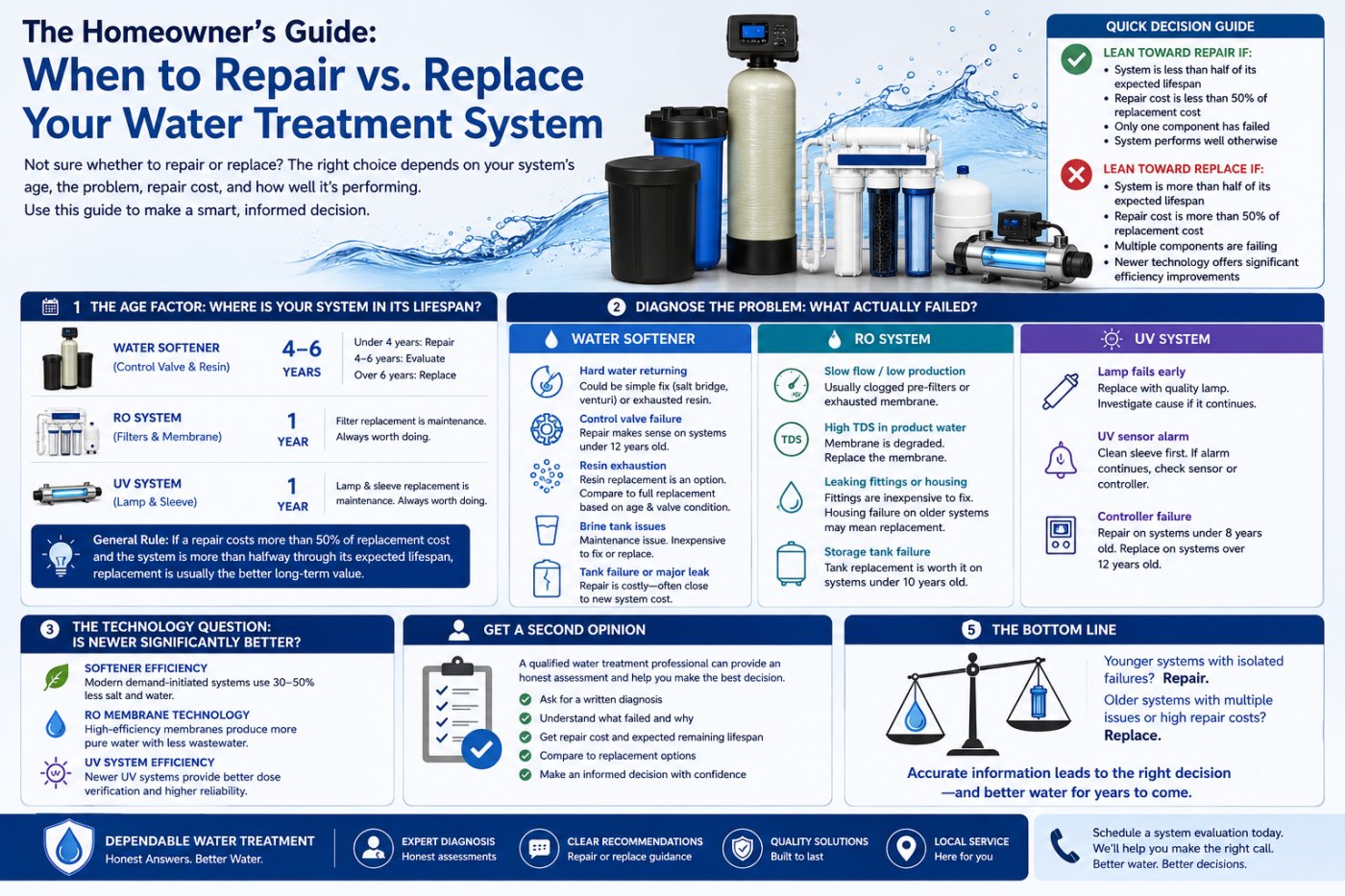
A general rule of thumb across most home systems and appliances: if a repair costs more than 50 percent of the replacement cost and the system is more than halfway through its expected lifespan, replacement is usually the better economic decision. Applied to water treatment:
- Water softener under 8 years old: Repair almost always makes sense unless the damage is catastrophic
- Water softener 8 to 12 years old: Evaluate repair cost vs. replacement cost carefully
- Water softener over 15 years old: Replacement is often the better long-term value, particularly if multiple components are showing wear
- RO system under 5 years old: Filter and membrane replacement is maintenance, not repair — always worth doing
- RO system over 10 years old with housing or component failure: Full system replacement is often comparable in cost to component repair and delivers current technology
- UV system: Lamp and sleeve replacement is always maintenance. Controller or chamber failure on a system over 10 years old points toward replacement
Diagnosing the Problem: What Actually Failed?
The nature of the failure matters as much as the system's age. Some failures are simple, inexpensive fixes. Others indicate systemic wear that will produce further failures in short order.
Water Softener: Common Problems and What They Mean
Hard water returning — salt level fine, softener running: Could be a salt bridge, a clogged venturi valve, a control valve malfunction, or exhausted resin. Diagnosis determines the fix. Salt bridge and venturi cleaning are inexpensive. Control valve repair or replacement is moderate cost. Resin replacement is a significant repair that may warrant comparing to full system replacement depending on age. For troubleshooting steps, see our article on how to tell if your softener has a problem.
Control valve failure: The control valve is the most mechanically complex and most commonly repaired component of a water softener. A quality control valve from a reputable manufacturer can be replaced independently of the rest of the system — the tank, resin, and brine tank may all be in good condition while only the valve needs replacing. Control valve replacement on a system under 12 years old with otherwise sound components is almost always worth doing. On a system over 15 years old with aging resin and other wear, the total repair cost may approach replacement cost.
Resin exhaustion or severe fouling: Resin can be replaced without replacing the entire softener. Resin replacement cost is significant but less than full system replacement. Whether it makes sense depends on the age and condition of the control valve and tank. If the control valve is in good shape and the tank is sound, resin replacement extends useful life substantially. If the control valve is also aging, the combined cost of resin plus eventual valve replacement may exceed new system cost.
Brine tank issues: Salt bridges, salt mushing, and brine tank fouling are maintenance issues that don't indicate system failure. Cleaning or in severe cases replacing the brine tank is inexpensive relative to the value of the rest of the system.
Tank failure or significant leaking: A cracked or failed mineral tank is a more serious situation. Tank replacement is possible but costly, and often brings total repair cost close to new system territory for older softeners.
RO System: Common Problems and What They Mean
Slow flow or low production: Usually indicates clogged pre-filters, an exhausted membrane, or low feed water pressure. Pre-filter replacement is routine maintenance. Membrane replacement is a moderate cost that's almost always worth doing on a system in good overall condition. Check pre-filters first — a clogged pre-filter starves the membrane and causes premature membrane failure.
High TDS in product water: Indicates membrane degradation. As covered in our article on what TDS means for Florida homeowners, rejection rates below 85 percent indicate membrane replacement is needed. Membrane replacement is maintenance — always worth doing on a system that's otherwise functional.
Leaking fittings or housing: Push-fit fittings in RO systems can fail over time, particularly in Florida where temperature fluctuations stress plastic components. Fitting replacement is inexpensive. Housing failure on an older system may indicate it's time to evaluate full replacement.
Storage tank failure: RO storage tanks have a bladder that can fail, causing the tank to fill with water and lose pressure. Tank replacement is moderate cost and worth doing on a system under 10 years old. On an older system, consider whether full replacement makes more sense.
UV System: Common Problems and What They Mean
Lamp failure before annual replacement interval: A UV lamp that's failing significantly before its rated annual lifespan may indicate electrical issues, water quality problems affecting the lamp, or simply a lower-quality lamp. Replace with a quality lamp from the system manufacturer. If premature failures continue, investigate the cause before spending on repeated lamp replacements.
UV sensor alarm: A UV sensor that's alarming despite a new lamp may indicate a fouled quartz sleeve reducing UV transmission, a failing sensor, or a controller issue. Clean the sleeve first — this is the most common cause. If the alarm continues with a new lamp and clean sleeve, controller evaluation is needed.
Controller failure: UV controllers are relatively simple electronic components. Replacement is moderate cost. On a system under 8 years old, controller replacement is worth doing. On a system over 12 years old, evaluate whether the chamber and lamp technology have been superseded by more efficient current systems.
The Technology Question: Is Newer Significantly Better?
Water treatment technology does advance over time, and in some cases replacement delivers meaningful improvements beyond simply fixing a failure.
Water softener efficiency. If your current softener is a timer-based system 15+ years old, replacing it with a modern demand-initiated regeneration system can reduce salt consumption by 30 to 50 percent. Over the life of the new system, the salt savings contribute meaningfully to the economics of replacement.
RO membrane technology. Modern high-efficiency RO membranes produce more purified water per gallon of feed water than older membranes, reducing waste water significantly. If water efficiency matters to you, a modern RO system may deliver meaningful improvement over a 10+ year old design.
UV system efficiency. Modern UV systems with higher-efficiency lamps and better sensors deliver more reliable dose verification than older designs. For well water users for whom biological safety is the primary concern, current UV technology is meaningfully better than designs from 10 to 15 years ago.
Getting a Second Opinion
For any repair vs. replace decision involving significant cost, getting a second opinion from a qualified water treatment professional is worthwhile. A good technician will give you an honest assessment of the system's condition, the likely cost and longevity of repair, and what a replacement would deliver — without steering you toward the higher-revenue option regardless of what's actually best for your situation.
Ask for the diagnosis in writing, including what specifically failed, what the repair involves, and what the expected remaining lifespan of the repaired system is. That information gives you what you need to make an informed comparison against replacement options.
The Bottom Line
Repair vs. replace is rarely a black-and-white decision — it lives in the gray area where system age, failure type, repair cost, replacement cost, and technology improvements all intersect. The framework is straightforward: younger systems with isolated component failures almost always merit repair. Older systems with multiple failing components or repair costs approaching replacement cost increasingly favor replacement. And when current technology offers meaningful efficiency improvements, the replacement calculus shifts further toward new equipment.
What matters most is making the decision with accurate information — a clear diagnosis, honest cost estimates, and a realistic picture of what either path delivers over the next 5 to 10 years.
Dependable Water Treatment provides honest repair vs. replace assessments for Florida homeowners — with clear diagnostics and transparent recommendations. Contact us to schedule a system evaluation.