If you're on a private well in Florida, you're responsible for your own water's safety in a way that municipal water customers aren't. Your utility isn't testing your water, treating it for bacteria, or monitoring it for biological contamination. That responsibility falls entirely on you — and ultraviolet disinfection is one of the most effective and elegant tools available for meeting it.
UV disinfection is chemical-free, highly effective against a broad range of biological contaminants, and leaves no byproducts in your water. Understanding how it works helps you appreciate both its strengths and its limitations — and how it fits into a complete well water treatment system.
What Is Ultraviolet Light?
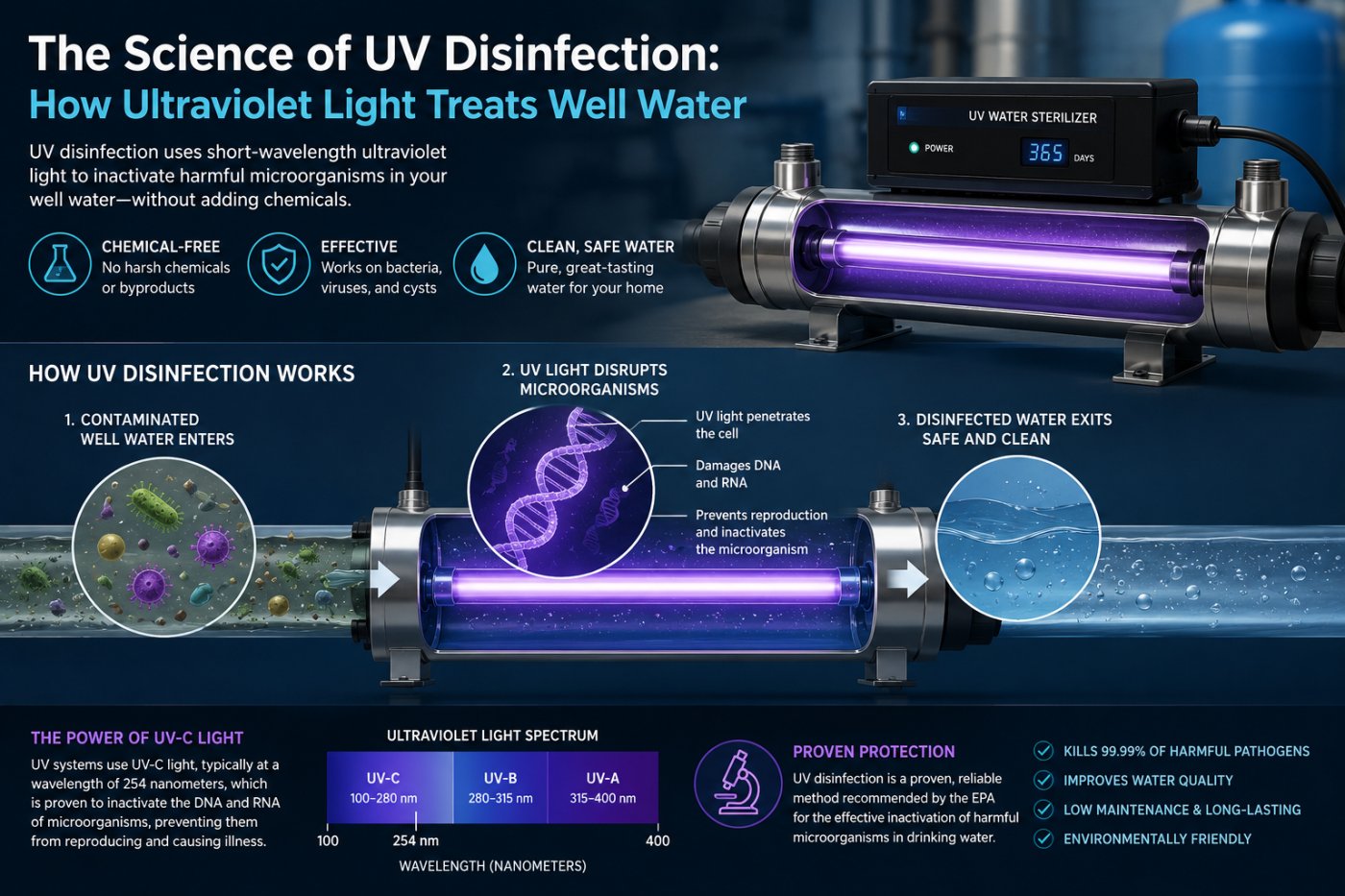
Ultraviolet light is electromagnetic radiation with a wavelength shorter than visible light — between approximately 100 and 400 nanometers. UV light is divided into three ranges:
UV-A (315–400 nm): The range responsible for tanning and some biological effects. Not used for water disinfection.
UV-B (280–315 nm): Causes sunburn and has some germicidal properties. Not the primary range for water treatment.
UV-C (100–280 nm): The germicidal range — highly effective at destroying biological contaminants. UV water disinfection systems operate in the UV-C range, specifically around 254 nanometers, which is the wavelength at which DNA most strongly absorbs UV energy.
How UV Disinfection Works
UV disinfection works by exposing water to UV-C light as it flows through a treatment chamber. The mechanism is not chemical — it's physical. UV-C radiation at 254 nanometers is absorbed by the DNA and RNA of microorganisms, including bacteria, viruses, and protozoa.
When a microorganism's DNA absorbs sufficient UV energy, it forms thymine dimers — abnormal bonds between adjacent thymine bases in the DNA strand. These bonds disrupt the DNA's structure, preventing the microorganism from replicating. A microorganism that cannot replicate cannot cause infection — it's effectively neutralized, even if it remains physically present in the water.
This is a critical distinction: UV disinfection doesn't remove microorganisms from the water. It renders them unable to reproduce and therefore unable to cause illness. The inactivated organisms remain in the water but pose no biological threat.
What UV Disinfection Is Effective Against
UV-C radiation at the appropriate dose is effective against a remarkably broad range of biological contaminants:
- Bacteria — including E. coli, coliform bacteria, Salmonella, Legionella, and many others. UV is highly effective against most bacteria at standard residential doses.
- Viruses — including norovirus, hepatitis A, and many others. UV is effective against most viruses, though some require higher doses than bacteria.
- Protozoa — including Giardia and Cryptosporidium, which are notably resistant to chlorine disinfection. UV is highly effective against both, making it superior to chlorine for these specific pathogens.
- Algae and mold spores — UV is effective at controlling these biological contaminants as well.
The effectiveness of UV disinfection against Giardia and Cryptosporidium is particularly significant for Florida well water users. These protozoa form cysts that are highly resistant to chlorine at typical treatment doses — but are effectively inactivated by UV light at standard residential doses. For well water with any risk of protozoan contamination, UV disinfection provides protection that chlorination alone does not.
The UV Dose: How Much Light Is Enough?
UV disinfection effectiveness is determined by dose — the amount of UV energy delivered to the water, expressed in millijoules per square centimeter (mJ/cm²). The required dose varies by target organism:
- Most bacteria: 10 mJ/cm² provides greater than 99.99% inactivation
- Most viruses: 30 to 40 mJ/cm² for high-level inactivation
- Giardia and Cryptosporidium: 10 mJ/cm² provides greater than 99.9% inactivation
Residential UV systems are typically rated to deliver a minimum dose of 40 mJ/cm² at their rated flow rate — providing effective inactivation of the full range of biological contaminants at normal household water flow rates. The NSF/ANSI 55 standard for UV systems requires a minimum dose of 40 mJ/cm² for Class A systems (those designed to treat water with potential biological contamination).
Dose delivery depends on two factors: the intensity of the UV lamp and the exposure time (which is determined by flow rate and chamber design). A system operating above its rated flow rate delivers less UV dose per unit of water — potentially reducing effectiveness. Proper sizing relative to your household's peak flow rate is essential.
What UV Disinfection Does Not Do
UV disinfection is powerful against biological contaminants — but it has clear limitations that make it one component of a complete treatment system rather than a standalone solution:
It does not remove any contaminants from the water. UV inactivates biological organisms but does not physically remove them, nor does it remove any chemical contaminants, minerals, or dissolved substances. Hardness, iron, sulfur, nitrates, and all other non-biological water quality issues are completely unaffected by UV treatment.
It requires clear water to be effective. This is one of the most important practical limitations of UV disinfection. UV light must penetrate the water to reach and inactivate microorganisms. If the water is turbid (cloudy with suspended particles), colored (from iron, tannins, or other compounds), or high in dissolved minerals that absorb UV light, the effective dose delivered to the water is reduced. Iron in particular — common in Florida well water — strongly absorbs UV light and can dramatically reduce disinfection effectiveness.
This is why UV disinfection must always be the last stage in a well water treatment system — installed after sediment filtration, iron removal, and any other treatment that addresses turbidity and UV-absorbing compounds. Water entering the UV chamber must be clear and low in UV-absorbing substances for the system to perform correctly.
It provides no residual protection. Unlike chlorine, which remains in the water after treatment and continues killing microorganisms as water travels through your plumbing, UV provides no ongoing protection after the water passes through the chamber. If a microorganism enters the water downstream of the UV system — through a plumbing defect, a contaminated faucet, or cross-contamination — UV will not address it.
UV System Components and Maintenance
A residential UV disinfection system consists of a few key components:
UV lamp. A low-pressure mercury vapor lamp that produces UV-C radiation at 254 nanometers. The lamp is housed inside a protective quartz sleeve that allows UV light to pass through while keeping the lamp dry. UV lamps degrade over time — their UV output decreases even as they continue to emit visible light. A lamp that looks operational may no longer be delivering adequate UV dose. Most residential UV lamps should be replaced annually regardless of whether they appear to be functioning.
Quartz sleeve. The protective sleeve around the UV lamp must be kept clean to allow maximum UV transmission. Mineral deposits, iron fouling, or biofilm on the quartz sleeve reduce UV transmission and therefore reduce effective dose delivery. The sleeve should be cleaned periodically — typically when the lamp is replaced — and replaced every few years.
Controller and UV sensor. Quality UV systems include a UV intensity sensor that monitors actual UV output and alerts when levels drop below the effective threshold. This provides real-time assurance that the system is delivering adequate dose rather than assuming based on the lamp's age alone.
Annual maintenance. Replace the UV lamp every 12 months. Clean or replace the quartz sleeve. Verify the system is properly sized for current household flow rate. These simple steps ensure continuous, reliable biological protection.
Where UV Fits in a Florida Well Water System
For Florida homeowners on private wells, UV disinfection is typically the final stage in a complete treatment train — positioned after all other treatment to ensure the water entering the UV chamber is clear and free of UV-absorbing substances.
A complete Florida well water treatment system might look like this:
- Sediment pre-filter — removes physical particles that could shield microorganisms from UV light
- Iron filter / air injection system — removes iron and manganese that absorb UV light and cause staining. See our article on why Florida well water turns toilets orange for more on iron treatment.
- Water softener — removes hardness minerals. See our article on how ion exchange water softening works.
- Carbon filter — addresses sulfur odor and any remaining taste or odor compounds
- UV disinfection — final stage, providing biological protection for fully pre-treated, clear water
This layered approach ensures that each stage's effectiveness is maximized and that the UV system receives water in the condition it needs to perform correctly.
UV vs. Chlorination for Well Water
Chlorination is the other primary disinfection option for well water. Both have legitimate applications, and the right choice depends on your specific situation:
UV advantages over chlorination: No chemicals to handle or store. No disinfection byproducts (THMs, HAAs) formed. Highly effective against Giardia and Cryptosporidium. Doesn't affect water taste or odor. Lower ongoing operating cost.
Chlorination advantages over UV: Provides residual protection throughout the plumbing system. Can address iron bacteria and biofilm in the well and distribution system. May be more appropriate for wells with confirmed bacterial contamination requiring shock treatment.
For many Florida well water homes without a history of bacterial contamination but wanting reliable ongoing biological protection, UV is the preferred choice. For wells with confirmed bacterial issues, iron bacteria, or biofilm problems, chlorination — potentially in combination with UV — may be the more comprehensive approach.
The Bottom Line
UV disinfection is one of the most effective and elegant water treatment technologies available — chemical-free, highly effective against a broad spectrum of biological contaminants, and completely free of disinfection byproducts. For Florida homeowners on private wells, it provides the biological safety layer that well water lacks by default.
Its effectiveness depends on proper installation as the final stage of a complete treatment system, annual lamp replacement, and correct sizing for household flow rate. Within those parameters, it delivers reliable, continuous biological protection that gives well water users genuine peace of mind about the safety of their water.
Dependable Water Treatment designs and installs complete well water treatment systems for Florida homeowners — including UV disinfection properly positioned and sized for your specific water conditions. Contact us to schedule a water test and find out what your well water needs.