If you've ever used a water testing pen — the kind that gives you a number in seconds when you dip it in water — you've measured TDS. Total dissolved solids is one of the most commonly referenced water quality measurements, and also one of the most misunderstood. A high TDS reading gets people alarmed. A low TDS reading gets marketed as a sign of purity. The reality is more nuanced than either reaction suggests.
What Are Total Dissolved Solids?
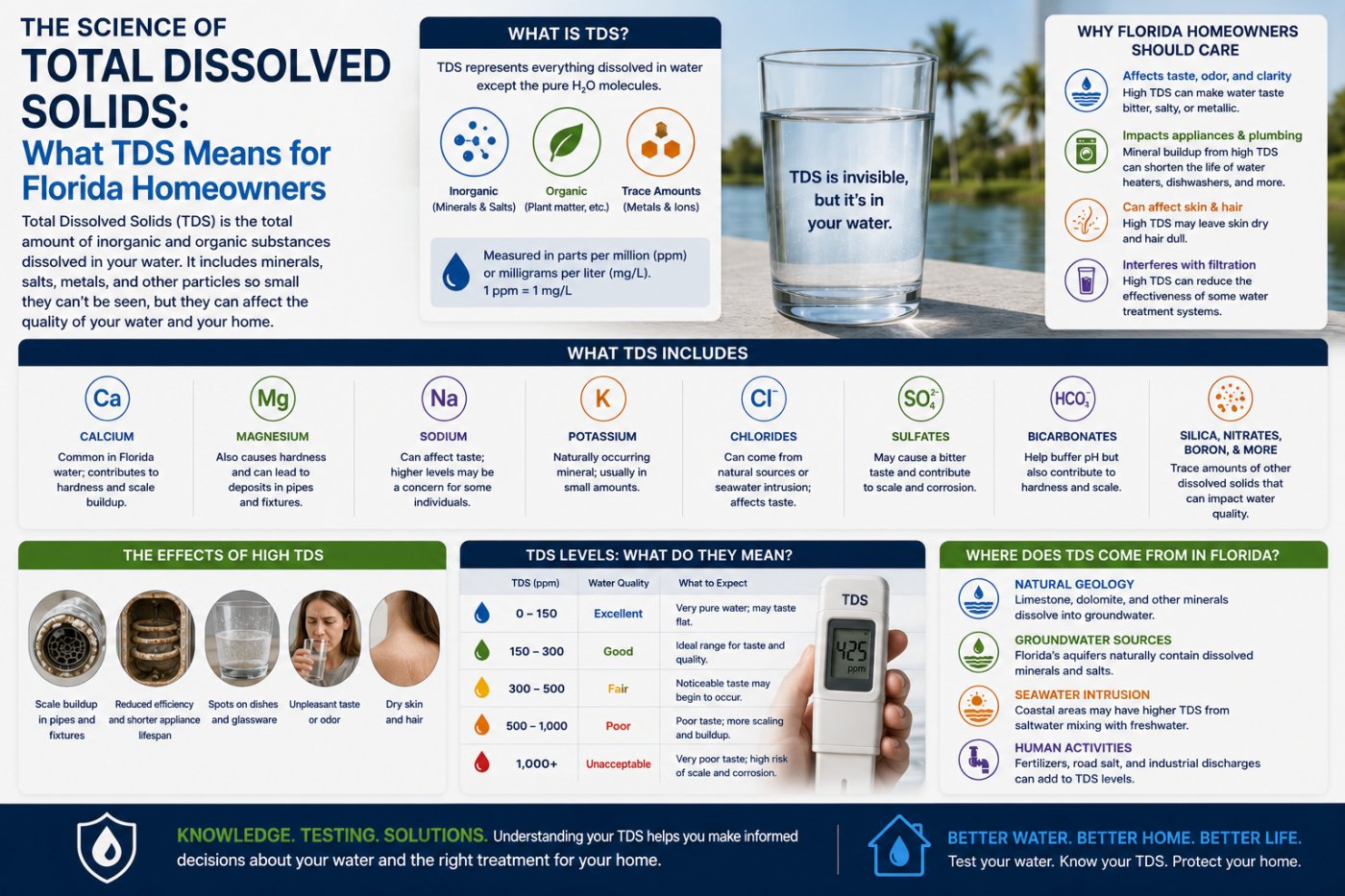
Total dissolved solids — TDS — is a measure of the combined concentration of all inorganic and organic substances dissolved in water. The "solids" in question aren't visible particles you can see or filter out with a standard filter. They're substances that have fully dissolved into the water at a molecular level — minerals, salts, metals, and other compounds that can only be separated from the water through processes like reverse osmosis or distillation.
TDS is expressed in parts per million (PPM) or milligrams per liter (mg/L) — they mean the same thing. A TDS reading of 300 PPM means there are 300 milligrams of dissolved substances in every liter of water.
What Makes Up TDS in Florida Water?
In Florida residential water, TDS is typically composed of:
Hardness minerals. Calcium and magnesium — the minerals responsible for hard water — are usually the largest contributors to TDS in Florida groundwater. As covered in our article on what hard water is and how it forms, Florida's limestone geology dissolves significant amounts of these minerals into the water supply.
Bicarbonates and carbonates. The alkalinity compounds naturally present in Florida groundwater contribute substantially to TDS.
Sodium. Present naturally in some Florida water sources, and added in small amounts by a water softener during the ion exchange process.
Chlorides and sulfates. Naturally occurring minerals that contribute to TDS without typically causing specific problems at normal concentrations.
Iron and manganese. In Florida well water, dissolved iron and manganese add to TDS and cause the staining and other problems covered in our article on what iron in water does to your home.
Disinfection byproducts and treatment chemicals. For municipal water users, chlorine, chloramines, and their byproducts contribute to TDS along with any other chemicals added during treatment.
Organic compounds. Naturally occurring organic matter — tannins from vegetation, humic acids — can contribute to TDS particularly in shallow wells and surface water sources.
What TDS Tells You — and What It Doesn't
TDS is a broad indicator, not a specific diagnostic tool. This is the most important thing to understand about it.
A high TDS reading tells you there's a lot of stuff dissolved in your water. It doesn't tell you what that stuff is. High TDS from calcium and magnesium — hard water — is a very different situation from high TDS from nitrates or heavy metals. The number is the same; the implications are completely different.
Similarly, a low TDS reading doesn't mean your water is safe or problem-free. Water can have low TDS and still contain bacteria, low-level chemical contaminants, or have a problematic pH. TDS meters don't detect biological contamination at all.
This is why TDS is best understood as one data point within a comprehensive water test — useful for what it indicates, but not a substitute for testing specific parameters individually.
TDS and Water Taste
There is a relationship between TDS and water taste, though it's not as straightforward as "lower TDS = better taste."
The World Health Organization's guidelines suggest that water with TDS below 300 PPM is generally considered excellent tasting, 300 to 600 PPM is good, 600 to 900 PPM is fair, and above 1,200 PPM becomes increasingly unpalatable for most people.
However, what's dissolved in the water matters as much as how much. Water with moderate TDS primarily from calcium and magnesium may taste clean and pleasant — some people prefer the mineral taste of moderately hard water over pure, near-zero TDS water from distillation or RO. Water with similar TDS from chloramines or sulfates may taste noticeably worse.
The "TDS equals taste quality" equation is a simplification that the bottled water industry has used effectively in marketing — but it's not a complete picture.
TDS and Your Water Treatment System
TDS interacts with your water treatment system in several important ways.
Water softeners and TDS. A water softener doesn't significantly reduce TDS — it replaces calcium and magnesium ions with sodium ions. Since sodium has a lower atomic weight than calcium and magnesium, softening actually reduces TDS slightly, but the change is modest. If you measure TDS before and after a water softener, you'll see a small decrease — not the dramatic reduction some people expect.
Reverse osmosis and TDS. RO is the most effective consumer-level technology for reducing TDS. A properly functioning RO system removes 90 to 99 percent of dissolved solids, producing water with very low TDS — typically 10 to 50 PPM depending on source water and membrane quality.
TDS measurement is actually the most practical way to monitor RO membrane performance. Testing TDS before the RO membrane and after it tells you the rejection rate — the percentage of dissolved solids being removed. A new, high-quality membrane might achieve 97 to 99 percent rejection. As membranes age and wear, rejection rates decline. When TDS rejection drops below 85 to 90 percent, membrane replacement is typically recommended.
This makes a simple TDS meter an inexpensive and effective tool for ongoing RO system monitoring — a test that takes seconds and tells you whether your membrane is performing correctly.
Carbon filtration and TDS. Carbon filters remove chlorine, chloramines, and certain organic compounds — but they don't remove dissolved minerals. A carbon filter has minimal effect on TDS. If you measure TDS before and after a carbon filter, the readings will be nearly identical even if the filter is working perfectly.
This is an important point: a carbon filter can dramatically improve water taste and remove chemical contaminants while leaving TDS unchanged. TDS alone doesn't tell you whether a carbon filter is working.
What Is a Good TDS Level for Florida Water?
The EPA's secondary standard for TDS in drinking water is 500 PPM. This is a secondary standard — meaning it's based on aesthetic concerns (taste, odor, appearance) rather than health effects. Water above 500 PPM may have a noticeable mineral taste, and very high TDS can indicate elevated concentrations of specific minerals worth investigating.
For Florida homeowners, typical TDS values vary significantly by location and source:
- Municipal water in Central Florida: often 200 to 500 PPM
- Well water in hard water areas: often 300 to 700+ PPM
- Well water near coastal areas: can be higher due to saltwater influence on the aquifer
- After RO treatment: typically 10 to 50 PPM
- After water softening only: similar to source water, slightly reduced
If your TDS is significantly above 500 PPM, it's worth investigating what's contributing to the elevated reading — a comprehensive water test will tell you whether it's primarily hardness, specific minerals of concern, or other factors.
Using a TDS Meter at Home
TDS meters are inexpensive — typically $10 to $30 — and easy to use. They provide a useful quick check on water quality, particularly for monitoring RO system performance. However, they have clear limitations:
- They measure total dissolved solids, not specific contaminants
- They don't detect bacteria, viruses, or biological contamination
- They can't distinguish between harmless minerals and harmful contaminants
- They don't replace comprehensive water testing for treatment decisions
A TDS meter is a useful tool in the right context — as a monitoring device for an existing treatment system, or as a first indicator that something may have changed in your water quality. It's not a substitute for professional water testing when making treatment decisions.
The Bottom Line
TDS is a useful but limited water quality measurement. It tells you how much is dissolved in your water — not what it is, whether it's harmful, or what to do about it. High TDS in Florida water is often primarily from hardness minerals, which a water softener addresses effectively. Very high TDS from multiple sources may warrant reverse osmosis treatment for drinking water specifically.
Understanding TDS as one piece of a larger water chemistry picture — alongside hardness, pH, iron, bacteria, and other parameters — is what allows you to make informed decisions about water treatment rather than reacting to a single number out of context.
Dependable Water Treatment offers comprehensive water testing for Florida homeowners — measuring TDS alongside all the parameters that actually determine what treatment your home needs. Contact us to schedule a water test.