
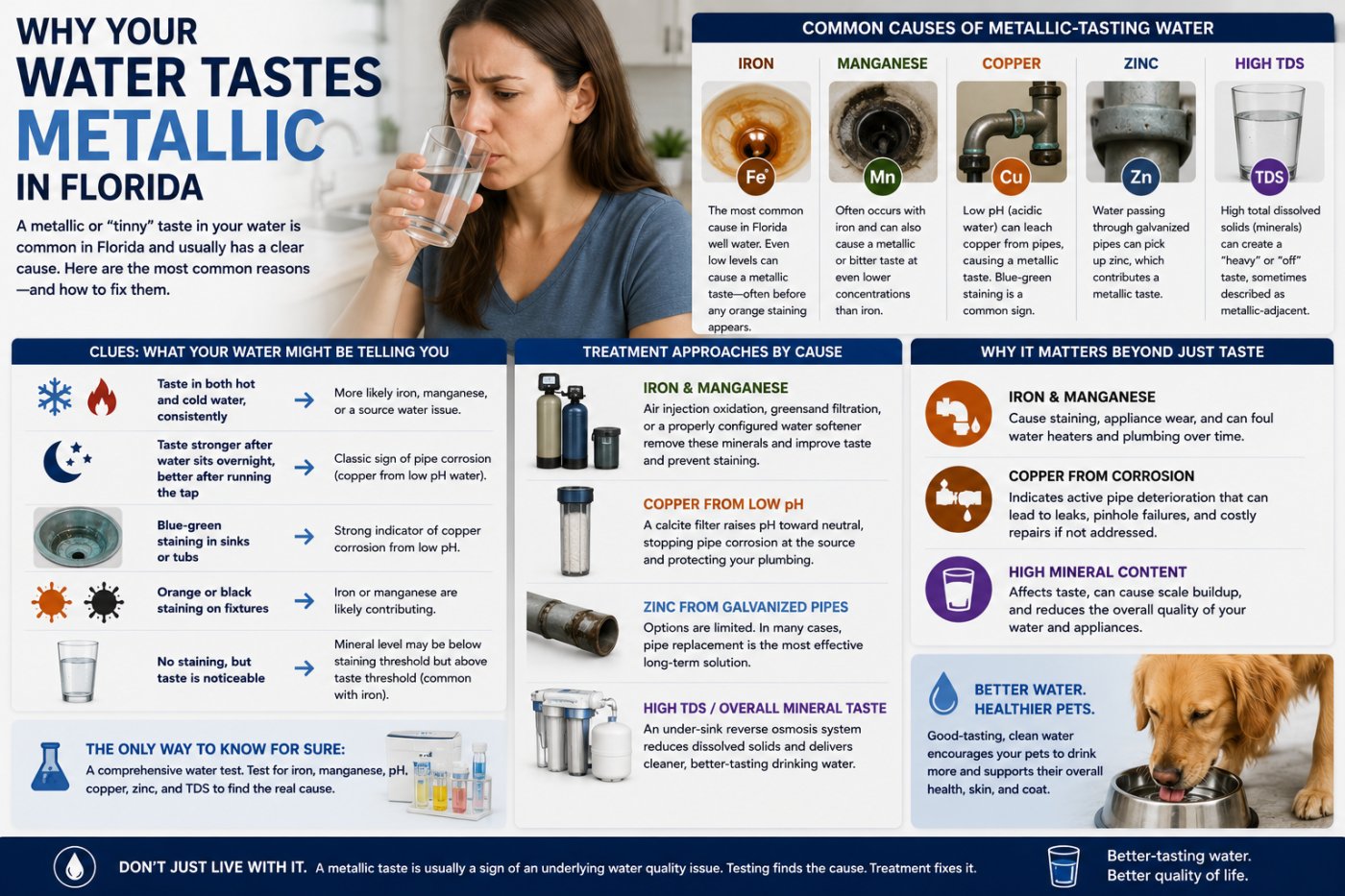
You fill a glass of water, take a sip, and immediately notice something off — a distinct metallic or "tinny" taste that lingers after you swallow. It's an unmistakable and unpleasant sensation, and if you've experienced it in your Florida home, you're far from alone. Metallic-tasting water has several possible causes, and identifying the right one is the key to actually fixing it.
Iron: The Most Common Culprit
In Florida — particularly for well water users — dissolved iron is the most frequent cause of metallic-tasting water. As covered in our article on what iron in water does to your home, iron is extremely common in Florida groundwater due to the state's geology.
Even at concentrations well below the level that would cause visible orange staining, dissolved iron can produce a noticeable metallic taste. The taste threshold for iron in water is lower than the staining threshold — meaning your water can taste metallic from iron content well before you'd notice any orange discoloration on fixtures. This is one of the more common water quality surprises for well owners: a comprehensive water test shows iron present, but the homeowner had no idea because there was no visible staining, only an unexplained metallic taste they'd been living with.
Manganese: A Related but Distinct Cause
As covered in our article on the difference between iron and manganese in well water, manganese often travels alongside iron in Florida groundwater and can also contribute a metallic or bitter taste, becoming noticeable at even lower concentrations than iron due to its lower taste and odor threshold.
Copper From Corroded Pipes
If your water has low pH — meaning it's acidic — it can be corrosive enough to leach copper from your home's copper pipes and fittings, producing a distinctly metallic taste that's sometimes described as tasting like blood or pennies, a description that makes sense given that copper is the actual source. As covered in our article on why water pH matters for your home, acidic well water is a genuine concern in parts of Florida, and copper leaching is one of its most direct and noticeable consequences.
If you also notice blue-green staining in your sinks, tubs, or around drains, this is a strong confirming sign that copper corrosion from low pH water is contributing to a metallic taste, since that staining is caused by the same corroded copper being deposited on surfaces.
Zinc
Zinc, sometimes present in water that has passed through galvanized pipes (older piping with a zinc coating designed to prevent rust), can also contribute a metallic taste. Galvanized pipes are less common in newer Florida construction but can still be found in older homes, particularly those built several decades ago before copper and modern plastic piping became standard.
High Total Dissolved Solids
As covered in our article on what TDS means for Florida homeowners, a high overall concentration of dissolved minerals can contribute to an unpleasant, sometimes metallic-adjacent taste even when no single mineral is present at a problematic level individually. This is more of a general "heavy" or "off" mineral taste than a sharp metallic one, but it's worth considering as part of the full picture, particularly in areas with naturally high TDS groundwater.
How to Narrow Down the Cause
Because several different factors can produce a similar metallic taste sensation, distinguishing between them by taste alone is difficult and not reliable. A comprehensive water test — one that includes iron, manganese, pH, copper, zinc, and TDS — is the only way to identify which specific factor, or combination of factors, is responsible for your particular situation.
A few observational clues can help you form a hypothesis before testing, though testing should always confirm the actual cause:
- Taste is present in both hot and cold water, consistently: more likely points to iron, manganese, or a source water issue rather than pipe corrosion, which sometimes shows more prominently in water that's been sitting in contact with pipes overnight.
- Taste is stronger after water has been sitting overnight, or first thing in the morning, and less noticeable after running the tap for a minute: this pattern is a classic sign of pipe corrosion, since water in contact with corroded copper pipe overnight picks up more dissolved copper than fresh water flowing through.
- Blue-green staining present in sinks or tubs: strongly suggests copper corrosion from low pH is at least part of the picture.
- Orange or black staining present on fixtures: suggests iron or manganese are contributing, alongside the metallic taste.
- No staining at all, but taste is noticeable: suggests the mineral concentration may be below the staining threshold but above the taste threshold, which as noted above is common with iron specifically.
Treatment Approaches by Cause
For iron and manganese: Depending on concentration and form, treatment ranges from a properly configured water softener for lower levels of dissolved iron, to dedicated air injection oxidation or greensand filtration for higher concentrations or when manganese is significantly present. As covered in our article on what the best treatment setup for Florida well water looks like, this is typically addressed as one stage within a broader well water treatment system.
For copper from acidic water: A pH neutralizer, typically a calcite filter, raises your water's pH toward neutral, stopping the ongoing corrosion process at its source rather than just addressing symptoms. This not only resolves the metallic taste but also protects your pipes from further deterioration, which has its own long-term value beyond the taste issue alone.
For zinc from galvanized pipes: Unfortunately, treatment options are more limited when the source is the pipe material itself rather than the water chemistry. In some cases, pipe replacement is the most effective long-term solution, particularly if the galvanized piping is aging and showing other signs of deterioration, such as declining water pressure from internal corrosion buildup.
For high TDS contributing to an overall metallic or heavy taste: An under-sink reverse osmosis system, as covered in our article on how reverse osmosis works, is highly effective at reducing overall dissolved solids and producing noticeably cleaner-tasting drinking water regardless of which specific minerals are contributing to the taste.
Why Addressing the Taste Matters Beyond Just Taste
A metallic taste is rarely just a cosmetic annoyance — it's usually a signal pointing toward an underlying water quality issue that has other implications beyond taste alone. Iron and manganese, as covered in their dedicated articles, cause staining and appliance wear even at levels too low to notice by taste alone in some cases, while at levels high enough to taste, staining is often already occurring or will develop over time. Copper from corroded pipes indicates active pipe deterioration that will continue and potentially worsen without pH correction, eventually leading to more serious plumbing problems like pinhole leaks.
In other words, a metallic taste is often your water quite literally telling you something worth investigating further, even before more visible problems develop.
The Bottom Line
Metallic-tasting water in Florida most commonly traces back to iron, manganese, or copper from corroded pipes due to low pH — with high overall mineral content sometimes contributing a related but distinct "heavy" taste. Because these causes require different treatment approaches, a comprehensive water test is the necessary first step to identify what's actually happening in your specific home before choosing a solution.
If your water has been tasting metallic and you've been simply living with it, that taste is worth investigating — both for the immediate improvement in your daily water experience and for what it might reveal about your home's water quality and plumbing condition more broadly.
Dependable Water Treatment tests Florida water for iron, manganese, pH, and other factors that cause metallic taste. Contact us to find out what's actually causing your water's taste and how to fix it.