Reverse osmosis is the gold standard for drinking water purification at the household level. It removes a broader range of contaminants than any other consumer water treatment technology — including many things that carbon filters and water softeners leave behind. But how does it actually work? And why does a process called "reverse osmosis" produce such exceptionally pure water?
The science behind RO is straightforward once you understand the concept it's built on — and understanding it helps you make better decisions about whether an RO system is right for your Florida home and how to maintain it properly.
What Is Osmosis?
To understand reverse osmosis, you first need to understand regular osmosis — the natural process that RO reverses.
Osmosis is a naturally occurring phenomenon in which water moves through a semipermeable membrane from an area of low solute concentration to an area of high solute concentration. A semipermeable membrane is a barrier that allows water molecules to pass through but blocks dissolved substances — solutes — from crossing.
The driving force behind osmosis is osmotic pressure — the natural tendency of solutions to equalize their concentration across a membrane. If you have pure water on one side of a semipermeable membrane and salt water on the other, water molecules naturally migrate from the pure water side to the salt water side, diluting the salt water and equalizing the concentration difference. This is osmosis.
You can observe osmosis in everyday life — it's the process by which plant roots absorb water from soil, and why cells in your body regulate their water content.
What Is Reverse Osmosis?
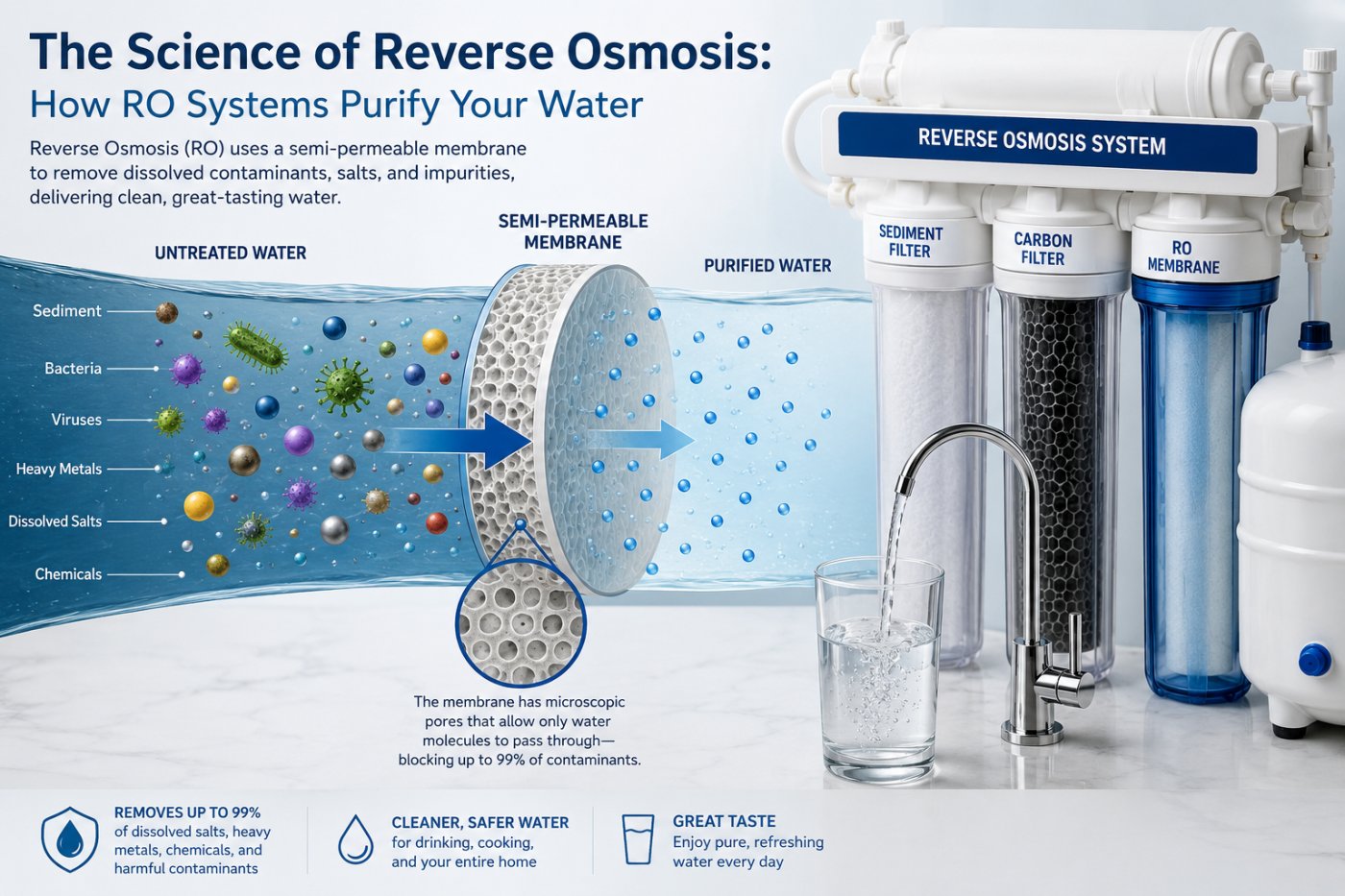
Reverse osmosis, as the name suggests, reverses this natural process. Instead of allowing water to flow naturally from low concentration to high concentration, RO uses applied pressure to force water from the high concentration (contaminated) side of the membrane to the low concentration (purified) side.
In practical terms: your household water pressure — typically 40 to 80 PSI in a Florida home — pushes water against the RO membrane. The membrane's pores are extraordinarily small — approximately 0.0001 microns, or about 1/100,000th the diameter of a human hair. Water molecules are small enough to pass through these pores under pressure. The dissolved contaminants — minerals, salts, metals, chemicals, and most other substances — are too large to fit through and are left behind.
The water that passes through the membrane is collected as purified permeate — your drinking water. The concentrated solution of contaminants that doesn't pass through is flushed away as reject water, or brine, down the drain.
The Stages of a Residential RO System
A residential reverse osmosis system is not just a single membrane — it's a multi-stage treatment process, with each stage addressing different aspects of water quality. A typical under-sink RO system for a Florida home includes:
Stage 1 — Sediment pre-filter. The first stage removes physical particles — sand, silt, rust, and debris — that could clog or damage the RO membrane. This is a mechanical filter, typically rated at 5 microns, that protects everything downstream.
Stage 2 — Carbon pre-filter. Before water reaches the RO membrane, a carbon filter removes chlorine and chloramines. This is a critical protective step — chlorine and chloramines degrade RO membranes over time, significantly shortening their lifespan. The carbon pre-filter protects the membrane and extends its life. For Florida homes on municipal water with chloramines, a catalytic carbon pre-filter is the appropriate choice, as covered in our article on how activated carbon filtration works.
Stage 3 — RO membrane. The heart of the system. Water is forced through the semipermeable membrane under pressure, removing 90 to 99 percent of dissolved contaminants. The purified water is directed to the storage tank; the concentrated reject water goes down the drain.
Stage 4 — Storage tank. Because RO membranes produce purified water slowly — typically 50 to 100 gallons per day for a residential system — purified water is stored in a pressurized tank so it's available on demand when you turn on the tap.
Stage 5 — Post-carbon polishing filter. As a final step, water from the storage tank passes through a carbon polishing filter before reaching your tap. This removes any residual taste or odor that may have developed during storage, ensuring the water tastes as clean as it actually is.
Optional Stage — Remineralization filter. Some RO systems include a remineralization stage that adds back a controlled amount of calcium, magnesium, and other minerals after the membrane, improving taste and addressing concerns about very low mineral content in RO water. For more on this topic, see our article on the myth that RO water is bad for you because it removes minerals.
What Reverse Osmosis Removes
The RO membrane's extraordinarily small pore size allows it to reject a broader range of contaminants than virtually any other consumer treatment technology:
- Dissolved minerals — calcium, magnesium, sodium, and other minerals that contribute to hardness and TDS
- Heavy metals — lead, arsenic, mercury, chromium, and others
- Nitrates — a particular concern for infants and in agricultural areas of Florida
- PFAS (forever chemicals) — increasingly detected in Florida water sources, RO is one of the most effective treatments available
- Fluoride — removed at high rates by RO membranes
- Chlorine and chloramines — addressed primarily by the carbon pre-filter, with additional removal at the membrane
- Bacteria and some viruses — the membrane's small pore size physically blocks most biological contaminants, though RO is not typically relied upon as the sole disinfection method
- Pharmaceuticals and emerging contaminants — RO removes a broad range of trace compounds that other treatment methods may leave behind
- Sodium — including the sodium added by a water softener, making RO the ideal complement to a whole-house softener for drinking water
A properly functioning RO system typically achieves 90 to 99 percent rejection of dissolved contaminants — producing water with very low total dissolved solids, typically 10 to 50 PPM from source water that may be 300 to 600 PPM or higher.
What Reverse Osmosis Does Not Remove
While RO is the most comprehensive consumer water treatment technology, it has limitations:
- Dissolved gases — gases like carbon dioxide, radon, and hydrogen sulfide can pass through RO membranes because their molecules are small enough. Carbon pre-filtration addresses hydrogen sulfide at lower concentrations; additional treatment may be needed for dissolved gas concerns.
- Some pesticides and VOCs — certain organic compounds with very small molecular size may pass through RO membranes to some degree. The carbon pre-filter addresses many of these before they reach the membrane.
- Bacteria and viruses completely — while RO removes most biological contaminants, it's not certified as a disinfection device. For well water with confirmed bacterial contamination, UV disinfection should be included in the treatment system.
Reject Water: Understanding RO Efficiency
One aspect of RO systems that surprises homeowners is the reject water — the concentrated brine that doesn't pass through the membrane and goes down the drain. For every gallon of purified water produced, a traditional RO system may send 2 to 4 gallons of reject water to the drain.
This efficiency ratio — expressed as recovery rate — varies by system design, water pressure, temperature, and source water quality. Modern high-efficiency RO systems have improved recovery rates significantly, with some achieving 1:1 ratios or better. Permeate pump systems, which use the energy in the reject water to boost feed pressure, can dramatically improve efficiency and reduce waste water.
For Florida homeowners concerned about water efficiency, selecting a high-efficiency RO system with a permeate pump is worth the additional investment.
Monitoring RO Performance: The TDS Test
The most practical way to monitor your RO system's performance over time is to measure TDS before and after the membrane. A simple TDS meter — inexpensive and easy to use — gives you the rejection rate: the percentage of dissolved solids being removed.
A new, high-quality RO membrane typically achieves 95 to 99 percent TDS rejection. As the membrane ages, rejection rates gradually decline. When TDS rejection drops below 85 to 90 percent consistently, membrane replacement is indicated. As covered in our article on what TDS means for Florida homeowners, a TDS meter is an inexpensive and effective tool for ongoing RO system monitoring.
RO in a Complete Florida Home Water Treatment System
An under-sink RO system works most effectively as part of a layered treatment approach for a Florida home — not as a standalone solution for all water quality issues.
The most comprehensive setup for a Florida home on municipal water combines:
- A whole-house water softener to remove hardness throughout the home — protecting appliances, plumbing, and improving skin, hair, and laundry
- A whole-house catalytic carbon filter to remove chloramines and chemical contaminants from all household water
- An under-sink RO system at the kitchen tap for drinking and cooking water — removing sodium from the softener, nitrates, heavy metals, PFAS, and anything else the upstream systems leave behind
This layered approach addresses every water quality concern Florida homeowners face — at the whole-house level and at the point of consumption. For a detailed look at why the whole-house components are necessary alongside RO, see our article on why some Florida homes need both a softener and carbon filter.
The Bottom Line
Reverse osmosis works by forcing water through a semipermeable membrane under pressure, leaving dissolved contaminants behind. The result is water with exceptionally low TDS and a broad range of contaminants removed — making it the most comprehensive drinking water purification technology available at the residential level.
For Florida homeowners dealing with hard water, chloramines, nitrates, PFAS, or simply wanting the cleanest possible drinking water, an RO system at the kitchen sink — paired with appropriate whole-house treatment — delivers water quality that rivals or exceeds the best bottled water, at a fraction of the ongoing cost.
Dependable Water Treatment installs reverse osmosis systems and complete whole-house water treatment for Florida homeowners. Contact us to find out what your water needs and build the right system for your home.