If your home has a water softener — or if you've just moved into a home that has one — knowing whether it's actually working is more important than most people realize. A water softener that isn't performing correctly gives you a false sense of security. You think your water is being treated. It isn't. And the whole time, hard water is running through your plumbing, scaling your appliances, and doing the same damage it would do in a home with no treatment at all.
The tricky part is that a failing water softener doesn't announce itself. It doesn't beep, flash an error code, or stop running. It just quietly stops softening — and the signs show up slowly around your home before most people connect them back to the softener.
Here's how to tell if your water softener has a problem.
The Most Obvious Sign: Hard Water Symptoms Coming Back
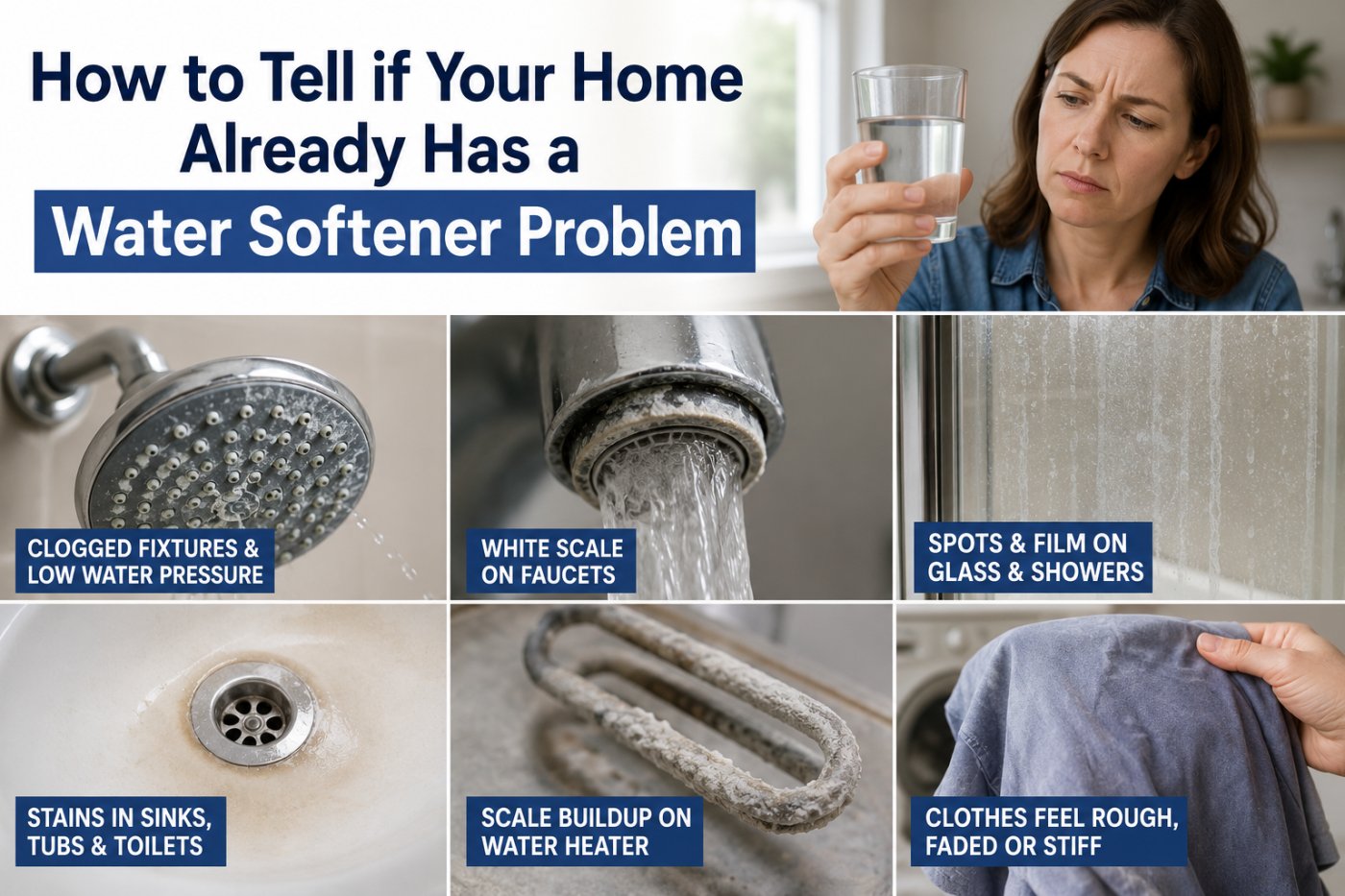
If your water softener is working correctly, you should have essentially zero hard water symptoms throughout your home. If any of the following are returning or getting worse, your softener may not be doing its job:
- White, chalky buildup reappearing on faucets, showerheads, and fixtures
- Spots on dishes and glassware after the dishwasher
- Laundry feeling stiff or looking dull after washing
- Soap and shampoo not lathering the way they used to
- Dry, itchy skin after showering
- Scale building up inside your kettle or coffee maker
Any one of these could indicate a performance problem. Multiple symptoms appearing at once is a strong signal that your softener needs attention.
Check the Salt Level
The most common reason a water softener stops working is simple: it ran out of salt. Without salt, the resin bed can't regenerate, the ion exchange process stops, and hard water flows straight through the system untreated.
Open your brine tank and look inside. The salt level should be at least halfway up the tank. If it's low or empty, refill it — but don't stop there. Find out why it ran out. Did you just forget to check it, or has the salt level not been dropping at all despite normal water use?
Salt level not dropping is actually a warning sign in itself. If the salt level hasn't changed in weeks despite normal household water use, your softener may not be regenerating — which means it's not using salt because it's not cycling properly.
Look for a Salt Bridge
As mentioned in our softener maintenance article, a salt bridge is a hardened crust that forms across the top of the salt in the brine tank. It creates a hollow space underneath, so the softener appears to have salt but the salt can't dissolve into brine solution for regeneration.
To check for a salt bridge, press down firmly on the surface of the salt with a broom handle. If it feels solid at the top but hollow beneath — or if it breaks through with pressure — you have a salt bridge. Breaking it up and ensuring the salt below is loose and free-flowing is the fix.
Do a Simple Soap Test
One of the quickest ways to check if your softened water is actually soft is a basic soap test.
Take a clean, clear bottle and fill it about one-third full with water from a tap in your home. Add a few drops of pure liquid soap — not detergent, which is formulated to work in hard water and won't give you an accurate result. Shake the bottle vigorously for a few seconds.
Soft water will produce a rich, fluffy lather that fills the upper portion of the bottle, with clear water below.
Hard water will produce very little lather — mostly flat bubbles — with cloudy, milky water below.
If your softened water fails the soap test, it's not soft. Your softener has a problem.
Use a Water Hardness Test Strip
A more precise option is a water hardness test strip, available at hardware stores, pool supply stores, and online. These strips give you a numerical reading of your water's hardness level in grains per gallon or parts per million.
Test the water coming out of a softened tap and compare it to your known source water hardness. Properly softened water should test at or near zero grains per gallon. If you're getting a significant hardness reading from a tap that should be delivering softened water, your softener isn't doing its job.
Testing is also a good way to establish a baseline. If you test your softened water today and it reads near zero, you have a reference point to compare against in the future if symptoms start appearing.
Check the Bypass Valve
Water softeners have a bypass valve — a valve that allows water to flow around the softener rather than through it. Bypass valves are useful during maintenance or emergencies, but if someone has put the softener in bypass mode and forgotten about it, your entire home has been running on untreated water.
Locate your softener's bypass valve and confirm it's in the service position — not bypass. This is a surprisingly common source of "my softener stopped working" calls, and it takes about five seconds to check.
Listen to the Regeneration Cycle
A functioning water softener regenerates automatically — typically in the early morning hours when water use is low. During regeneration, you should hear the softener cycling: water flowing, valves shifting, the brine draw process running. The whole cycle typically takes 60 to 90 minutes.
If you've never heard your softener regenerate — or if you used to hear it and now you don't — it may have stopped cycling. Check the timer or control settings on your softener to confirm it's set to regenerate on an appropriate schedule for your household's water usage.
If the softener is set to regenerate but isn't doing so, there may be a mechanical problem with the control valve or motor.
Check the Control Valve and Settings
Modern water softeners have programmable control valves that manage regeneration timing and frequency. If the settings have been changed — or if the softener lost power and reset to default settings that don't match your water hardness and usage — it may be regenerating too infrequently to keep up with your household's demand.
Check that the hardness setting programmed into your softener matches your actual water hardness level. If your water hardness has increased — which can happen with well water as aquifer levels change — your softener may be undersized or set incorrectly for current conditions.
Look Inside the Brine Tank
Beyond salt level and bridges, look at the overall condition of the brine tank. A healthy brine tank should have clean, dry salt above the water line and a clear brine solution below.
Warning signs inside the brine tank:
- Brown or orange discoloration — may indicate iron fouling of the salt
- Thick, muddy sludge at the bottom — salt mushing, which interferes with brine draw
- Unusually high water level — may indicate a drainage problem
- A strong, unpleasant odor — may indicate bacterial growth in the tank
Any of these conditions can affect regeneration quality and softener performance.
Check the Resin Bed
The resin bed inside the softener tank is what actually does the softening work. Over time — particularly in Florida homes with significant iron in the water — the resin can become fouled with iron deposits, reducing its effectiveness.
Signs of resin bed problems include:
- Water that consistently fails the soap or hardness test despite proper salt levels and regeneration
- Orange or discolored water from softened taps
- Fine, dark particles appearing in the water (resin beads breaking down in an older system)
Resin cleaner added to the brine tank periodically helps prevent iron fouling. If the resin is severely fouled or has reached the end of its lifespan, replacement is possible without replacing the entire softener unit.
When to Call a Professional
Some water softener problems are easy to diagnose and fix yourself — a low salt level, a salt bridge, a bypass valve left in the wrong position. Others require a trained technician: control valve failures, resin replacement, brine injector problems, or persistent performance issues that don't respond to basic troubleshooting.
If you've checked the obvious factors and your softener still isn't performing correctly, a professional service call is the right next step. A technician can test your water, inspect the system components, and identify the specific cause of the problem.
If Your Home Has a Softener You Know Nothing About
Many Florida homeowners move into homes that already have a water softener installed — and they have no idea how old it is, when it was last serviced, or whether it's even working. If that describes your situation, here's what to do:
- Find the softener and check the salt level
- Confirm the bypass valve is in service position
- Run the soap test or use hardness test strips on a softened tap
- Check the control settings and confirm the regeneration schedule looks reasonable
- If you're not sure what you're looking at or the water tests hard, call a water treatment professional for an inspection
A softener that was installed and never maintained can have significant resin fouling, salt mushing, or control valve wear — even if it looks fine from the outside.
The Bottom Line
A water softener that isn't working correctly isn't just useless — it's a false sense of security that lets hard water damage accumulate in your home while you assume it's being addressed. The signs of a failing softener are easy to miss if you're not looking for them.
Staying on top of salt levels, checking periodically with a hardness test strip, and scheduling professional service when performance questions arise keeps your system doing what you invested in it to do.
If your softened water hasn't been checked recently, it's worth taking a few minutes to run through the basic checks. Your pipes, appliances, and fixtures will thank you.
Dependable Water Treatment services, repairs, and maintains water softeners throughout Florida. If you're not sure whether your softener is working correctly, contact us for a water test and system inspection.