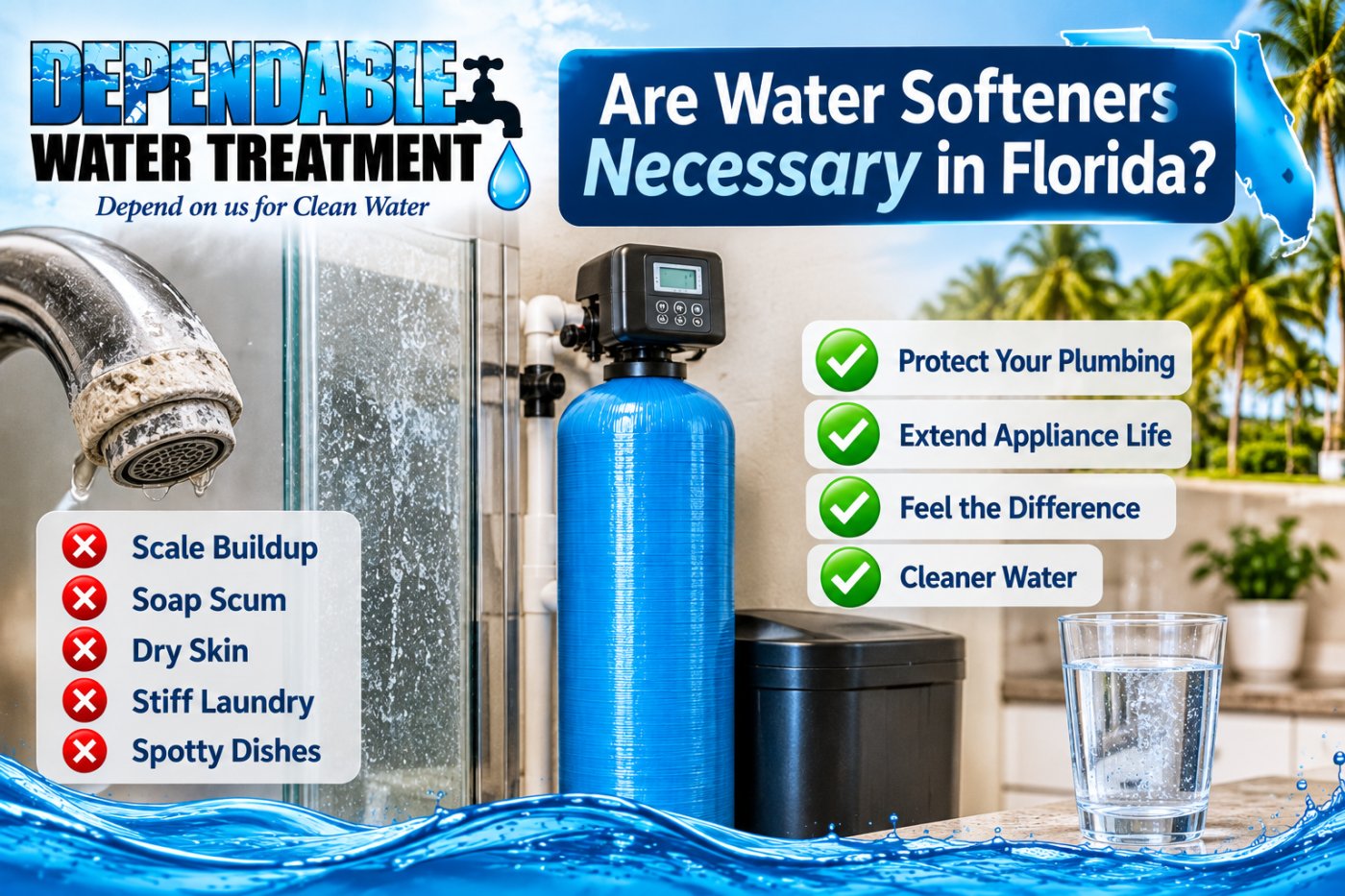
Short answer: no law or health rule requires you to have a water softener in Florida, but in most of the state the water is hard enough that a softener is worth having. Hard water will not make you sick. It does wear on your plumbing, your appliances, your skin, and your patience, and a softener is the most direct way to stop it. Whether you actually need one comes down to a simple test of your own water.
That distinction matters, because the word "necessary" gets used loosely. A softener is not a safety device like a smoke detector. It is closer to a roof gutter. You can live without it, but over the years you will pay for the damage it would have prevented. Here is how to tell which side of that line your home falls on.
Why Florida Water Is So Hard
Hardness comes from dissolved calcium and magnesium, and Florida has plenty of both. Most of the state sits on limestone, and the groundwater that feeds both private wells and many city supplies passes through that rock on its way to you. The water picks up minerals the whole way, so it arrives hard before it ever reaches your pipes.
Hardness is measured in grains per gallon. The U.S. Geological Survey classifies water above roughly 7 grains per gallon as hard and above about 10.5 as very hard. Water in much of Central Florida lands in that range or beyond it. The exact number varies by neighborhood, by water source, and even by the season, which is why guessing is not a good plan. We explain what a test measures in our article on what a professional water test measures.
What Hard Water Does to a Florida Home
The effects are gradual, which is why many homeowners do not connect them to the water at first. Minerals leave white, chalky scale on faucets, shower doors, and glassware. Inside your pipes and water heater, that same scale builds up layer by layer. It insulates heating elements, so the heater works harder, and it narrows pipes and clogs fixture screens, which can reduce flow.
You also feel it. Soap and shampoo do not rinse cleanly in hard water, so a film can stay on your skin and hair. Laundry can come out stiff and dull, and detergent has to work harder against the minerals. Dishwashers, washing machines, ice makers, and coffee makers all collect scale over time. None of this is dangerous, but all of it adds up over the life of a home.
When You Might Not Need One
There are homes where a softener is not necessary. If your test shows soft or only mildly hard water, there is little for a softener to do. Some people also decide the effects are not bothering them enough to justify the equipment, which is a perfectly reasonable choice as long as it is an informed one. And in some cases the real problem is not hardness at all. Iron, sulfur, chlorine, low pH, or tannins can cause stains, smells, and tastes that a softener will not fix, and treating the wrong problem is a common and avoidable mistake.
That is why the order of operations matters. Test first, then decide. If hardness is the issue, a softener addresses it directly. If something else is present, the right equipment may be a filter, a neutralizer, or a combination, as we describe in our article on why some Florida homes need both a softener and a carbon filter.
What a Softener Does and Does Not Do
A softener uses ion exchange to swap the calcium and magnesium in your water for sodium or potassium, which prevents scale. It is very good at that one job. It does not remove chlorine, bacteria, or most other contaminants, and it does not make water safer to drink. If you want to improve drinking water specifically, reverse osmosis at the kitchen tap is the usual approach, and we explain how it works in our article on how reverse osmosis purifies your water.
Equipment also does not last forever, and a softener needs reasonable upkeep to keep working. Our article on how long water treatment systems last covers what to expect.
How to Decide for Your Home
Start with the evidence in your own house. Scale on faucets and shower glass, spots on dishes, stiff laundry, and dry skin after showering are all signs. A hardness test confirms it and tells you how hard the water really is. From there, the right equipment depends on that number, how much water your household uses, and anything else found in the test. We walk through that process in our article on how to determine what water treatment your home needs.
Not sure whether your home needs a softener? We can test your water and tell you honestly. Call Dependable Water Treatment at 407-242-7150 or contact us online to schedule a water test.