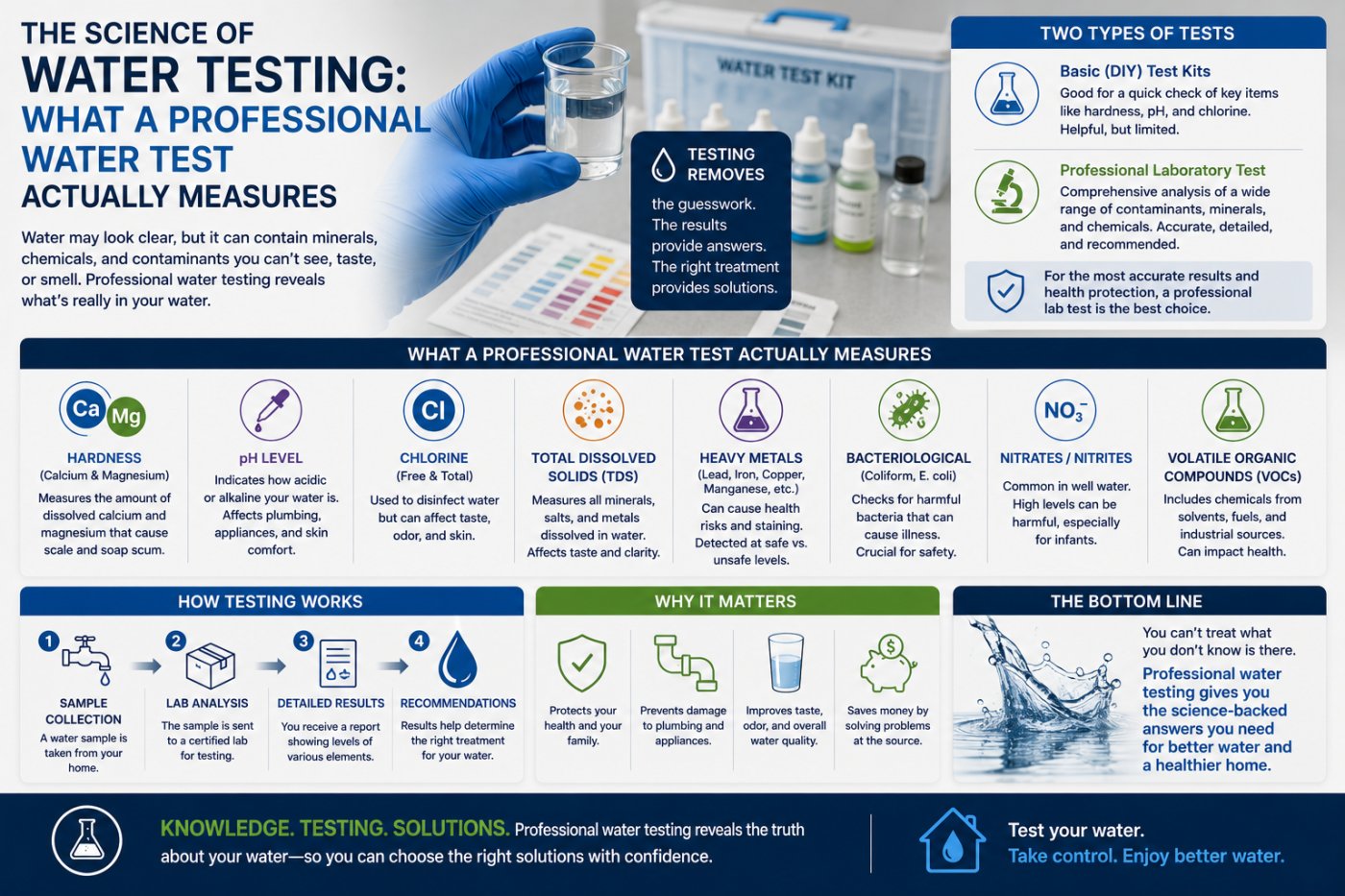
If you've been told you should test your water — or if you've decided it's time to find out what's actually coming out of your taps — the next question is usually: what does a water test actually measure, and what will the results tell me?
A professional water test is not a single measurement. It's a panel of tests that together paint a complete picture of your water's chemistry, safety, and suitability for treatment. Understanding what each component measures — and why it matters — helps you make sense of the results and make informed decisions about what to do next.
Why Water Testing Matters Before Treatment
The single most important thing to understand about water treatment is that the right solution depends entirely on what's actually in your water. A system designed for high iron content won't adequately address a sulfur problem. A water softener sized for 15 GPG will underperform in water that tests at 25 GPG. A carbon filter addresses chloramines — but does nothing for hardness or bacteria.
Without a water test, you're guessing. And guessing at water treatment means either spending money on systems that don't solve your actual problem, or missing problems that are costing you money and affecting your health every day.
A comprehensive water test is the non-negotiable starting point for any water treatment decision. As we discussed in our article on what hard water is and how it forms, Florida's geology creates a wide range of water quality conditions — and what your neighbor needs may be completely different from what your home needs.
The Core Parameters: What Gets Tested
Hardness (Calcium and Magnesium)
Hardness is typically the first thing people want to know — and for good reason. Measured in grains per gallon (GPG) or parts per million (PPM), hardness tells you the concentration of dissolved calcium and magnesium in your water.
This number drives softener sizing, treatment approach selection, and gives you a baseline for evaluating softener performance after installation. In Florida, where hardness commonly runs 10 to 30+ GPG, this is almost always a significant finding. For a detailed explanation of what the GPG number means, see our article on what a grain per gallon actually measures.
pH
pH measures how acidic or alkaline your water is on a scale of 0 to 14, with 7 being neutral. For drinking water, the EPA recommends a pH between 6.5 and 8.5.
pH matters for several reasons in water treatment:
- Low pH (acidic water) is corrosive. It can leach lead and copper from pipes and solder joints, cause blue-green staining in sinks and tubs, and accelerate deterioration of plumbing components. Acidic well water is a real concern in some parts of Florida.
- High pH (alkaline water) can affect the taste of water and the effectiveness of certain treatment processes.
- pH affects iron treatment. The form iron takes in water — and therefore the best way to remove it — depends significantly on pH. A water treatment professional needs your pH reading to recommend the right iron removal approach.
Iron
Iron is measured in parts per million (PPM) and is one of the most important parameters for Florida well water users. As covered in our article on what iron in water does to your home, iron causes the orange staining on toilets, sinks, and laundry that's so common in Florida well water homes.
A comprehensive test distinguishes between:
- Ferrous iron — dissolved iron that's invisible in water but stains when oxidized
- Ferric iron — already oxidized iron that makes water appear orange or cloudy
- Iron bacteria — microorganisms that feed on iron and produce a reddish slime
Each type requires a different treatment approach, which is why the specific iron test result matters — not just whether iron is present, but how much and in what form.
Manganese
Manganese often travels alongside iron in Florida well water and causes similar staining — but the deposits tend to be black or dark brown rather than orange. Manganese requires its own treatment consideration because it behaves differently from iron at different pH levels and responds differently to various filtration approaches.
At elevated levels, manganese is also a health concern — the EPA has set a health advisory for manganese in drinking water, making it one of the parameters where testing has direct safety implications.
Hydrogen Sulfide (Sulfur)
Measured in PPM, hydrogen sulfide is the compound responsible for the rotten egg odor that plagues many Florida well water homes. Testing confirms whether hydrogen sulfide is present and at what concentration, which determines the appropriate treatment approach — from activated carbon filtration for low levels to air injection oxidation for higher concentrations.
Total Dissolved Solids (TDS)
TDS measures the total concentration of all dissolved substances in your water — minerals, salts, metals, and other compounds — expressed in PPM or mg/L. It's a broad indicator of overall water mineral content rather than a specific contaminant measure.
TDS is particularly relevant for reverse osmosis system evaluation. A properly functioning RO system should reduce TDS by 90 to 99 percent. Testing TDS before and after an RO membrane tells you whether the membrane is performing correctly.
Bacteria (Coliform and E. coli)
For well water users, bacteria testing is a safety-critical component of any comprehensive water test. Coliform bacteria testing screens for a broad category of bacteria that indicates potential contamination. E. coli testing specifically identifies fecal contamination — a serious health concern that requires immediate remediation.
Municipal water is treated for bacteria before it reaches your home and is regularly tested by your utility. For private well owners, no one tests your water for you — and bacterial contamination can be present in water that looks, smells, and tastes completely normal. Annual bacteria testing is strongly recommended for well water homes.
Chlorine and Chloramines
For municipal water users, testing for chlorine or chloramines tells you what disinfectant your utility is using and at what concentration it's arriving at your tap. This determines whether a standard carbon filter or a catalytic carbon filter is needed — standard carbon removes free chlorine effectively but is significantly less effective against chloramines.
As covered in our article on what chloramine is and why it's in Florida water, many Florida municipal systems have transitioned to chloramines — and homeowners who don't know this may have filtration that isn't addressing their disinfectant effectively.
Nitrates
Nitrates are colorless, odorless, and tasteless — completely undetectable without testing. They're a particular concern in agricultural areas of Florida, where fertilizer runoff can contaminate well water. At elevated levels, nitrates pose a serious health risk for infants and pregnant women. A water test that includes nitrates is especially important for well water homes in or near agricultural areas.
Additional Parameters
Depending on your location, your water source, and any specific concerns, a comprehensive test may also include:
- Arsenic — naturally occurring in some Florida groundwater sources
- Lead — particularly relevant in homes with older plumbing or solder joints
- PFAS — increasingly detected in Florida water sources near military bases and industrial sites
- Tannins — organic compounds from decaying vegetation that cause yellow or brown water color, common in some Florida well water
- Turbidity — a measure of water clarity, indicating suspended particles
Types of Water Tests
Not all water tests are created equal, and understanding the difference helps you choose the right test for your situation.
Basic hardness test strips. Inexpensive and available at hardware stores. Gives you a rough hardness reading. Useful for a quick check but not precise enough for treatment decisions.
Basic home test kits. Multi-parameter kits that test for hardness, pH, chlorine, and a few other parameters. More useful than strips for a general overview but still limited in scope and precision.
Professional water test by a treatment company. A water treatment company will typically offer a comprehensive test that covers the parameters most relevant to their treatment recommendations. These tests are often provided free or at low cost as part of the evaluation process. The results are analyzed by someone who can explain what they mean and recommend appropriate treatment.
Certified laboratory testing. For health-critical parameters — bacteria, nitrates, lead, arsenic, PFAS — a certified laboratory test provides the most reliable results. Samples are collected using proper protocols and analyzed under controlled conditions. This is the gold standard for well water safety testing and is particularly important if you have any concerns about contamination.
How to Prepare for a Water Test
For accurate results, a few simple steps make a difference:
- Run the water for 2 to 3 minutes before collecting a sample for most parameters, to flush standing water from the pipes and get a representative sample from the source.
- For lead testing, collect the first draw from the tap without running the water first — lead from pipes and solder joints concentrates in water that's been sitting in contact with the plumbing.
- Use the sample containers provided by the testing lab or company — they're designed for the specific tests being run and may be pre-treated.
- Follow timing instructions — bacteria samples in particular have specific handling requirements to ensure accurate results.
What to Do With the Results
A water test result is a starting point, not an end point. Once you know what's in your water — and at what concentrations — you can make informed decisions about what treatment is appropriate, what size system is needed, and what combination of technologies addresses your specific situation.
The results also give you a baseline for future comparison. Testing your water again after treatment is installed confirms the system is performing correctly. Periodic retesting — particularly for well water — catches changes in water chemistry before they become serious problems.
The Bottom Line
A professional water test is the foundation of every good water treatment decision. It tells you what's actually in your water — not what you think is there based on how it looks or smells, and not what your neighbor has. In Florida, where water quality varies significantly by location, source, and local geology, there's no substitute for knowing your specific water chemistry before choosing a treatment system.
If you haven't tested your water recently — or ever — that's the most important first step you can take toward protecting your home, your appliances, and your family.
Dependable Water Treatment offers professional water testing for Florida homeowners on both well and municipal water. Contact us to schedule a water test and get a clear picture of what's in your water.