Short answer: white flakes in a kettle, a coffee maker or your hot water are often hard water scale. Heating hard water can leave a chalky mineral deposit, and pieces of that deposit can break loose. If the flakes show up mostly in hot water from the tap, the water heater is the other place to look.
Florida has hard water in many areas, so chalky buildup is a familiar sight. Mineral scale itself is generally harmless, but the flakes alone can’t tell you whether your water is safe to drink.
Why Heating Water Creates Flakes
Hard water carries dissolved calcium and magnesium. When you heat hard water, calcium carbonate can come out of solution and form scale. In a kettle, it can coat the heating surface and walls. In a tank water heater, scale can collect on heating surfaces, and loose sediment can accumulate at the bottom. Pieces can break off and show up in the water as white or off-white flakes.
How to Tell If It Is Scale
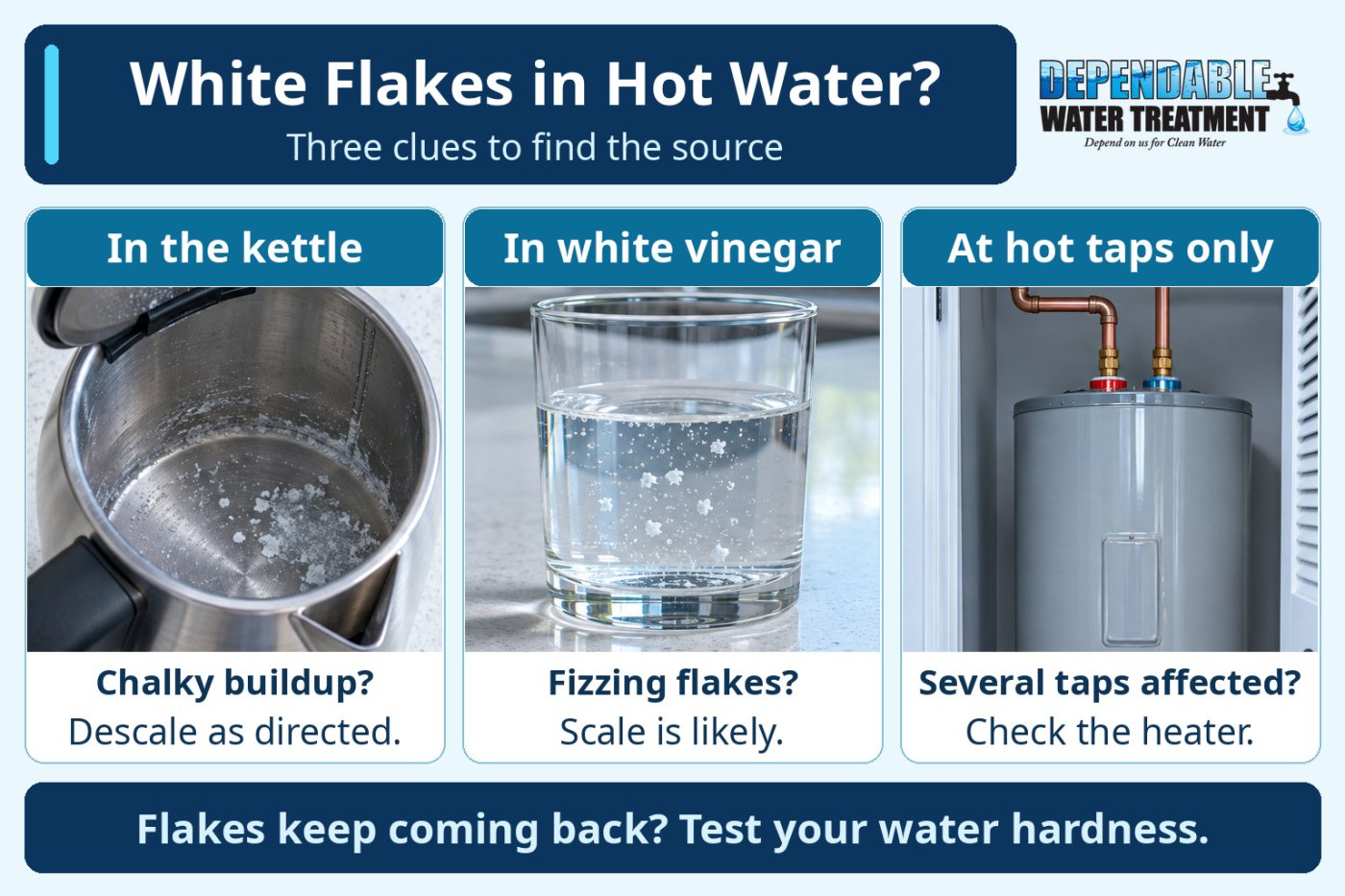
A simple check is to put some of the flakes in a small glass of white vinegar. If the flakes fizz and start to dissolve, calcium carbonate scale is likely. You will also see the same pattern in other places: a chalky crust on faucet aerators and showerheads, white spots on glassware and dishes, and a rough coating inside your coffee maker. If flakes appear only in the hot water at several taps, the water heater is a good place to look.
Other things can look similar. Tiny, uniformly round tan beads can be resin escaping from a softener. White plastic fragments can come from a deteriorating water heater dip tube. If the flakes do not dissolve in vinegar, or they look different from chalky scale, it is worth having someone take a look. You can also learn what a thorough test measures in our article on what a professional water test measures.
How to Clean the Kettle and Small Appliances
Check your kettle’s manual for its descaling steps. Some models use diluted white vinegar, while others call for citric acid or a specific descaler. Follow the directions for how much to use, whether to heat it, and how long to let it sit. Then empty the kettle and rinse it thoroughly with fresh water. Check your coffee maker’s manual, too, since it may call for a different product or cleaning cycle.
What About the Water Heater?
If scale is coming from the water heater, flushing the tank can remove loose sediment. Scale that’s stuck to heating surfaces may remain and can affect heating performance. Have a qualified professional check the heater, especially if it’s older or heavily scaled. If the incoming water is still hard, scale can build up again after cleaning.
How to Stop It Coming Back
Cleaning removes today's scale, but as long as hard water keeps flowing, new scale keeps forming. The lasting fix is to remove the hardness before it reaches your kettle and your water heater. A water softener does that by exchanging the calcium and magnesium for sodium or potassium, reducing the minerals that form hardness scale. We explain how long a softener keeps doing that in our article on how long water treatment systems last, and when a carbon filter belongs alongside it in our article on why some Florida homes need both a softener and a carbon filter.
Seeing white flakes or scale at home? We can test your water hardness and recommend the right fix. Call Dependable Water Treatment at 407-242-7150 or contact us online to schedule a water test.