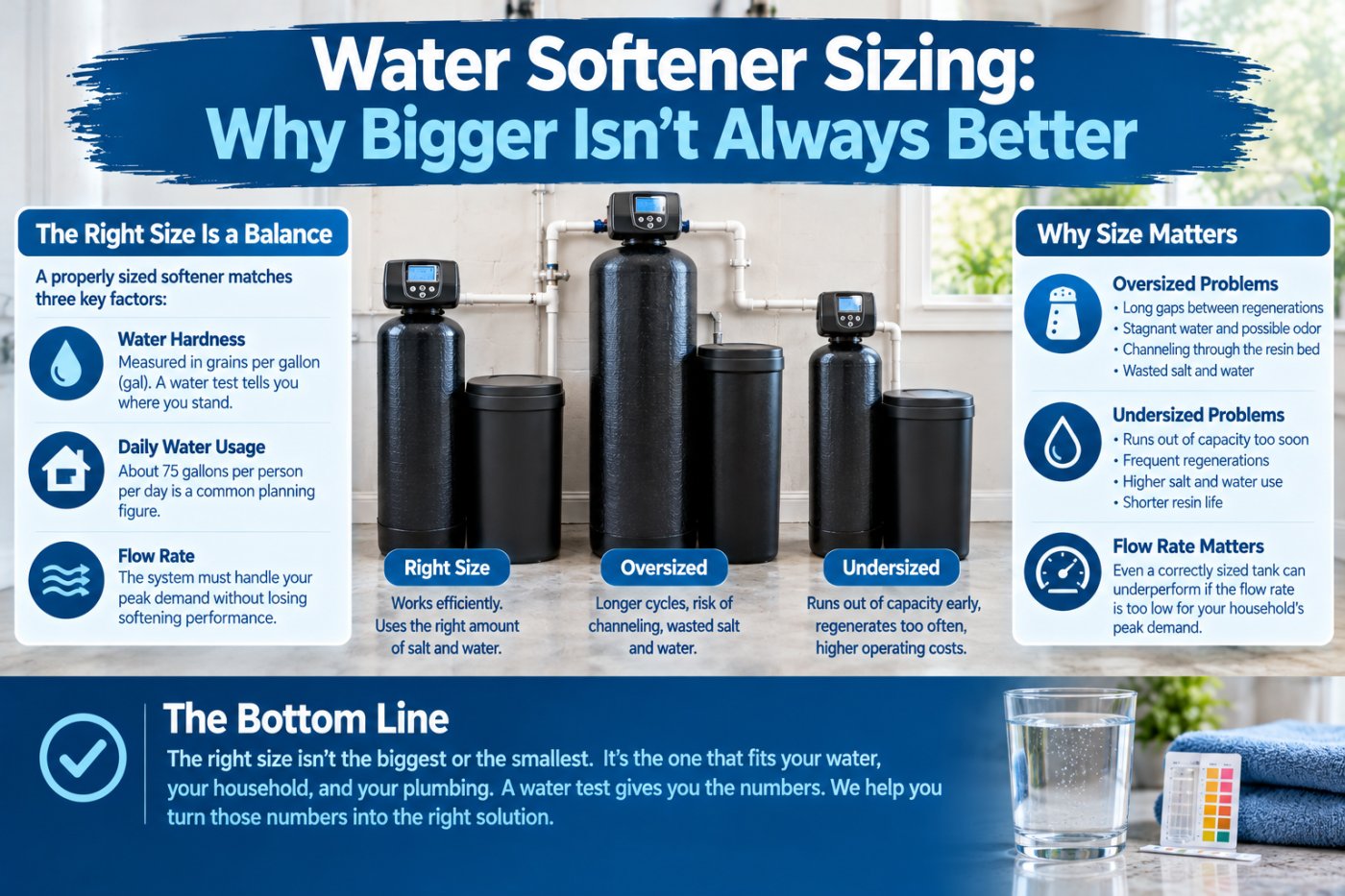
When people shop for a water softener, the instinct is usually to buy the largest one they can. More capacity sounds like more protection, and nobody wants to run out of soft water. In practice, a softener that is far too big for your home can be just as much of a problem as one that is too small. Sizing is really about matching three things: how much hardness your water carries, how much water your household uses, and how fast that water needs to flow through the tank. Get those right and the softener works quietly for years. Get them wrong and you end up with wasted salt, wasted water, and hardness that still shows up at the tap.
The Math Behind a Properly Sized Softener
A softener's capacity is measured in grains, which is the unit used to describe how much hardness the resin can remove before it needs to be regenerated. Your water's hardness is measured in grains per gallon, and a simple test will tell you where you stand. In Central Florida it is common to see numbers well above the point where water is considered hard, which we cover in our article on what a professional water test measures.
To size a softener, you multiply the gallons your household uses in a day by the grains per gallon in your water. That gives you the number of grains the system has to remove daily. A common planning figure is about 75 gallons per person per day, so a family of four might use around 300 gallons. If that water tests at 15 grains per gallon, the softener has to remove roughly 4,500 grains a day. Most homes are sized so the system regenerates about once every several days rather than every night or once a month, which gives the resin time to do its job without overworking it.
Iron changes the equation. Iron is exchanged onto the resin just like hardness is, so many technicians add extra grains to the calculation for every part per million of iron in the water. This is one reason a home with well water may need a different size than a neighbor on city water with the same hardness reading. If iron is high enough, it is often better to remove it before the softener, a point we explain in our article on why some Florida homes need more than a softener.
Why Oversizing Causes Problems
A softener that is much larger than it needs to be will go a long time between regenerations. That sounds efficient, but it has side effects. Resin that sits for days or weeks without being refreshed can develop a stagnant bed, and the water sitting in the tank can pick up a stale taste or odor. Regeneration also works best when the resin has been used enough to need it. A tank that is regenerated before it has done much work uses salt and water to get very little done.
Oversizing can also lead to channeling, where water takes a path of least resistance through the resin bed instead of flowing evenly through all of it. When that happens, part of the resin is doing all the work while the rest sits idle, and hardness can leak through. A properly sized tank keeps water moving through the whole bed at a steady rate.
Why Undersizing Is Worse
An undersized softener has the opposite problem. It runs out of capacity quickly and regenerates too often, which burns through salt and water and wears the resin faster. If the household uses more water than expected, the softener can run out before its next scheduled regeneration, and hard water will flow into the house until the cycle catches up. This is one reason a softener sometimes seems to work fine for a while and then stops after a family grows or a guest stays for a few weeks.
Resin does not last forever, and heavy cycling shortens its life. Our article on how long water treatment systems last explains what to expect from each component.
Flow Rate Matters Just as Much as Capacity
Capacity tells you how much hardness a softener can remove. Flow rate tells you how quickly water can pass through it while still being softened properly. Every softener has a maximum service flow rate, and if your home pulls more water than that at once, such as showers, a dishwasher, and a washing machine running together, the resin does not have enough contact time to do its job. You may see hardness leak through at peak demand, or notice a drop in water pressure.
Homes with larger plumbing, multiple bathrooms, or irrigation connected to the house line often need a system chosen for flow as much as for grain capacity. This is a big reason an online calculator alone is not a reliable way to size a system.
The Best Way to Get It Right
Properly sizing a softener starts with a water test and an honest look at how your household uses water. Your hardness, your iron level, the number of people in the home, your plumbing, and even whether you plan to add a bathroom or a pool all play a part. We walk through that process in our article on how to determine what water treatment your home needs.
Not sure whether your softener is the right size for your home? We can test your water and check your system. Call Dependable Water Treatment at 407-242-7150 or contact us online to schedule a water test.