If you've started researching water treatment for your Florida home, you've almost certainly encountered the term "grains per gallon." It's the standard unit used to measure water hardness, and it shows up everywhere — on water softener specifications, water test results, and product comparisons. But what does it actually mean? And why does the number matter for your home?
Understanding grains per gallon is one of those foundational concepts that makes everything else in water treatment click into place.
What Is a Grain?
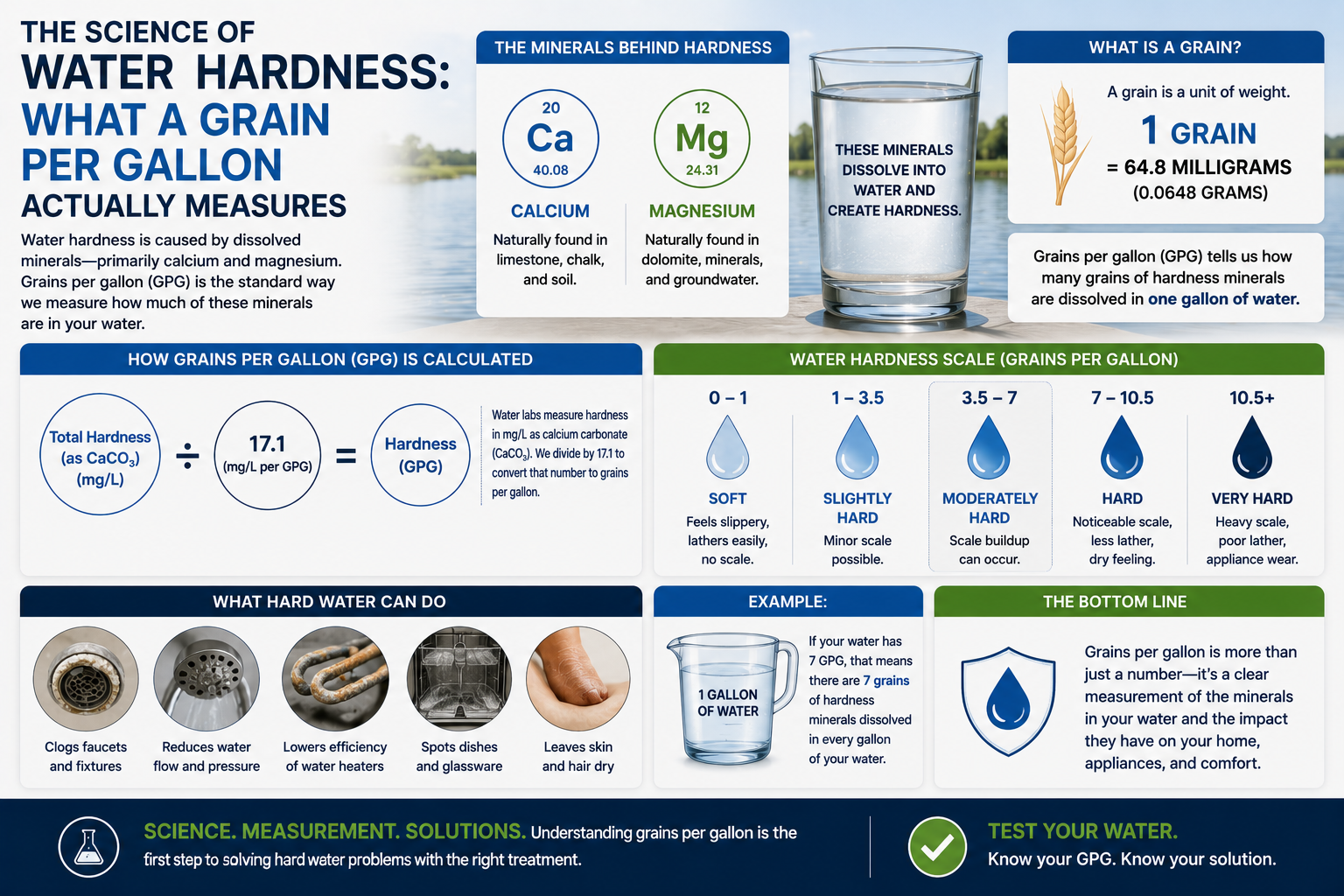
The "grain" as a unit of measurement has nothing to do with food grains — it's actually one of the oldest units of weight in the English measurement system, originally based on the weight of a single grain of wheat or barley. One grain equals approximately 64.8 milligrams, or about 0.00143 pounds.
It's an old unit, but it stuck around in water treatment because it provides a convenient scale for expressing mineral concentrations in water — small enough to be precise, large enough to be meaningful at household water volumes.
What Is a Grain Per Gallon?
A grain per gallon (GPG) measures the concentration of hardness minerals — calcium and magnesium — dissolved in your water. Specifically, it tells you how many grains of dissolved calcium carbonate equivalent are present in one gallon of water.
One grain per gallon equals 17.1 milligrams per liter (mg/L), which is the same as 17.1 parts per million (PPM). You'll sometimes see hardness expressed in PPM or mg/L rather than GPG — they're measuring the same thing, just in different units.
To convert between them:
- GPG to PPM: multiply GPG by 17.1
- PPM to GPG: divide PPM by 17.1
So if your water test comes back at 20 GPG, that's equivalent to 342 PPM. If it comes back at 300 PPM, that's approximately 17.5 GPG.
The Hardness Scale — Where Does Your Water Fall?
Water hardness is generally classified on a scale that runs from soft to very hard. Here's how the categories break down:
| Classification | GPG | PPM |
|---|---|---|
| Soft | 0 – 1 | 0 – 17 |
| Slightly Hard | 1 – 3.5 | 17 – 60 |
| Moderately Hard | 3.5 – 7 | 60 – 120 |
| Hard | 7 – 10.5 | 120 – 180 |
| Very Hard | 10.5+ | 180+ |
The EPA considers water above 7 GPG to be hard. Water above 10.5 GPG is classified as very hard. Florida water commonly tests between 10 and 30+ GPG across much of the state — meaning a significant portion of Florida homeowners are living with very hard water by any measure.
Why the Number Matters for Your Home
The grain per gallon number isn't just an abstract measurement — it has direct, practical implications for how hard water affects your home and what you need to do about it.
For appliance damage: The higher your GPG, the faster scale accumulates on heating elements, inside pipes, and throughout your appliances. A home at 25 GPG will see scale buildup progress significantly faster than a home at 10 GPG — and the efficiency losses and appliance wear happen on a compressed timeline. As covered in our article on <a href="https://dependablewatertreatment.com/blog/can-hard-water-damage-your-water-heater">how hard water damages your water heater</a>, even moderate hardness causes measurable damage over time.
For water softener sizing: Your GPG number is one of the two primary inputs for sizing a water softener correctly. The formula for calculating your daily softening requirement uses your GPG directly — the higher it is, the larger the softener capacity you need to handle your household's daily demand. For a detailed look at how this works, see our article on <a href="https://dependablewatertreatment.com/blog/what-size-water-softener-does-your-home-actually-need">what size water softener your home actually needs</a>.
For regeneration frequency: Your softener's regeneration cycle — how often it flushes and recharges — is calibrated to your water's hardness level. A softener set for 15 GPG water will regenerate on a very different schedule than one set for 25 GPG water. Incorrect settings mean either wasted salt or inadequate softening.
For treatment decisions: At certain hardness levels, treatment approaches that work reasonably well at lower hardness become inadequate. Salt-free conditioning systems, for example, show reasonable results at lower hardness levels but fall significantly short at the 15 to 25+ GPG levels common in Florida. Knowing your GPG tells you which treatment options are actually viable for your situation. Our article on <a href="https://dependablewatertreatment.com/blog/do-salt-free-water-systems-actually-work-in-florida">whether salt-free systems work in Florida</a> covers this in detail.
What Your GPG Number Tells You About Your Softener's Performance
Once you have a water softener installed, your GPG number becomes the benchmark for evaluating whether it's working correctly.
Softened water should test at or near 0 GPG at any softened tap in your home. If you test your softened water and get a reading above 1 GPG consistently, your softener may not be performing correctly — the hardness level relative to your source water tells you how much the softener is actually removing.
This is also why knowing your source water hardness level is important before installation. Without a baseline GPG number, you have no way to verify that your softener is delivering the performance it should.
How Iron Affects Your Effective Hardness Number
If your well water contains iron — which is common in Florida — your effective hardness number for softener sizing purposes is higher than your measured GPG alone would suggest.
Iron competes with calcium and magnesium for space on the softener's resin beads. A commonly used rule of thumb among water treatment professionals is to add approximately 4 GPG to your hardness number for every 1 PPM of iron present in your water. So if your water tests at 15 GPG hardness and 2 PPM iron, your effective hardness for sizing purposes is approximately 23 GPG.
This adjustment is one reason why a comprehensive water test — not just a hardness test — is important before selecting and sizing a treatment system. For more on iron in Florida well water, see our article on <a href="https://dependablewatertreatment.com/blog/what-is-iron-in-water-and-why-is-it-staining-everything">what iron in water does to your home</a>.
Getting Your GPG Number
There are a few ways to find out your water's hardness level in grains per gallon:
Basic test strips. Hardness test strips are available at hardware stores and online. They give you a rough reading that's useful for a general sense of your water's hardness. They're not precise enough for accurate softener sizing, but they can confirm whether hard water is a factor worth investigating further.
Your utility's water quality report. If you're on municipal water, your utility's annual Consumer Confidence Report may include hardness data for your area. This gives you a general figure, though hardness can vary somewhat across a distribution system.
Professional water testing. A professional water test gives you a precise GPG reading along with a complete picture of everything else in your water — iron, pH, bacteria, sulfur, chlorine or chloramines. This is the right starting point before making any water treatment decisions.
The Bottom Line
Grains per gallon is the language of water hardness — and understanding what the number means, how it affects your home, and how it factors into treatment decisions makes every other conversation about water softeners, system sizing, and water quality far more meaningful.
In Florida, knowing your GPG is particularly important because the state's hardness levels are high enough that the choice of treatment approach, the size of the system, and the urgency of addressing it all depend significantly on that number.
If you don't know your water's GPG, that's the first thing worth finding out.
Want to know your water's hardness level? Dependable Water Treatment offers professional water testing for Florida homeowners. Contact us to schedule a test and find out exactly what you're working with.