Most Florida homeowners know that a water softener removes hardness from water. Fewer understand how it actually accomplishes that — and understanding the mechanism helps you make better decisions about sizing, maintenance, salt selection, and troubleshooting when something isn't working right.
The technology behind water softening is elegant in its simplicity. It's called ion exchange, and once you understand it, the entire logic of how a water softener works — and why it needs salt — becomes immediately clear.
What Is an Ion?
To understand ion exchange, you need to start with ions. An ion is an atom or molecule that carries an electrical charge — either positive or negative — because it has gained or lost electrons.
Calcium and magnesium — the minerals that make water hard — exist in water as positively charged ions. In chemistry notation, calcium is Ca²⁺ and magnesium is Mg²⁺. The "2+" indicates they each carry a double positive charge. These positively charged ions are called cations.
Sodium also exists in water as a positively charged ion — Na⁺ — carrying a single positive charge.
This distinction in charge strength is fundamental to how ion exchange works.
The Resin Bed: Where the Magic Happens
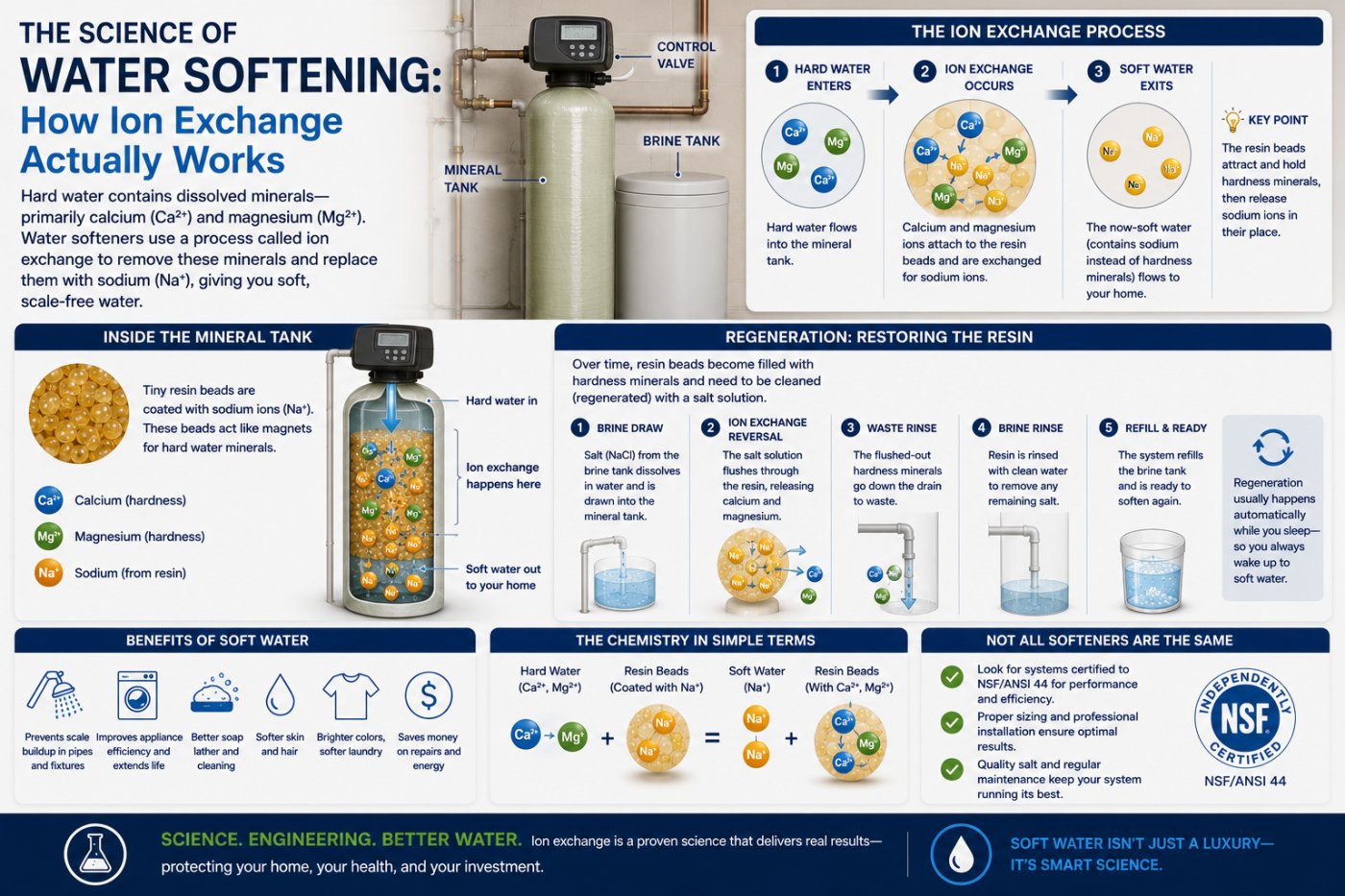
Inside every water softener is a tank filled with thousands of tiny resin beads — typically made from a sulfonated polystyrene polymer. These beads are the working heart of the softener.
Each resin bead is covered with negatively charged sites — chemical attachment points that attract and hold positively charged ions. During the softener's normal operation, these sites are pre-loaded with sodium ions (Na⁺).
When hard water flows through the resin bed, the calcium and magnesium ions in the water come into contact with these sodium-loaded beads. And here's where the chemistry happens: calcium and magnesium carry a double positive charge (2+), while sodium carries only a single positive charge (1+). The resin sites have a stronger attraction to the doubly charged calcium and magnesium ions than to the singly charged sodium.
As a result, the calcium and magnesium ions displace the sodium ions from the resin sites — they essentially take sodium's place on the bead. The displaced sodium ions are released into the water. The calcium and magnesium ions are captured on the resin and held there.
The water that exits the resin tank has had its calcium and magnesium removed and replaced with sodium — it's now soft water.
Why the Water Softener Needs Salt
The resin bed has a finite capacity. Over time, as hard water continues flowing through the softener, the resin sites fill up with calcium and magnesium until no more sodium is available to exchange. At this point, the resin is exhausted — it can no longer soften water.
This is where salt comes in.
The softener periodically goes through a process called regeneration, during which it reverses the ion exchange process to restore the resin's softening capacity. Here's how regeneration works:
Backwash. The softener first backwashes the resin bed — running water backwards through the tank to loosen and clean the resin and flush out any accumulated debris.
Brine draw. The softener draws a concentrated salt solution — brine — from the brine tank. This highly concentrated sodium solution flows through the resin bed.
Recharge. The sheer concentration of sodium in the brine solution overwhelms the calcium and magnesium on the resin sites. Even though sodium has a weaker individual attraction to the resin than calcium or magnesium, the enormous quantity of sodium ions in the brine solution forces the calcium and magnesium off the resin through mass action. The calcium and magnesium ions are flushed down the drain, and the resin sites are reloaded with sodium ions — ready to soften water again.
Rinse. The softener rinses the excess brine from the resin tank to ensure sodium-laden brine doesn't enter your home's water supply.
Return to service. The softener returns to normal operation, with a fully recharged resin bed.
This is why salt is essential to a water softener — not because salt goes into your water directly, but because the sodium from dissolved salt is what recharges the resin between regeneration cycles. Without salt, regeneration can't happen, and the resin bed eventually becomes fully saturated with calcium and magnesium and stops softening.
How the Softener Knows When to Regenerate
Modern water softeners use one of two approaches to determine when regeneration is needed:
Timer-based regeneration. Older and less efficient softeners regenerate on a fixed schedule — every set number of days regardless of how much water has been used. This approach is simple but wasteful — the softener regenerates even when the resin still has plenty of capacity, using salt and water unnecessarily.
Demand-initiated regeneration (DIR). Modern, efficient softeners track actual water usage through a meter in the control valve. They calculate how much softening capacity has been used based on the volume of water processed and the programmed hardness level, and only regenerate when the resin actually needs it. This approach uses significantly less salt and water — often 30 to 50 percent less than timer-based systems — making it both more economical and more environmentally considerate.
When evaluating water softeners, demand-initiated regeneration is a feature worth prioritizing for its efficiency benefits.
The Role of Resin Quality and Capacity
Not all resin is created equal. Resin beads vary in quality, crosslink density, and ion exchange capacity. Higher crosslink density — typically expressed as a percentage, with 8% crosslink being standard and 10% being premium — produces resin that is more resistant to physical degradation, oxidation from chlorine, and fouling from iron.
In Florida, where water often contains iron and municipal water contains chlorine or chloramines, resin quality matters significantly for long-term performance. Chlorine in particular degrades standard resin over time, which is one reason a whole-house carbon filter upstream of the softener — which removes chlorine before it reaches the resin — extends resin life on municipal water systems.
Resin capacity — how many grains of hardness the resin can remove before exhaustion — is the basis for a softener's rated grain capacity. A 48,000 grain softener can theoretically remove 48,000 grains of hardness before needing to regenerate. However, actual capacity depends on the salt dose used during regeneration — more salt produces a more complete recharge but at higher operating cost. Efficient regeneration uses the minimum salt needed to achieve adequate recharge rather than maximum salt to achieve maximum theoretical capacity.
What Ion Exchange Does and Doesn't Remove
Ion exchange softening is highly effective at removing calcium and magnesium — the hardness minerals. It also removes low to moderate levels of ferrous iron (dissolved iron) and some manganese through the same ion exchange mechanism, since these metals also exist as positively charged cations.
What ion exchange does not remove:
- Bacteria, viruses, or other biological contaminants
- Nitrates
- PFAS or other chemical contaminants
- Chlorine or chloramines
- Hydrogen sulfide (sulfur odor)
- Ferric iron (already oxidized, particulate iron) — this needs to be filtered out rather than exchanged
- High concentrations of iron — excessive iron fouls the resin over time
For a comprehensive picture of what a water softener does and doesn't address, see our article on whether water softeners make water safe to drink, and our article on why some Florida homes need both a softener and carbon filter.
Why Softened Water Feels Different
Understanding ion exchange explains why softened water feels different from hard water — particularly the slippery sensation that surprises people when they first shower in softened water.
Hard water's calcium and magnesium react with soap to form soap scum — an insoluble residue that sticks to skin, hair, and surfaces. That soap scum is partly responsible for the "squeaky clean" sensation people associate with hard water bathing. It's not cleanliness — it's residue.
Softened water contains no calcium or magnesium to react with soap. Soap lathers freely and rinses away completely, leaving skin with its natural oils intact. The slippery sensation is clean skin without residue — not soap left behind. For a full explanation of this common misconception, see our article on the myth that soft water leaves soap on your skin
The Bottom Line
Ion exchange is one of the most elegant and effective water treatment technologies available — a simple chemical process that has been reliably removing hardness from residential water for decades. Understanding how it works demystifies everything from why your softener needs salt to why softened water feels the way it does.
For Florida homeowners dealing with the state's characteristically hard water, a properly sized and maintained ion exchange water softener remains the most reliable and comprehensive solution available.
Want to understand more about how water softening works for your specific Florida water conditions? Dependable Water Treatment is happy to explain the process, test your water, and recommend the right system for your home. Contact us to get started.