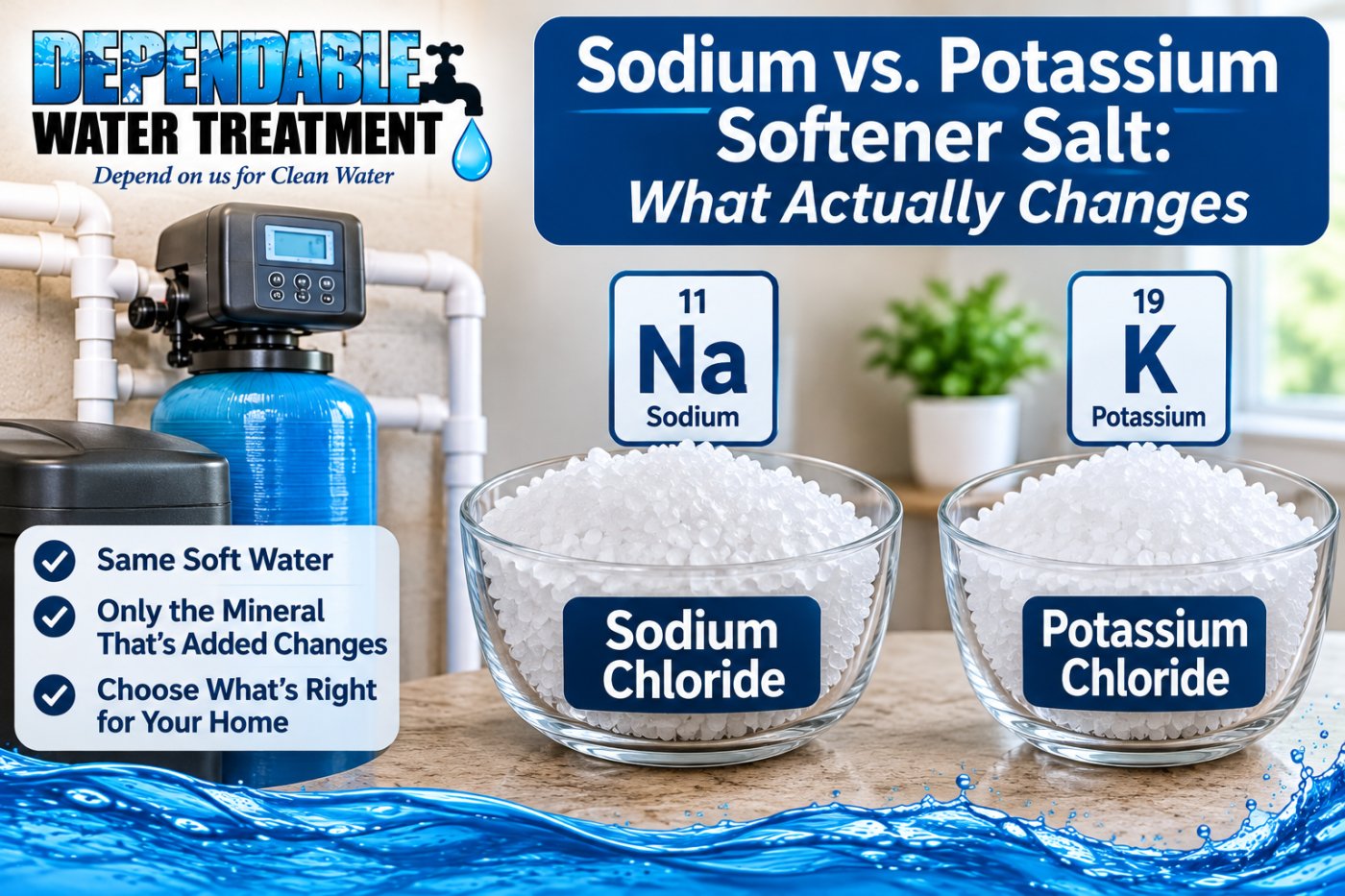
Short answer: both types of salt soften water the same way, and the only real difference is which mineral replaces the hardness in your water. Sodium is the standard choice, potassium is the alternative for people who want to limit added sodium, and neither one changes how soft your water feels.
If you have been reading about softener salt, you have probably seen strong opinions on both sides. Some sources treat potassium as a cleaner, healthier upgrade. Others call it an unnecessary gimmick. The truth sits in the middle, and it is easier to see once you understand what the salt is actually doing inside your softener.
What the Salt Does in a Softener
The salt in your brine tank does not go into your drinking water in bulk. It is used to regenerate the resin. As hard water passes through the resin bed, the beads grab calcium and magnesium and release sodium in exchange. Once the beads are loaded with hardness, the softener flushes them with a strong brine, which pushes the hardness off and recharges the beads. The brine and the hardness go to the drain.
The key point is that the beads give up one mineral to catch another. When you use sodium chloride, the mineral released into your water is sodium. When you use potassium chloride, it is potassium. We explain the full process in our article on how long water treatment systems last, and the same mechanics apply here.
Side by Side
| Sodium chloride | Potassium chloride | |
|---|---|---|
| What it adds to softened water | Sodium | Potassium |
| How well it softens | Standard performance | Works the same way, though a somewhat larger amount is often needed |
| Best known for | The default for most home softeners | An option for people who want to limit added sodium |
| Worth discussing with a doctor | If you are on a sodium restricted diet | If you have kidney issues or take medication that affects potassium |
How Much Sodium Does a Softener Add?
Because the resin trades roughly one sodium for each unit of hardness it removes, the amount added depends on how hard your incoming water is. As a rough rule, softening adds on the order of 8 milligrams of sodium per liter for every grain per gallon of hardness removed. Harder water means more sodium in the softened water. A home with very hard Florida water will see a larger increase than a home with moderately hard water.
For most healthy people, drinking water is a small part of total sodium intake compared with food. Still, people who have been told by a doctor to limit sodium, or who are managing blood pressure, are often advised to pay attention to the sodium in their water as well. That is a question for your physician, not for a water company, and we do not give medical advice. What we can tell you is what your water contains and what your options are.
What About Potassium?
Potassium chloride regenerates the resin just as effectively, and it replaces the sodium in the exchange with potassium instead. For many homeowners that is a reasonable choice. A few things are worth knowing before switching. Potassium chloride generally needs to be used at a somewhat higher dose to match the performance of sodium. And while extra potassium is not a concern for most people, those with kidney conditions or who take certain medications that affect potassium levels are usually advised to check with their doctor first.
It is also important to know that the two are not interchangeable in every system without a quick check. Most softeners handle either salt, but the settings may need adjusting, and potassium products vary in purity and form.
Neither One Changes How Soft Your Water Is
A common assumption is that one salt produces softer water than the other. It does not. Both remove calcium and magnesium the same way, and both leave your water at essentially zero hardness when the softener is working properly. If your water is still hard after you switch, the cause is somewhere else in the system, such as the settings, the resin, or something upstream, which we explain in our article on why some Florida homes need both a softener and a carbon filter.
If You Want the Lowest Sodium at Your Drinking Tap
If you want to limit the minerals in the water you drink, regardless of which salt your softener uses, a reverse osmosis system at the kitchen tap is the most direct approach. It removes most of the dissolved minerals, including the sodium or potassium the softener adds, and it leaves the rest of the house with soft water. We explain how it works in our article on how reverse osmosis purifies your water.
The right choice comes down to your household, your hardness, and what you want from your water. A water test is the place to start, and our article on how to determine what water treatment your home needs explains how that decision gets made.
Not sure which salt fits your softener or your household? We can test your water and go over your options. Call Dependable Water Treatment at 407-242-7150 or contact us online to schedule a water test.