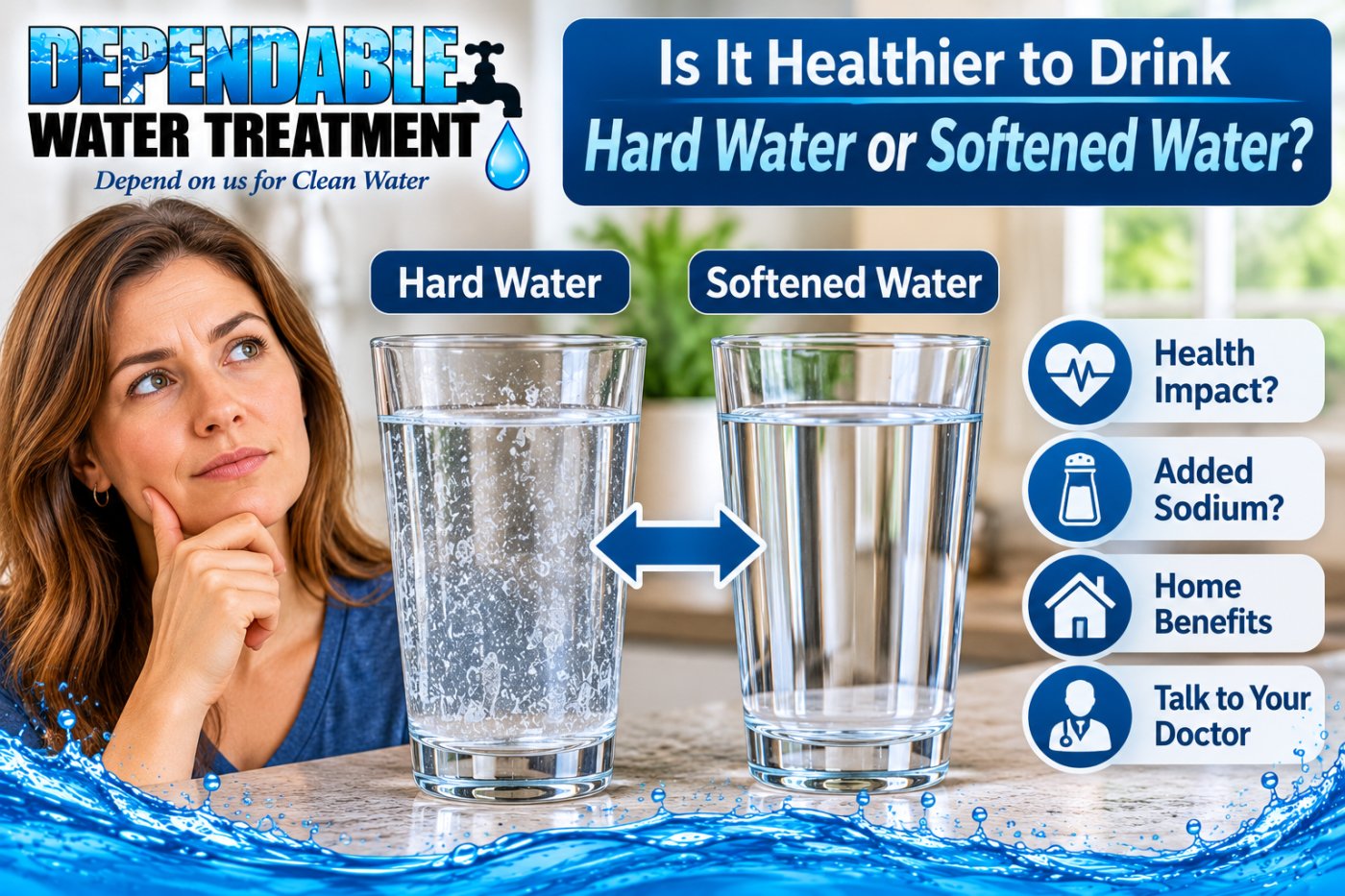
Short answer: for most healthy people, neither one is clearly healthier. Hard water is not harmful to drink, and softened water is generally considered safe too. The main difference is that softening adds sodium to your water, which matters mainly to people who have been told to limit sodium. If that is you, talk with your doctor, because this is a question for a medical professional and not for a water company.
This topic attracts a lot of strong claims from both sides, so this article sticks to published sources and says plainly where the evidence runs out. We are a water treatment company, not a medical provider, and nothing here is medical advice.
What Is Documented About Hard Water
Hard water carries dissolved calcium and magnesium. People have wondered for decades whether drinking it protects the heart. A 2008 report in Environmental Health Perspectives described the idea as about 50 years old and said that no firm conclusions have ever been drawn, because most of the earlier studies compared whole regions and could not rule out other explanations. The World Health Organization was coordinating work to study it further at the time. That report is a news article from 2008, so newer research may exist that it does not reflect.
The honest summary is that the question is unsettled. There is no established proof that drinking hard water is harmful, and there is no established proof that it is protective. Anyone who tells you otherwise with certainty is going beyond the evidence.
What is not in dispute is how hard water behaves in your home. It leaves scale, stiffens laundry, and shortens the life of appliances, which we cover in our article on how long water treatment systems last. Those are plumbing and comfort effects, not health effects.
What Is Documented About Softened Water
A softener trades the calcium and magnesium in your water for sodium or potassium, so softened water contains more sodium than it did before. How much more depends on how hard your water is to begin with. In a 1997 study published in the Archives of Internal Medicine, researchers measured sodium in 59 softened well water samples and found an average of 278 milligrams per liter, with a wide range from 46 to 1,219. Nonsoftened municipal water from local sources in the same study averaged 110. The authors concluded it was unlikely that the added sodium would pose a health risk for most people, with a caution for people on severely sodium-restricted diets. It is a single, older study from one area, so treat the specific numbers as an example rather than a prediction for your home.
For people on restricted diets, there is a published guideline. According to the Vermont Department of Health, the U.S. EPA recommends no more than 20 milligrams per liter of sodium in drinking water for people limited to 500 milligrams of sodium a day. Most softened water will be above that level. The same page advises people on a low-sodium diet to talk with their health care provider about the sodium in their water.
What We Cannot Say
We cannot tell you that softened water is better for you, and we cannot tell you that hard water is. The published sources above do not support either claim. What they support is narrower: hard water is not known to be harmful, softened water is generally considered fine for most people, and people with sodium restrictions should ask their doctor. Claims that go further than that, in either direction, are not backed by the sources we found.
If You Want to Keep Sodium Out of Your Drinking Water
You do not have to choose between a softener and low sodium. There are practical ways to have both. A reverse osmosis system at the kitchen tap removes most of the dissolved minerals from your drinking water, including the sodium a softener adds, while the rest of the house keeps its soft water. We explain how it works in our article on how reverse osmosis purifies your water. Some homes also keep a single unsoftened cold tap, or use potassium instead of sodium in the softener, though anyone with a medical reason to limit potassium should check with their doctor first.
The right setup depends on your water, your household, and any medical guidance you have been given. A water test is where that starts, and our article on how to determine what water treatment your home needs explains how the decision gets made.
Want to know exactly what is in your water and what a softener would change? We can test it and walk you through your options. Call Dependable Water Treatment at 407-242-7150 or contact us online to schedule a water test.