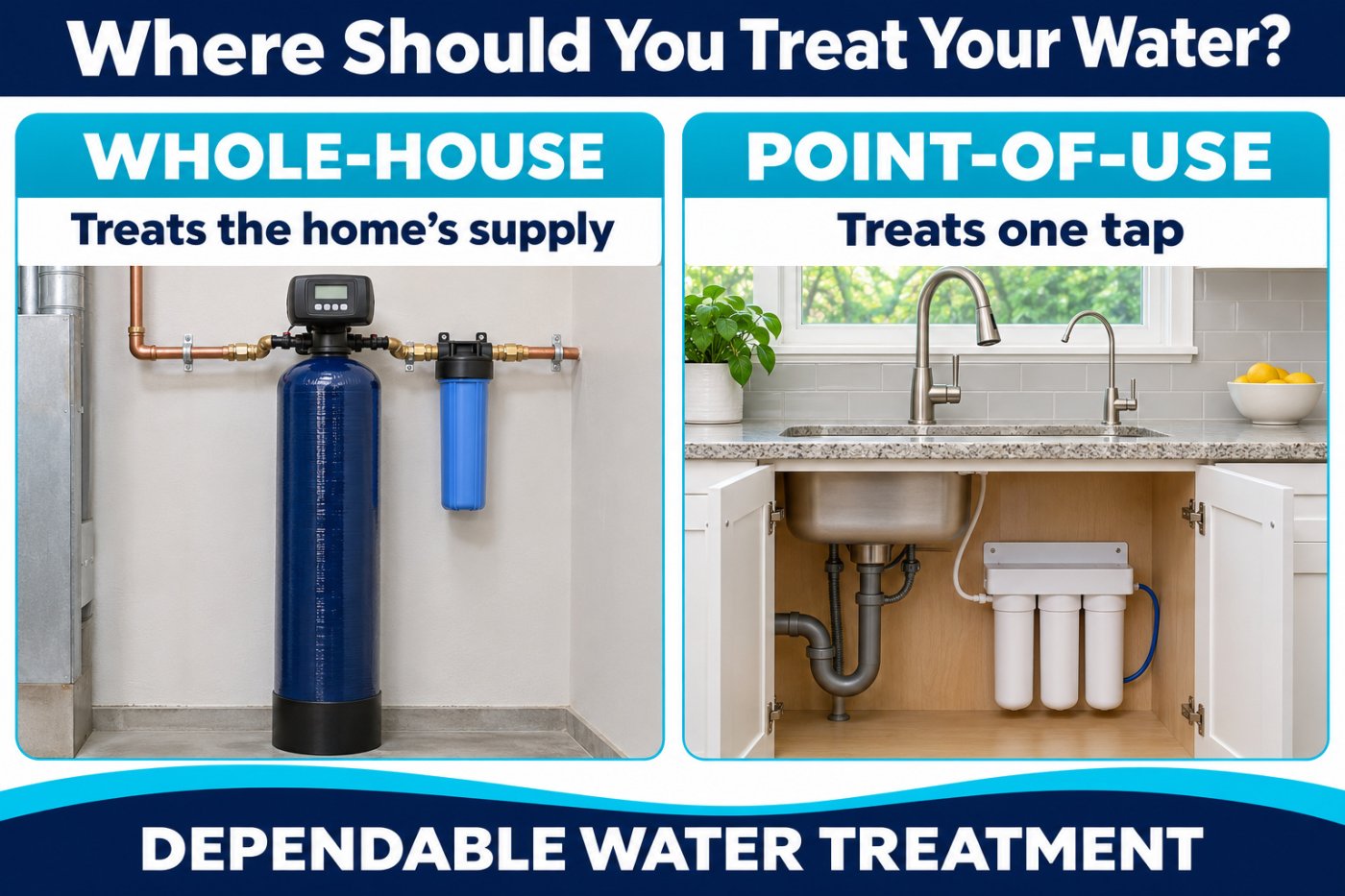
Short answer. Treat the water where the problem shows up. Hardness that leaves scale throughout the house, iron that stains fixtures, and sulfur odor in the incoming water can call for a whole-house system. If the concern is limited to the water you drink and cook with, a point-of-use system at the kitchen sink may be enough. Some Florida homes use both.
It is easy to get this backwards. Homeowners often buy a small drinking-water filter to fix a problem that is really in every pipe in the house, or install a large whole-house system to solve something that only needed a filter under the sink. Knowing the difference saves frustration, and it starts with understanding what each type actually does.
What Whole-House and Point-of-Use Mean
A whole-house system, also called point-of-entry, is installed where the water line enters your home, so it treats the water going to taps, showers, appliances, and the water heater downstream of the system. A point-of-use system treats water at a single location, most commonly a reverse osmosis unit or filter at the kitchen sink for drinking and cooking.
| Problem | Where it matters | Typical approach |
|---|---|---|
| Hard water and scale | Fixtures, appliances, water heater, and laundry | Whole-house |
| Iron staining | Tubs, toilets, laundry, fixtures | Whole-house |
| Sulfur (rotten egg) smell | Multiple hot and cold taps if it comes from the supply | Whole-house if confirmed in the incoming water |
| Chlorine taste and smell | Drinking, cooking, and sometimes showers | Point-of-use carbon for drinking and cooking, or whole-house carbon if needed throughout |
| Taste from dissolved minerals or salts | Drinking and cooking | Point-of-use reverse osmosis where appropriate |
| Contaminants identified by testing | Depends on how you are exposed | Choose the treatment and location for the specific contaminant |
When Whole-House Treatment Makes Sense
If a problem from the incoming water shows up throughout your home, treating it where the water enters can protect all the fixtures and appliances it reaches. Hardness is the classic example. It leaves scale in your pipes, water heater, and appliances, well beyond the reach of a filter at one sink. Iron in the supply can stain tubs and laundry, and hydrogen sulfide can cause a rotten egg smell at multiple taps. If the smell is only in the hot water, check the water heater first. Our article on why some Florida homes need both a softener and a carbon filter explains how the pieces fit together.
If chlorine bothers you only in a glass of water, a kitchen carbon filter may be enough. Removing the disinfectant at the point of entry can make it easier for germs to grow in your home’s plumbing. Consider that trade-off before choosing whole-house carbon, and maintain any filter on the manufacturer’s schedule.
When Point-of-Use Makes Sense
If you only need to treat the water you drink and cook with, a point-of-use system can handle that at the kitchen sink. An under-sink reverse osmosis system can reduce many dissolved substances and often delivers treated water through a separate faucet. For a health concern, check that the specific model is independently certified to reduce the contaminant your test found. Some contaminants can also be a concern during bathing or cleaning, so ask your local health department what treatment and precautions you need. We cover how it works in our article on how reverse osmosis systems purify your water. Point-of-use units are also a good fit when you want extra polishing for drinking water on top of whole-house treatment.
Why Many Homes Use Both
The two approaches can work together. For example, a softener can help protect plumbing and appliances from scale while a kitchen reverse osmosis unit reduces the dissolved substances you want to address in drinking water. Scale can build up on the membrane, and chlorine can damage some membranes. Check the manufacturer’s limits for the incoming water. Some systems already include a carbon prefilter for chlorine.
A refrigerator filter or a pitcher treats the water you draw from it. A problem throughout the house needs treatment where the water enters. We explain why in our article on the refrigerator filter myth.
How to Decide for Your Home
Start with what is actually in your water. Your utility’s annual water quality report is a starting point if you’re on public water. For a private well or a specific health concern, ask a state-certified drinking water lab what to test for. Then consider where the problem shows up and how you use the water. Guessing is how people end up buying the wrong equipment. Our article on how to determine what water treatment your home needs walks through the process step by step.
Not sure whether you need whole-house treatment, a drinking water system, or both? We can test your water and point you in the right direction. Call Dependable Water Treatment at 407-242-7150 or contact us online to schedule a water test.