Every Florida homeowner knows the hurricane preparation checklist — batteries, water bottles, plywood, a full tank of gas. But fewer homeowners think through what actually happens to their water supply during and after a storm, and how that affects both their household plumbing and any water treatment equipment they rely on every day. Understanding the risks helps you prepare properly and know what to check once the storm has passed.
What Happens to Municipal Water During a Hurricane
Municipal water systems face several distinct threats during a major storm, and understanding them helps explain why boil water notices are so common in the aftermath of Florida hurricanes.
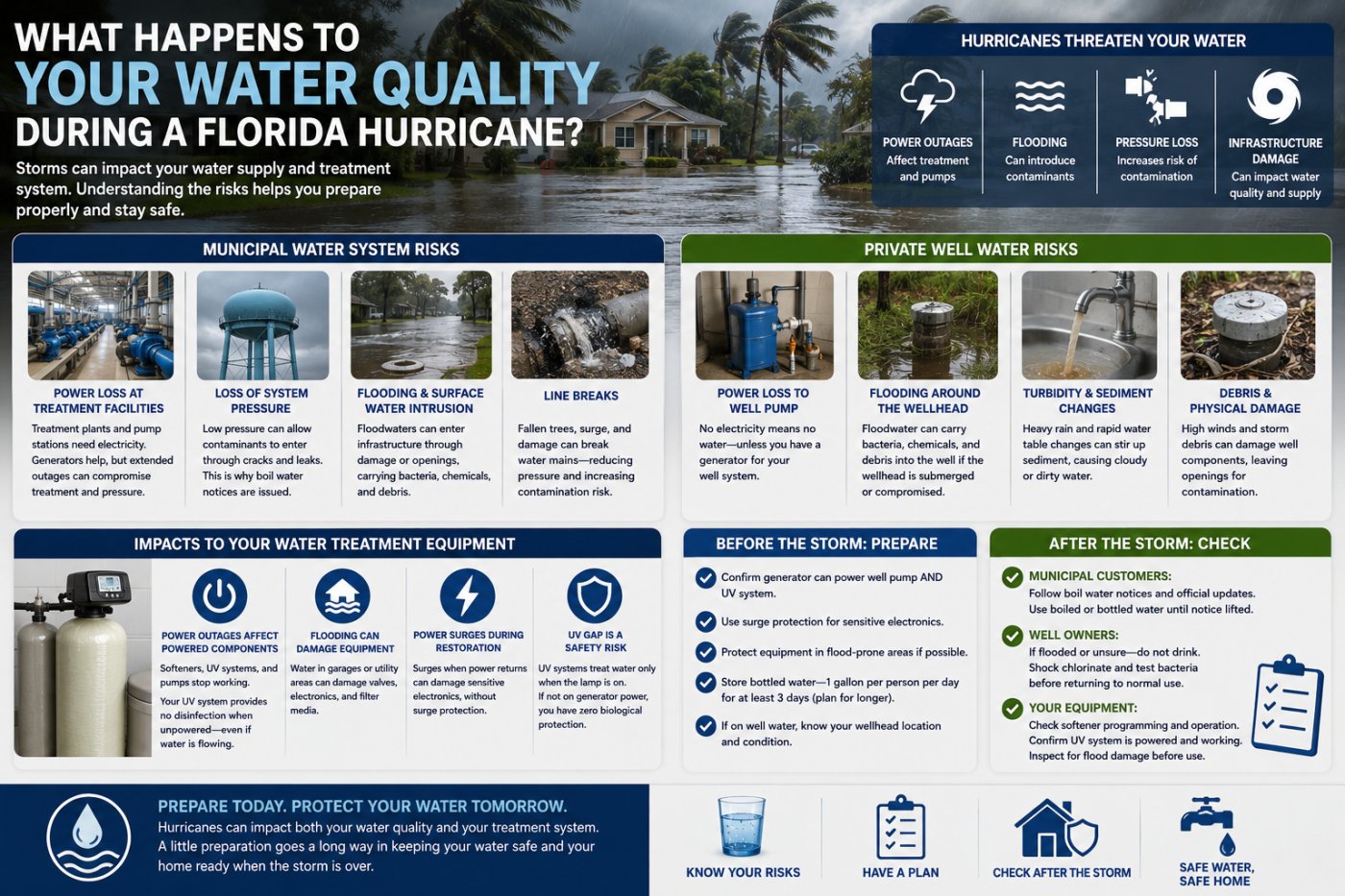
Power outages at treatment facilities. Water treatment plants and the pump stations that maintain pressure throughout the distribution system require electricity to operate. While most facilities have backup generators, extended outages — especially widespread ones affecting fuel delivery for generators — can compromise a utility's ability to maintain full treatment and adequate system pressure.
Loss of system pressure. This is one of the most significant risks. Water distribution systems are designed to maintain positive pressure throughout the network, which keeps contaminants from entering the pipes. When pressure drops — due to pump failures, power loss, or major line breaks from storm damage — the risk of contamination entering the system through cracks, joints, or compromised sections increases significantly. This is the primary reason utilities issue boil water notices after major storms, even when there's no confirmed contamination — it's a precautionary measure responding to the pressure loss risk.
Flooding and surface water intrusion. Storm surge and heavy flooding can allow surface water — carrying bacteria, chemicals, debris, and other contaminants — to enter water infrastructure through damaged pipes, exposed connections, or compromised treatment facilities. This is a particular concern in low-lying areas and coastal communities that experience storm surge.
Line breaks. Fallen trees, storm surge, and general infrastructure stress during a hurricane frequently cause water main breaks. Each break is a potential entry point for contamination and a factor reducing system-wide pressure.
What Happens to Well Water During a Hurricane
Private well owners face a different set of risks, tied more directly to their own property and equipment rather than a larger distribution network.
Power loss to the well pump. Most residential well systems rely on an electric pump to draw water from the aquifer and maintain pressure in the home's plumbing. A power outage means no water at all until power is restored, unless you have a generator connected to your well system.
Flooding around the wellhead. This is one of the most serious risks for Florida well owners during hurricane season. If floodwater rises above or near the wellhead — the point where the well casing meets the surface — surface water and everything it's carrying (bacteria, chemicals, debris, agricultural runoff, sewage in severe flooding situations) can potentially enter the well. A properly constructed well with the wellhead elevated above expected flood levels and a sanitary seal in good condition significantly reduces this risk, but it doesn't eliminate it entirely in extreme flooding events.
Turbidity and sediment changes. Even without direct floodwater intrusion, heavy rainfall and rapid changes in water table levels during and after a hurricane can temporarily increase sediment and turbidity in well water, as the rapid water movement disturbs the aquifer and surrounding soil.
Debris and physical damage. High winds can damage well caps, casings, and above-ground equipment, creating pathways for contamination even without flooding, simply from physical damage to the well's protective components.
What This Means for Your Water Treatment Equipment
Beyond the water supply itself, your water treatment system faces its own set of hurricane-related risks.
Power outages affect powered components. Water softener control valves, UV disinfection systems, and any pump-assisted RO systems all require electricity to function. During an extended outage, these systems simply stop operating — your softener won't regenerate, and critically, your UV system won't provide any disinfection, even though water may still be flowing through the household plumbing via gravity or a generator-powered well pump.
This UV gap is particularly important to understand. As covered in our article on how UV disinfection works, UV systems provide no residual protection — they only treat water as it passes through the chamber while the lamp is powered and functioning. If your well pump is running on generator power but your UV system isn't connected to that same generator circuit, your water is receiving zero biological treatment even though it's flowing normally through your taps. This is an easy oversight during storm preparation that has real safety implications.
Flooding can damage equipment directly. Water treatment systems installed in garages, utility closets, or ground-level mechanical rooms are vulnerable to direct flood damage if water intrusion reaches the equipment itself — potentially damaging control valves, electronic components, and filter media.
Power surges during outage recovery. As power is restored across affected areas, surges and irregular voltage are common. Sensitive electronic components in control valves, UV controllers, and RO system components can be damaged by these surges if not protected.
Hurricane Preparation for Your Water System
Before the storm:
- If you have a generator, confirm it can power your well pump and ideally your UV disinfection system together, not just one or the other
- Consider surge protection for sensitive water treatment electronics if you don't already have it
- If your treatment equipment is in a flood-prone location, know what you can reasonably do to protect it, and understand that some risk to ground-level equipment may be unavoidable in severe flooding
- Store an emergency supply of bottled water as your primary backup — the standard recommendation is one gallon per person per day for at least three days, and Florida emergency management guidance suggests planning for longer given the potential for extended outages
- If you're on well water, know the location and condition of your wellhead and sanitary seal before storm season, so you have a baseline to compare against afterward
After the Storm: What to Check
For municipal water customers:
Follow your utility's guidance regarding boil water notices — these are typically issued as a precaution after significant pressure loss or known line breaks, and should be followed even if your water looks and smells normal, since contamination isn't always detectable by sight or smell. Boil water notices are typically lifted only after the utility has confirmed water quality through testing, so follow official updates rather than assuming your water is fine once service is restored.
For well water owners:
If your wellhead experienced any flooding, or if you have any reason to suspect contamination, don't use the water for drinking or cooking until it's been tested. A shock chlorination of the well — a disinfection procedure using a chlorine solution circulated through the well and plumbing system — is commonly recommended after any flooding event affecting a well, followed by bacteria testing to confirm the water is safe before returning to normal use.
For your water treatment equipment:
Once power is restored, check that your softener resumed normal operation and hasn't lost its programming due to the outage — many control valves retain settings through a battery backup, but extended outages can sometimes require reprogramming. Confirm your UV system is powered and operating — check for the indicator light or alarm status most systems display. If your equipment experienced any flooding, have it professionally inspected before returning it to service rather than assuming it's fine, since water intrusion into electronic components isn't always immediately obvious.
The Bottom Line
Hurricanes create real, if often temporary, water quality risks for both municipal and well water Florida homeowners — from pressure loss and potential contamination in city systems to flooding risks and power-dependent treatment gaps for well owners. Understanding these risks before storm season lets you prepare more effectively, and knowing what to check afterward helps ensure your water and your treatment system are both back to full, safe operation once the storm has passed.
Have questions about protecting your water treatment system before hurricane season, or need an inspection after a storm? Dependable Water Treatment is here to help Florida homeowners. Contact us for guidance or service.