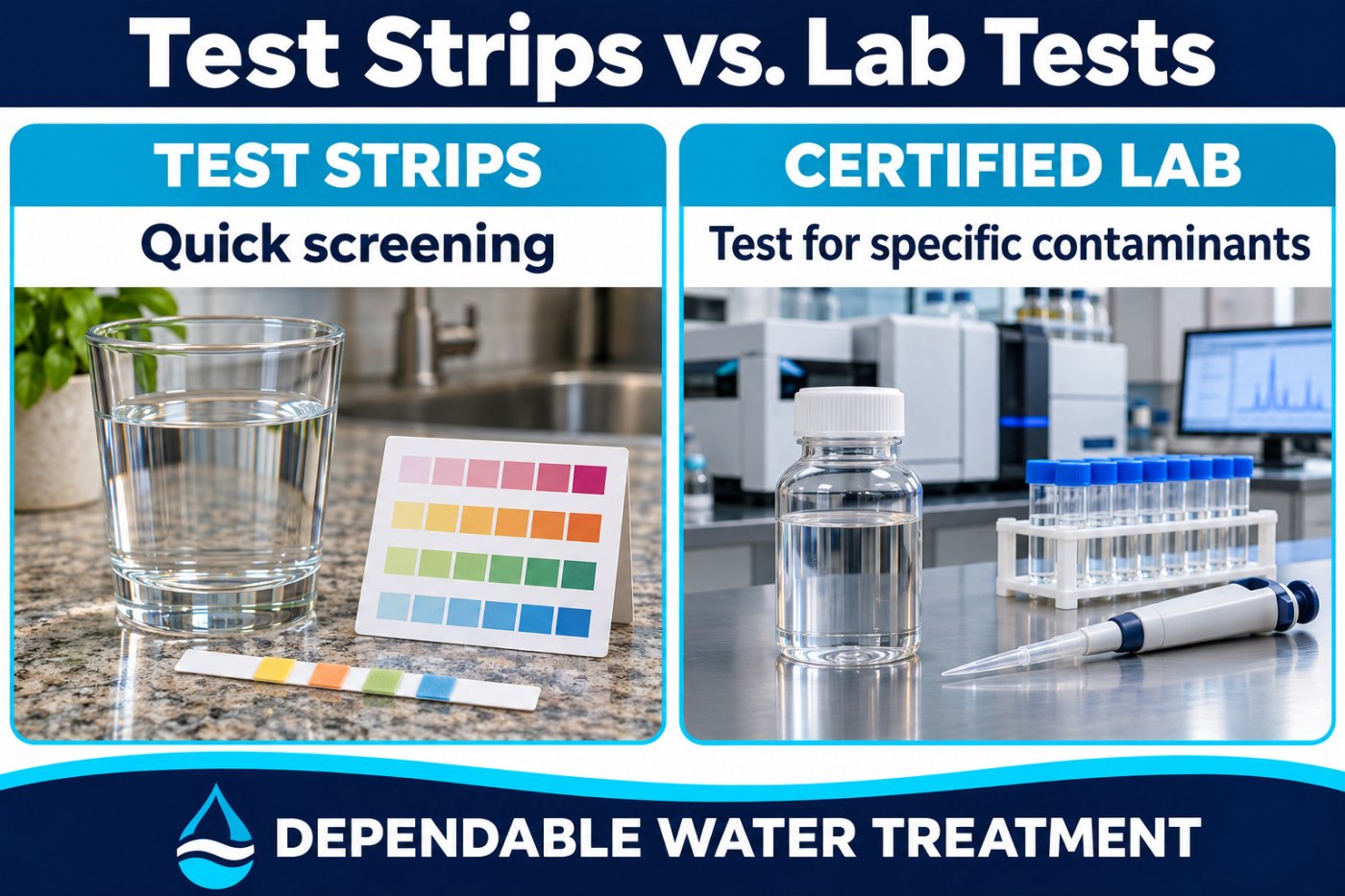
Short answer. Test strips can give you a rough reading for things like hardness, chlorine, or pH. An on-site professional test can help you choose treatment equipment. If you are checking drinking water for bacteria, lead, or other contaminants that can affect your health, use a state-certified drinking water lab that can test for the specific concern.
Home test kits are everywhere, and they are tempting because they are fast and easy. They can be useful, but only if you understand what they were built to do. Here is how the main options compare so you can pick the right one for the question you are asking.
The Main Types of Water Tests
| Test type | Best for | Main limits |
|---|---|---|
| Test strips | A quick, rough look at things like hardness, chlorine or pH | Color matching is subjective, strips can expire or be affected by moisture, and they cannot detect many contaminants |
| Drop-count (titration) kits | A more detailed hardness reading than many strips provide, depending on the kit | Each kit measures specific parameters, and results depend on careful technique |
| On-site professional test | Hardness, iron, pH, chlorine, and other measurements that help guide treatment | What it can measure depends on the methods and equipment |
| State-certified laboratory test | Specific health concerns, such as coliform bacteria, nitrate, or lead | Takes longer, requires careful sampling, and covers the tests you order |
Where Test Strips Fall Short
Strips work by changing color, and you compare that color to a chart. Lighting, the way you read the color, how long you wait, and how the strip was stored can all change the result. A strip that sat in a humid cabinet can give a wrong reading. Each strip is designed for specific measurements and ranges. A result in the expected range tells you about that measurement alone.
That matters most when someone is making a decision from the result. A broad hardness range can leave you guessing about how to size a softener. An ordinary strip reading also cannot establish whether water is safe to drink. Use strips for a first look, then choose the test that answers the question you have.
When You Need a Lab
Certain questions call for a state-certified laboratory. Bacteria testing is a clear example, particularly for private wells, where the owner is responsible for testing. The CDC recommends testing private wells at least once a year for total coliform bacteria, nitrate, total dissolved solids, and pH. Ask your local health department what else to test for, and confirm that the lab is certified for the specific tests you need, such as lead. A lab report gives you a record of what was measured.
How you collect the sample matters a great deal. Get the lab’s instructions before you turn on the tap. Use the container it provides and follow its directions for where to sample, how to store the sample, and when to deliver it. A lead sample may need the first water from a tap after it has sat unused, while a bacteria sample needs a sterile bottle.
What a Professional Test Adds
An on-site professional test sits in the middle. With the right methods and equipment, it can measure things that guide treatment, such as hardness, iron, pH, and chlorine. Ask what is being measured and how the results affect the equipment recommendation. That interpretation is the part people underestimate. A number on its own is not a recommendation, and the right equipment depends on how several results fit together. We explain what a thorough test measures in our article on what a professional water test measures, and how those results turn into a plan in our article on how to determine what water treatment your home needs.
A Simple Way to Choose
- Just curious? A strip can give you a rough first look, as long as you remember its limits.
- Choosing treatment equipment? Get a professional test so the equipment is matched to your actual water.
- Worried about drinking safety, bacteria or metals like lead? Use a state-certified laboratory.
- Not sure? Ask before you buy anything. The right test depends on the question.
Want to know what is really in your water? We can test it and explain the results in plain language. Call Dependable Water Treatment at 407-242-7150 or contact us online to schedule a water test.