If you've purchased a new construction home in Florida and assumed the builder took care of the water quality — you're not alone. It's a reasonable assumption. The home is brand new. Everything was just installed. Surely someone thought about the water, right?
In most cases, they didn't. And understanding why helps you avoid the costly mistake of assuming your new home's water is being properly treated when it isn't.
What Builders Are Required to Do — and What They're Not
Florida builders are required to connect homes to an approved water source — either a municipal supply or a permitted well. They're required to install plumbing that meets code. They are not required to install water treatment equipment beyond what's necessary to meet basic safety standards.
Hard water is not a safety issue by regulatory definition. Iron staining is not a code violation. The taste and odor of chloramines doesn't trigger any building requirement. From a code compliance standpoint, a builder can hand you the keys to a brand new home with water that's aggressively hard, full of iron, and laced with chemical disinfectants — and be in full compliance with every applicable requirement.
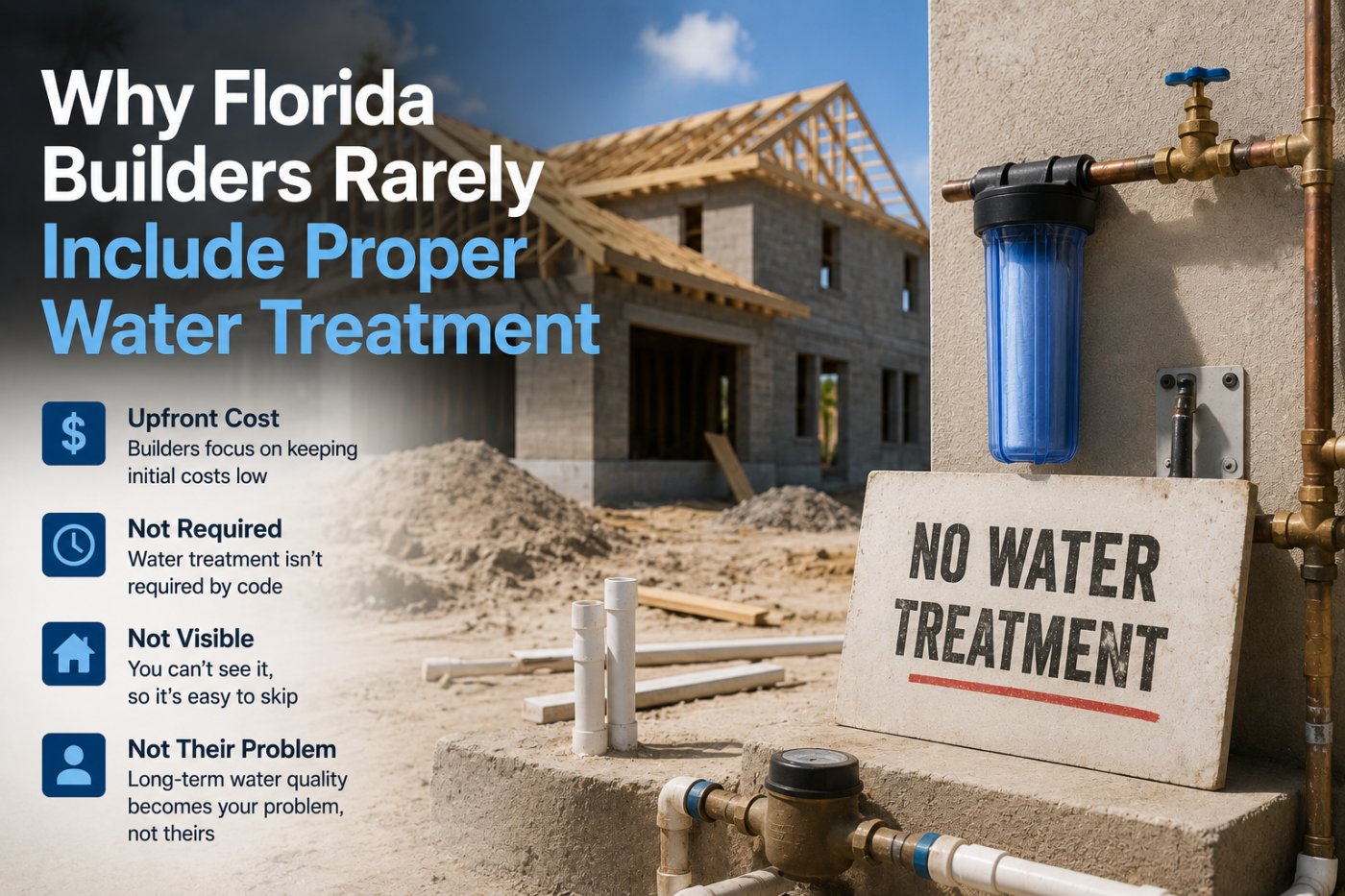
Water treatment is considered an upgrade, not a standard feature. And in production homebuilding — where margins are tight and costs are controlled at every turn — upgrades that aren't required don't get included.
The Economics of Production Homebuilding
To understand why builders skip water treatment, you have to understand how production homebuilding works.
Large builders construct hundreds or thousands of homes per year using standardized plans, standardized materials, and carefully controlled cost structures. Every dollar added to the base cost of a home either reduces the builder's margin or gets passed directly to the buyer — and in a competitive market, builders work hard to keep base prices attractive.
A whole-house water softener and filtration system for a Florida home costs roughly $1,000 to $3,000 installed. Across a subdivision of 300 homes, that's $300,000 to $900,000 in added cost. Builders don't absorb that — they eliminate it.
The calculation is simple: water treatment isn't required, most buyers don't ask about it specifically, and leaving it out saves money. So it gets left out.
The "Upgrade" Trap
Some builders do offer water treatment as an optional upgrade — typically through their preferred vendors at a significant markup. If you're in the process of buying a new construction home in Florida, you may have seen water softeners or filtration systems offered as add-ons during the design center selection process.
These upgrades are often priced considerably higher than what you'd pay to have the same system installed by an independent water treatment company after closing. Builder upgrade markups of 30 to 50 percent above market rate are common — because the design center is a profit center, and buyers in the excitement of choosing finishes and features are less likely to price-shop aggressively.
If you're buying new construction and considering a water treatment upgrade through the builder, it's worth getting independent quotes for comparison before committing.
New Plumbing Doesn't Mean Protected Plumbing
One of the biggest misconceptions new construction buyers have is that brand new pipes and appliances don't need protection yet — that water treatment is something to think about later, after the home has had some time to settle.
This misunderstands how hard water damage works. Scale begins forming on day one. The moment hard water starts flowing through your brand new water heater, mineral deposits begin accumulating on the heating element. From the first cycle of your new dishwasher, scale is building up on its components. Your new pipes begin accumulating mineral deposits from the first day water flows through them.
New appliances are actually at a critical point — protecting them from the start gives you the full designed lifespan. Waiting even a year or two means that lifespan is already being shortened, and some of that damage is permanent.
The best time to install a water softener in a new construction home is before you move in — or as close to move-in as possible.
The Well Water Problem in New Developments
Florida continues to see significant development in areas served by well water rather than municipal supplies — particularly in rural and semi-rural communities, and in areas where municipal infrastructure hasn't caught up with growth.
When a builder installs a well for a new home, they're required to meet certain standards for well construction and initial water testing. But that initial test is typically a basic safety screen — checking for coliform bacteria and a limited set of contaminants. It is not a comprehensive water quality analysis.
The hardness level, iron content, sulfur, pH, and other characteristics that determine what water treatment your home needs are often not part of the builder's standard testing. You may receive a new home with well water that passes the builder's required tests and still has aggressive hardness, significant iron, or sulfur odor that needs treatment.
Don't assume the builder's water test tells the whole story. A comprehensive independent water test after closing gives you the complete picture.
What Builders Install That Can Actually Create Water Quality Issues
Here's something that surprises many new homeowners: some of the standard materials and components builders use in new construction can actually contribute to water quality problems.
Copper plumbing in low-pH water. If your water has low pH (acidic water — common in some Florida well water situations), it can leach copper from brand new copper pipes and fittings. This gives water a metallic taste and can cause blue-green staining in sinks and tubs. New copper plumbing in an acidic water home can create a water quality issue that didn't exist before the home was built.
Water heater anode rods and sulfur. As covered in our sulfur water article, the magnesium anode rod in a standard water heater can react with sulfur compounds in the water to amplify hydrogen sulfide odor. A brand new water heater in a home with sulfur in the water can produce worse sulfur odor than the source water alone.
PVC and cross-linked polyethylene (PEX) piping. Modern homes increasingly use PEX tubing rather than copper. While PEX doesn't have the copper leaching issue, it can impart a plastic taste to water in new installations — particularly in the first weeks or months after a home is completed. This typically dissipates with use, but combined with other water quality issues, it can be a noticeable problem.
The Assumption Gap
The fundamental problem is an assumption gap between what buyers expect and what builders deliver.
Most buyers assume their new home comes with water that's been thought about and properly addressed. Builders assume buyers know that water treatment is their responsibility. Neither side has the conversation explicitly, and the result is a new homeowner who discovers six months in that their brand new water heater already has scale buildup, their dishes spot immediately, and their water smells odd — and they don't understand why.
The solution is simple: ask. Before closing on any new construction home in Florida, ask the builder specifically what water treatment is included. Get the answer in writing. And if the answer is "none" — which it usually is — plan for independent water treatment installation as part of your move-in process.
What to Do When You Move Into a New Construction Home
If you're moving into a new construction Florida home — or if you've recently moved in and haven't addressed water treatment yet — here's the practical path forward:
Get a comprehensive water test. Don't rely on the builder's test results. An independent water test measures hardness, iron, pH, bacteria, sulfur, chlorine or chloramines, and other factors that determine what treatment your home needs.
Install water treatment before or shortly after move-in. The sooner treatment is in place, the more of your new appliances' designed lifespan you protect. Every month of untreated hard water is a month of scale accumulation that can't be undone.
Don't overpay for builder upgrades. If you haven't closed yet and are considering the builder's water treatment upgrade, get independent quotes first. The same or better system may be available for significantly less through an independent water treatment company.
Consider the whole picture. A water softener addresses hardness. Depending on your water test results, you may also need iron filtration, carbon filtration for chloramines, UV disinfection for well water bacteria, or other components. Build the right system for your specific water — not just the one that was convenient to install.
The Bottom Line
Florida builders leave water treatment out because they're not required to include it and it adds cost. That's the simple truth. It's not negligence — it's economics. But it leaves new homeowners with a gap between the pristine new home they purchased and the water quality that home actually has.
Your new appliances, new pipes, new fixtures, and new plumbing are all starting their clock on day one. Hard water starts its damage on day one too. The sooner you address your water quality, the more of that investment you protect.
Moving into a new Florida home? Dependable Water Treatment tests your water and installs the right treatment system from day one — so your new appliances and plumbing get the protection they deserve from the start. Contact us before or after closing.