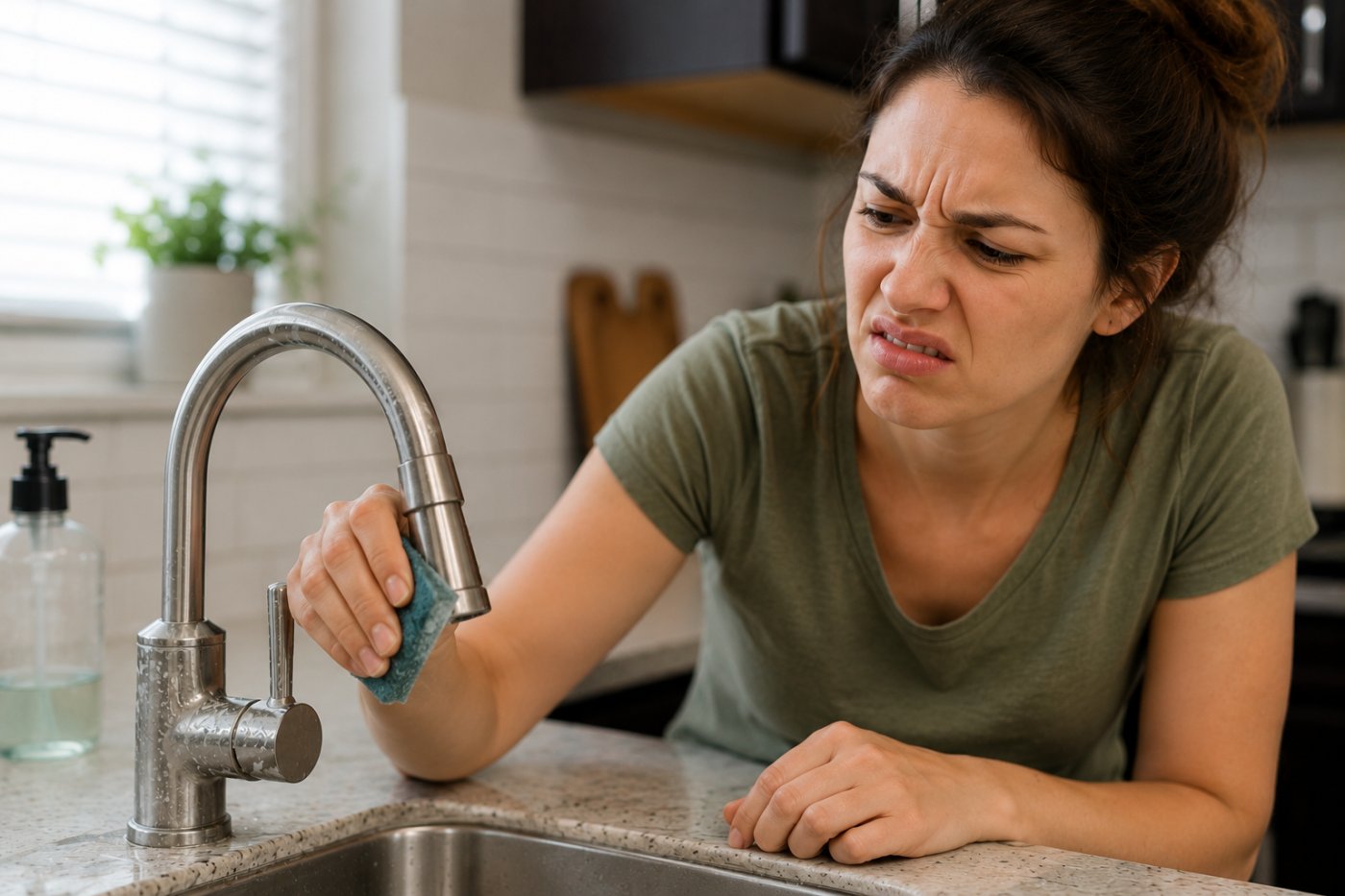
You've scrubbed it. You've sprayed it. You've tried every cleaner under the sun. And within a few days, that white crusty buildup is right back on your faucets, showerhead, and around your sink drain like it never left.
It's one of the most frustrating things about living in Florida — and it's not a cleaning problem. It's a water problem.
Here's what's actually going on and why no amount of scrubbing is going to fix it long-term.
That White Stuff Has a Name
The white, chalky, sometimes rock-hard residue you're seeing is called limescale — and it's a direct result of hard water.
Hard water is water that contains high concentrations of dissolved calcium and magnesium. These minerals are naturally present in Florida's groundwater because the entire state sits on top of a massive limestone shelf. As rainwater filters down through that limestone over thousands of years, it picks up calcium and magnesium along the way. By the time it reaches your tap, it's carrying a significant mineral load.
When that water hits your faucet, showerhead, or any surface and then evaporates — the water disappears but the minerals don't. They stay behind, and over time they bond together into that stubborn white crust you keep battling.
Why Florida Is Especially Bad for This
Hard water exists all over the country, but Florida is consistently ranked among the hardest water states in the nation. The geology here makes it almost unavoidable.
Water hardness is measured in grains per gallon (GPG) or parts per million (PPM). Anything above 7 GPG is considered hard. Many areas of Central Florida — including communities around Orlando, Kissimmee, Saint Cloud, and beyond — regularly test between 10 and 20 GPG or higher. That's not just hard. That's very hard.
If you're on a private well, it can be even worse. Well water pulls directly from the aquifer with no treatment in between, which means you're getting the full mineral content with nothing removed.
Where You'll See It First
Limescale doesn't show up randomly. It tends to appear wherever water flows and then evaporates — which means you'll notice it in predictable spots:
- Faucet aerators — that little mesh screen at the tip of your faucet gets clogged with mineral deposits, reducing your water flow over time
- Showerheads — the small nozzle holes get blocked, turning a strong spray into an uneven trickle
- Around drain openings — where water pools and then evaporates repeatedly
- Glass shower doors — those white spots and streaks that never seem to fully wipe away
- Inside your kettle or coffee maker — that flaky white residue floating in your morning coffee is limescale
- Dishwasher interior and dishes — spots and film on glasses even straight out of a clean cycle
It's Not Just Ugly — It's Damaging
Here's where it goes from annoying to actually costly.
Limescale buildup inside your pipes restricts water flow over time. Inside your water heater, it acts as an insulating layer between the heating element and the water — which means your heater has to work harder and use more energy to heat the same amount of water. Studies have shown that hard water can reduce a water heater's efficiency by 20 to 30 percent over time.
Your appliances — dishwasher, washing machine, ice maker — all have valves, seals, and internal components that hard water slowly destroys. The average lifespan of major appliances in hard water homes is significantly shorter than in homes with treated water.
So while the white buildup on your faucet looks like a cosmetic nuisance, it's actually a symptom of the same mineral activity that's quietly shortening the life of everything water touches in your home.
Why Cleaning Products Only Treat the Symptom
Acidic cleaners — things like white vinegar, CLR, or lime-removal sprays — work by dissolving the calcium deposits chemically. And they do work, temporarily. The acid breaks down the mineral bonds and the buildup wipes away.
But the moment hard water starts flowing again, the process starts over. You're not fixing the source. You're just cleaning up after it, over and over again.
It's the equivalent of mopping up a slow leak instead of fixing the pipe. You'll be mopping forever.
What Actually Solves the Problem
The only real solution is treating the water before it reaches your faucets — which means addressing the hardness at the point it enters your home.
A whole-home water softener does exactly that. Through a process called ion exchange, the softener removes calcium and magnesium from your water supply before it ever reaches a faucet, showerhead, or appliance. Softened water doesn't leave mineral deposits because the minerals have already been removed.
The difference is noticeable almost immediately:
- Faucets stay clean with normal wiping
- Showerheads maintain full pressure and even spray
- Glass shower doors stop developing that permanent haze
- Dishes come out of the dishwasher actually spotless
- Your water heater runs more efficiently
- Appliances last longer
And your cleaning routine gets dramatically simpler — because you're no longer fighting a problem that's being continuously recreated.
What About Water Filters?
A standard water filter won't solve your limescale problem. Filters are designed to remove contaminants — chlorine, sediment, bacteria, iron — not hardness minerals. If you install a carbon filter hoping it'll stop the white buildup, you'll be disappointed.
Some people ask about salt-free water conditioners as an alternative to traditional softeners. These systems don't remove hardness minerals but instead change their structure so they're less likely to stick to surfaces. They can reduce scaling to some degree, but they don't deliver the same results as a true ion-exchange softener — especially in Florida's extremely hard water conditions.
For consistent, long-term results in this part of the country, a properly sized water softener is the proven solution.
How to Know How Bad Your Water Actually Is
If you want to know exactly how hard your water is, you have a few options:
- Basic test strips — available at hardware stores, give you a rough reading in minutes
- Mail-in water test — more comprehensive, tests for hardness along with iron, pH, bacteria, and other factors
- Professional water test — the most accurate option, and it gives you a complete picture of everything in your water so you can make informed decisions about treatment
Knowing your actual hardness level matters because it determines what size softener your home needs and how to set it up correctly.
Stop Fighting Your Faucets
If you're tired of the white buildup, the spotted dishes, the weak showerhead spray, and the endless cleaning — the fix isn't a better cleaner. It's better water.
At Dependable Water Treatment, we help Florida homeowners get to the root of their water problems instead of just managing the symptoms. Whether you're on city water or a private well, we'll assess what's actually in your water and recommend a solution that makes sense for your home and your budget.
Reach out to us at 407-242-7150 and let's talk about what's really going on with your water.