Bottled water is the most common workaround Florida homeowners reach for when they don't trust their tap water. It's convenient, it's familiar, and it feels like a solution. But if you're spending money on bottled water because your tap water tastes bad, smells odd, or just doesn't seem right — you're treating one symptom of a whole-house problem while the rest of the problem continues unchecked.
Here's why bottled water is never the real answer.
Bottled Water Only Solves One Problem Out of Many
When people switch to bottled water, they're addressing one thing: what they drink and sometimes what they cook with. That's it.
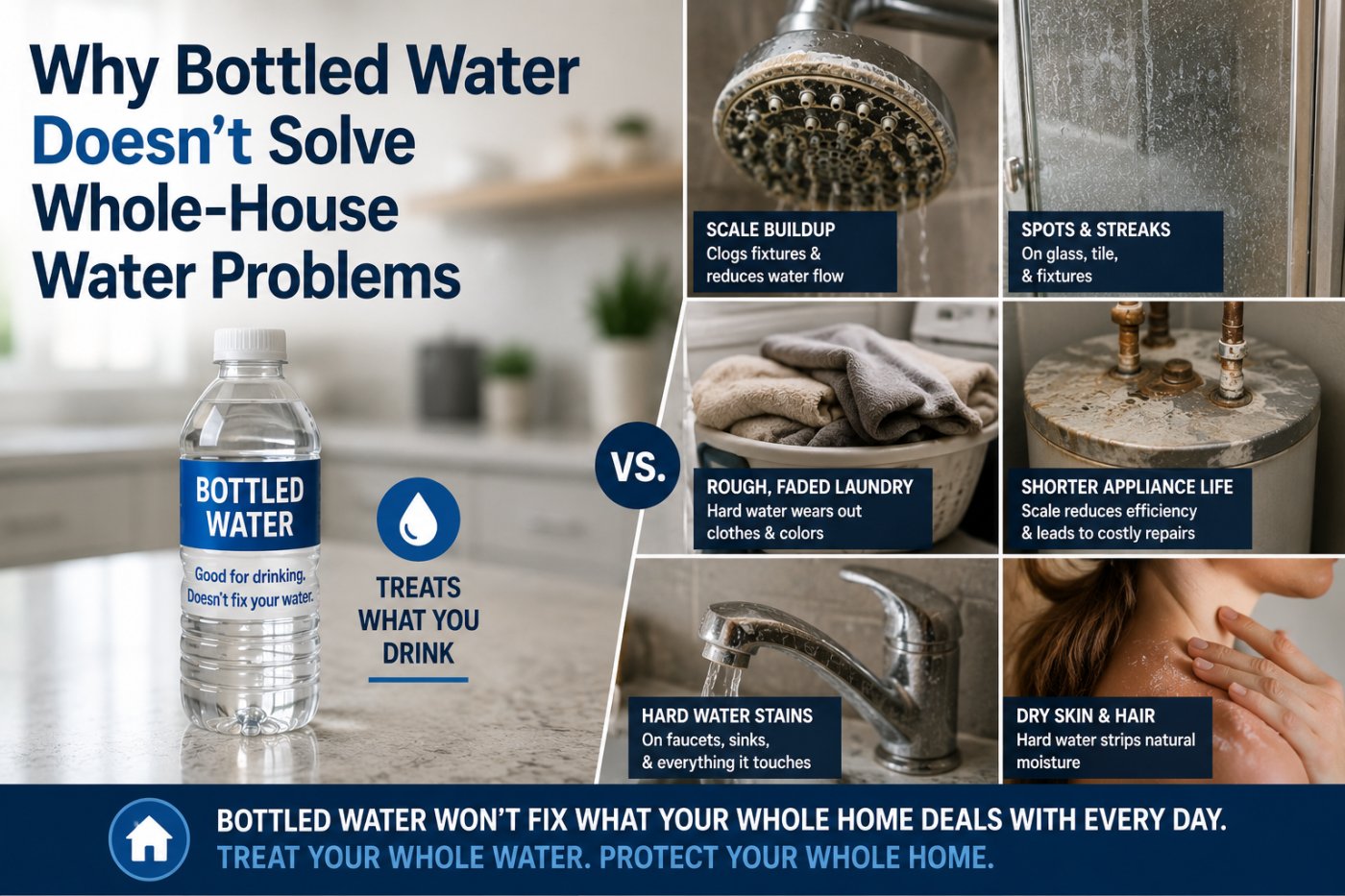
The hard water running through your home doesn't care that you're drinking from a plastic bottle. It's still scaling your water heater. It's still clogging your showerhead. It's still spotting your dishes. It's still making your laundry stiff and dull. It's still drying out your skin every time you shower. It's still damaging your washing machine, your dishwasher, and your pipes.
Bottled water doesn't touch any of that. You're paying for the illusion of a water solution while the actual water problem continues doing damage throughout your entire home.
The Real Cost of Bottled Water Adds Up Fast
Most people don't sit down and calculate what they actually spend on bottled water over time — because if they did, the number would be uncomfortable.
Consider a family of four that buys two cases of 24-count bottled water per week at roughly $6 to $8 per case. That's $12 to $16 per week, or $625 to $830 per year — just for drinking water. Many families spend significantly more, particularly if they're also buying larger jugs for a countertop dispenser.
Over five years that's $3,000 to $4,000. Over ten years, $6,000 to $8,000. And every dollar of it is gone — no asset, no protection for your home, no improvement to the water running through your plumbing.
A quality under-sink reverse osmosis system — which produces water that rivals or exceeds bottled water quality — costs roughly $300 to $800 installed and produces purified water for pennies per gallon. The math isn't close.
Bottled Water Quality Isn't Always What You Think
There's a widespread assumption that bottled water is purer and safer than tap water. The reality is more complicated.
The FDA regulates bottled water, but the standards are not dramatically stricter than the EPA's standards for municipal tap water. Studies have found that a significant percentage of bottled water is simply municipal tap water that has been filtered and repackaged — sometimes with minimal additional treatment beyond what the utility already does.
Bottled water is also not tested for contaminants as frequently as municipal water. Your city water utility is required to test its water hundreds of times per month and publish the results. Bottled water companies test far less frequently and are not required to publish their results in the same way.
Beyond the quality question, plastic bottles themselves are a concern. Chemicals from plastic packaging — including BPA and other compounds — can leach into water over time, particularly when bottles are exposed to heat. In Florida, where bottles sitting in a hot car or a warm garage is a daily reality, this is a practical concern worth taking seriously.
What Bottled Water Does to the Environment
This isn't the primary focus of a water treatment discussion, but it's worth acknowledging. The United States goes through roughly 50 billion plastic water bottles per year, and the majority of them end up in landfills rather than being recycled.
The energy required to produce, fill, transport, and refrigerate bottled water is dramatically higher than the energy required to treat and deliver tap water. For Florida homeowners concerned about their environmental footprint, a home filtration system is a significantly greener choice than ongoing bottled water consumption — while also delivering better value and better water quality.
The Shower Problem Bottled Water Can Never Fix
Here's a thought experiment: imagine trying to solve your shower water quality with bottled water. You can't. You shower in your tap water. Every morning, the hard minerals, chlorine, and chloramines in your water are in contact with your skin and hair for the duration of your shower.
No amount of bottled water consumption changes what's happening to your skin and hair in the shower. If you've been dealing with dry skin, itchy scalp, or hair that feels brittle and unmanageable — and attributing it to Florida's climate or your personal chemistry — your shower water is very likely a significant factor that bottled water does absolutely nothing to address.
The Cooking and Ice Problem
Most people who switch to bottled water drink it — but they often continue cooking with tap water, making ice with tap water, and running their coffee maker with tap water.
Hard water and chloramines affect the taste of everything cooked in it. Your pasta water, your soups, your coffee, your tea — all of it is made with whatever is in your tap. If the tap water tastes off, the food cooked in it is affected too.
An under-sink reverse osmosis system connected to your kitchen cold tap — and in many cases to your refrigerator water and ice maker line as well — addresses all of this at once. Your drinking water, cooking water, ice, and coffee maker water all come from the same purified source.
What Actually Solves the Problem
The right solution depends on what's in your water — which is why a water test is always the starting point. But for most Florida homeowners, the comprehensive answer looks like this:
A whole-house water softener removes hardness throughout the entire home. Every tap, every shower, every appliance, every load of laundry benefits. Your plumbing and appliances are protected from scale damage. Your skin and hair are no longer exposed to hard mineral water every day.
A whole-house carbon filter removes chlorine and chloramines from all the water entering your home — improving taste and odor at every tap while protecting your plumbing from chloramine's corrosive effects on rubber components.
An under-sink reverse osmosis system at the kitchen sink provides purified drinking and cooking water that rivals the best bottled water — at a fraction of the ongoing cost. Many systems can also connect to your refrigerator for purified ice and chilled water.
This combination addresses your drinking water, your cooking water, your shower water, your laundry water, and your appliance protection — all at once, permanently, and at a total cost that pays for itself compared to ongoing bottled water spending within just a few years.
The Convenience Comparison
One argument for bottled water is convenience — you grab a bottle, you drink it, done. But a home filtration system is actually more convenient once it's installed.
Purified water is available from your kitchen tap any time — no trips to the store, no cases to carry in from the car, no running out at an inconvenient time. Your refrigerator dispenses filtered water and ice automatically. You never have to think about it.
The inconvenience of bottled water — the shopping, the storage, the recycling, the plastic waste — disappears entirely when your home's water is properly treated.
The Bottom Line
Bottled water is an expensive, incomplete, and ultimately unsatisfying response to a water quality problem. It addresses what you drink and nothing else — while the same water that drove you to bottled water in the first place continues damaging your home, affecting your skin and hair, and running up your energy bills through appliance inefficiency.
The real solution is treating your water at the source — before it reaches any tap, any shower, any appliance, or any laundry load in your home. The upfront cost is real, but so is the payback — in appliance protection, energy savings, and the end of the bottled water bill that never actually solved the problem.
If you've been buying bottled water for years, add up what you've spent. Then consider what that money could have bought you instead.
Dependable Water Treatment installs whole-house water softeners, carbon filters, and under-sink reverse osmosis systems for Florida homeowners. Stop paying for bottled water and start treating the problem at the source. Contact us to schedule a water test.