Most Florida homeowners know their water is hard. They've seen the white buildup on the faucets. They've dealt with the spotted dishes and the stiff laundry. They've noticed their skin feels dry after showering. But a lot of people decide to live with it — either because they don't realize how much it's actually costing them, or because the problems seem manageable enough that treatment feels optional.
It isn't optional. It's just a cost you pay later instead of now.
Here's what actually happens to a Florida home when hard water goes untreated year after year.
Year One: The Subtle Signs
In the first year of living with untreated hard water, the effects are noticeable but easy to dismiss.
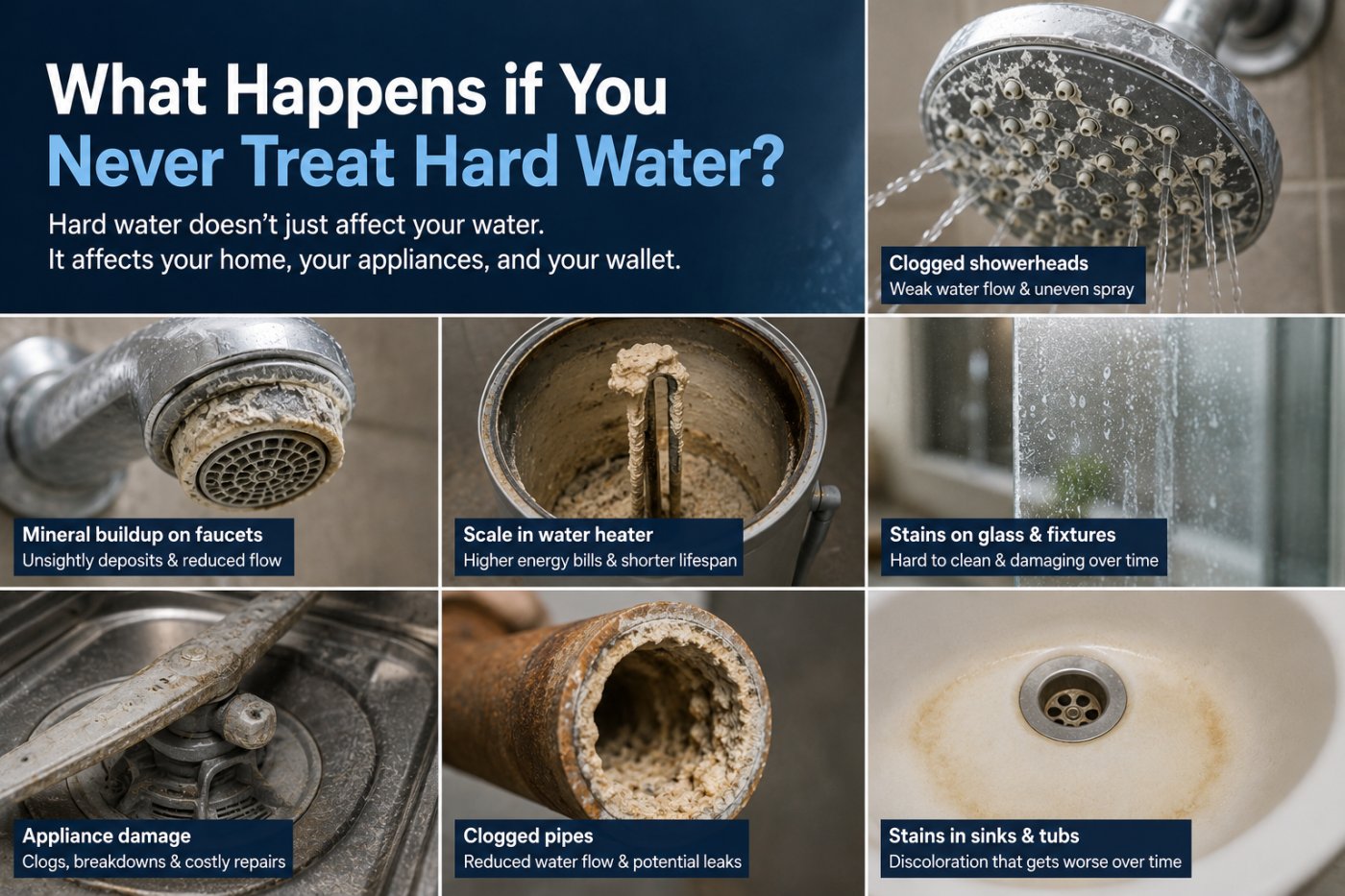
White mineral deposits appear on faucets and showerheads. You clean them off and they come back. Your dishes come out of the dishwasher with spots and a faint film. Your soap doesn't lather quite as well as you'd expect. Your skin feels a little drier than it used to, especially after showering.
Inside your water heater, a thin layer of scale is beginning to form on the heating element. Inside your pipes, microscopic mineral deposits are starting to accumulate on the interior walls. Your dishwasher's heating element is picking up its first layer of scale.
None of this feels urgent. Most people adjust their cleaning routine, buy a different soap, add more detergent, and move on. The hard water keeps working.
Years Two Through Five: The Damage Accelerates
By the second or third year, the effects are harder to ignore.
The scale on your water heater's heating element has thickened. Your water heater is now measurably less efficient — using more energy to heat the same amount of water. Your energy bill has crept up, though it's hard to pin down exactly why. Hot water doesn't seem as hot as it used to, and you're running out of it faster.
Your showerheads need replacing. The spray pattern has gotten bad enough that soaking in vinegar no longer fully restores it. Your faucet aerators are partially clogged and need cleaning or replacement every few months. The grout in your shower has developed a mineral-tinged discoloration that no amount of scrubbing fully removes.
Inside your washing machine, scale is accumulating on components that aren't easy to see or service. The seals and gaskets in your dishwasher are showing early wear from constant exposure to hard, chemically treated water. Your coffee maker needs descaling more frequently — and even after descaling, it doesn't heat water quite as quickly as it used to.
Your light-colored laundry has developed a dull, grayish quality that won't wash out. Towels and bed linens feel noticeably rougher than when they were new.
If you have well water with iron, the orange staining on your toilets, sinks, and tubs has progressed from a nuisance to a stubborn, embedded discoloration that requires serious effort to address.
Years Five Through Ten: Major Costs Begin
This is where untreated hard water stops being an annoyance and starts becoming a significant financial burden.
Your water heater is approaching or has passed the point of no return. In a home with soft water, a water heater installed in year one might still have 5 to 10 years of life left. In your home, scale buildup on the heating element, accelerated anode rod depletion, and repeated thermal stress on the tank lining have shortened that lifespan substantially. You may already be looking at water heater replacement — years ahead of schedule.
The pipes inside your walls have narrowed from years of scale accumulation. Water pressure throughout the house has declined noticeably. Some fixtures show significant pressure loss that cleaning the aerator no longer fully addresses.
Your dishwasher's spray arms are partially clogged, its heating element is heavily scaled, and its cleaning performance has declined to the point where dishes routinely come out with residue. Repair or replacement is on the horizon.
If you have a tankless water heater — often installed because of its efficiency and longevity promises — its heat exchanger passages have been narrowing with scale for years. Efficiency has dropped. The warranty may have already been voided by the manufacturer due to scale damage in a hard water area without documented water treatment.
The plumbing fixtures that seemed fine at year one — faucets, shower valves, toilet fill valves — are showing accelerated wear. The internal components of those fixtures, designed to last 10 to 20 years, are failing in half that time.
Years Ten and Beyond: The Full Cost Becomes Clear
By decade two in a Florida home with untreated hard water, the cumulative cost of never addressing the water quality has become very real.
Water heaters have been replaced at least once — possibly twice — ahead of their designed lifespan. Major appliances have needed repair or replacement years early. Plumbing fixtures have been replaced multiple times. Energy bills have been elevated for years. Cleaning products, descalers, and specialty detergents have been purchased consistently to manage symptoms that never fully go away.
Add it up — early water heater replacement, early dishwasher replacement, early washing machine replacement, elevated energy costs, plumbing repairs, fixture replacements, and ongoing cleaning product expenses — and the cost of never treating hard water in a Florida home can easily reach $5,000 to $10,000 or more over a 15 to 20 year period.
That number doesn't include the daily quality-of-life costs: the skin and hair issues, the water that never tastes quite right, the cleaning that never feels finished, the laundry that never looks truly clean.
What About Your Health?
Hard water is not considered a health risk for most people — calcium and magnesium are minerals your body needs, and drinking hard water isn't harmful. But the daily quality-of-life effects of hard water exposure add up in ways that affect how you feel.
Chronically dry skin from daily hard water exposure is more vulnerable to irritation and infection. Hair that's consistently stripped of moisture by hard water and chemical disinfectants can become brittle and prone to breakage. People with skin conditions like eczema or psoriasis often find their symptoms are significantly worsened by hard water.
These aren't acute health emergencies — but they're real, daily effects that compound over years of exposure.
The Comparison: What Treating Your Water Actually Costs
A whole-house water softener for a typical Florida home typically costs between $1,000 and $2,500 installed, depending on the size and type of system. Ongoing operating costs — salt and periodic maintenance — run roughly $100 to $300 per year for most households.
Over 15 years, the total cost of owning and operating a water softener might be $2,500 to $6,000 depending on the system and usage.
The cost of not treating your water over the same period — in premature appliance replacement, plumbing repairs, elevated energy bills, and ongoing cleaning products — can easily exceed that number several times over.
The math isn't complicated. The question is whether you're paying on the front end with a treatment system, or on the back end with repair bills, replacement costs, and energy waste.
The Things Money Can't Fully Fix
Some of the damage hard water does over time isn't fully reversible even with the best treatment installed later.
Scale that has accumulated inside pipes for years doesn't disappear when you install a softener. A softener stops new scale from forming — but existing buildup remains until it's mechanically addressed or slowly dissolves over time. In severe cases, pipe sections may need replacement.
Glassware that has been etched by years of hard water and harsh dishwasher cycles can't be restored — the surface damage is permanent. Grout that has been stained with mineral deposits for years may never return to its original color. Appliances that have experienced years of scale-accelerated wear have a shortened remaining lifespan even after water treatment is installed.
A water softener installed today protects everything from today forward. It can't undo what the years of hard water already did.
The Bottom Line
Hard water doesn't hurt you all at once. It works slowly, consistently, and quietly — scaling your appliances, wearing out your plumbing, raising your energy bills, and degrading your daily experience of your own home year after year.
The cost of treating your water is real. But it's a fraction of the cost of not treating it — and unlike the slow damage of hard water, it's a cost you control, understand, and get clear value from every single day.
If you've been putting off water treatment because it seems like something you can deal with later, this is what later looks like. The best time to address it was when you moved in. The second best time is now.
Dependable Water Treatment helps Florida homeowners protect their homes, appliances, and plumbing with water softeners and whole-home treatment systems. Contact us to schedule a water test and find out what your water has been doing to your home.