If you've started researching water treatment for your home, you've probably come across the term "whole-house water filtration system" — and you may have found yourself wondering what that actually means. Is it the same as a water softener? Is it a filter under the sink? Does it cover every faucet in your home or just some of them?
It's a fair source of confusion, because the term gets used loosely and covers a wide range of products. Let's clear it up.
What "Whole-House" Actually Means
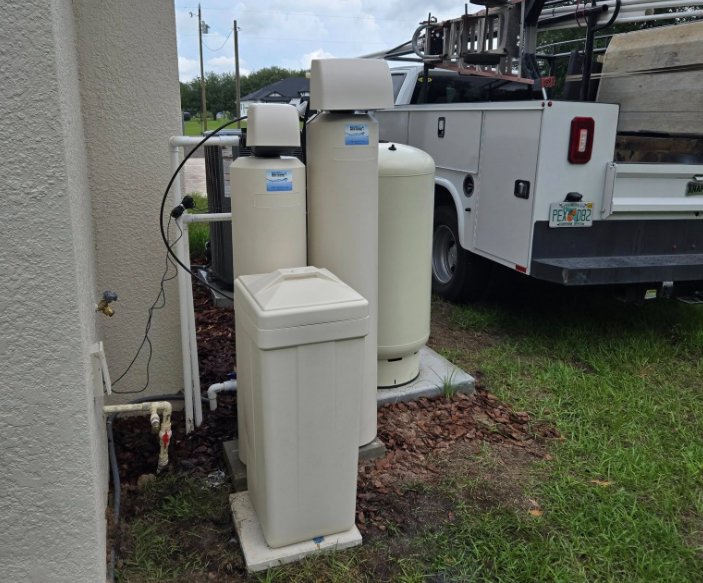
A whole-house water treatment system — sometimes called a point-of-entry system — is installed where your main water line enters your home. That means every faucet, every shower, every appliance, and every toilet in your house gets treated water.
This is different from a point-of-use system, like a filter pitcher in your refrigerator or a reverse osmosis unit under your kitchen sink. Those systems only treat water at one specific location. A whole-house system treats all the water in your home before it ever reaches any fixture.
That distinction matters more than most people realize. Your skin and hair are exposed to your shower water. Your washing machine uses your laundry water. Your water heater, dishwasher, and ice maker all run on your household water. A filter under the sink does nothing for any of those.
What a Whole-House System Actually Filters Out
This is where it gets important — because "whole-house filtration" isn't one specific thing. It's a category that can include several different types of treatment, depending on what's in your water and what problems you're trying to solve.
Here are the most common components and what each one does:
Water Softener A water softener addresses hardness — the calcium and magnesium minerals that cause scale buildup, stiff laundry, spotted dishes, dry skin, and premature appliance failure. It works through a process called ion exchange, swapping calcium and magnesium ions for sodium ions. The result is softened water that doesn't leave mineral deposits behind on anything it touches. In Florida, a water softener is the foundation of most whole-house treatment setups.
Carbon Filtration Activated carbon filters are excellent at removing chlorine, chloramines, volatile organic compounds (VOCs), and other chemicals that affect the taste, odor, and feel of your water. If your water comes from a municipal source in Florida, it's almost certainly treated with chlorine or chloramines — and a carbon filter removes those before they reach your taps, showers, and appliances. Carbon filtration is also effective at reducing hydrogen sulfide odor in well water at lower concentrations.
Iron Filtration Iron is a common problem in Florida well water. It causes orange and rust-colored staining on toilets, sinks, tubs, and laundry. An iron filter removes dissolved and particulate iron from your water before it can stain your fixtures or damage your appliances. Different types of iron require different filtration approaches, which is one reason water testing is so important before choosing a system.
Sediment Filtration A sediment filter is often the first stage in a whole-house system. It removes physical particles — sand, silt, rust flakes, and debris — that can come through your water line. Sediment filtration protects the downstream components of your system and extends the life of your other filters and equipment.
Air Injection / Oxidation Systems For homes with significant sulfur odor or high iron levels, an air injection system oxidizes those contaminants so they can be filtered out. These systems are particularly common for Florida well water where hydrogen sulfide is a problem.
Ultraviolet (UV) Disinfection UV systems use ultraviolet light to kill bacteria, viruses, and other biological contaminants in your water. They're commonly added to well water systems as a final safety layer, particularly in areas where bacterial contamination is a concern. UV systems don't remove anything from the water — they neutralize living organisms by disrupting their DNA so they can't reproduce.
Is a Whole-House System the Same as a Water Softener?
Not exactly — though the terms get used interchangeably sometimes, which adds to the confusion.
A water softener is one type of whole-house treatment. It's installed at the point of entry and treats all the water in your home, so in that sense it fits the definition. But a water softener only addresses hardness. It doesn't remove chlorine, iron, bacteria, sediment, or sulfur on its own.
A whole-house filtration system, in the broader sense, typically refers to a multi-stage setup that combines several treatment technologies to address multiple water quality issues at once. In Florida, a common combination might be a sediment pre-filter, followed by a water softener, followed by a carbon filter — each stage handling a different aspect of water quality.
The right combination depends entirely on what's in your water.
Why the Right System Depends on Your Water Test
This is something worth emphasizing: there is no universal whole-house system that's right for every home. What works perfectly for a home on city water in Tampa may be completely wrong for a home on well water in Ocala.
Your water has its own unique chemistry based on your source, your location, your plumbing, and your local geology. A water test tells you exactly what's present — hardness levels, iron content, pH, bacteria, sulfur, chlorine, and more. From there, a treatment system can be designed specifically for your situation.
Buying a system without testing your water first is like buying prescription glasses without getting your eyes checked. You might get lucky, but you're more likely to end up with something that doesn't actually solve your problem.
What a Properly Designed Whole-House System Does for Your Home
When a whole-house system is correctly matched to your water and properly installed, the effects are felt throughout your entire home:
- Every shower delivers water that's free of hard minerals and chemical disinfectants — better for your skin, hair, and scalp
- Every load of laundry comes out softer, brighter, and cleaner with less detergent
- Every appliance — water heater, dishwasher, washing machine — operates more efficiently and lasts longer without scale damage
- Every glass of water from any tap tastes and smells clean
- Your plumbing and fixtures are protected from mineral buildup and corrosion
- Your ice cubes are clear, your coffee tastes better, and your cooking water doesn't affect the flavor of your food
It's a whole-home upgrade, not just a kitchen fix.
What a Whole-House System Is Not
A whole-house softener or filtration system is not the same as a drinking water purification system. While softened, filtered water is significantly better than untreated tap water, some homeowners also choose to add a reverse osmosis system at the kitchen sink for an additional layer of purification specifically for drinking and cooking water.
RO systems remove a much broader range of contaminants — including sodium added by the softener, nitrates, fluoride, heavy metals, and more — and produce exceptionally pure drinking water. Many Florida homeowners use a whole-house softener and filtration system combined with an under-sink RO unit for the best of both worlds.
Maintenance — What's Actually Involved?
One concern people often have about whole-house systems is maintenance. The good news is that modern systems are designed to be low-maintenance.
A water softener needs salt added to the brine tank periodically — typically every few weeks to a couple of months depending on water usage and hardness levels. Carbon filters need their media replaced on a schedule, typically every few years. Sediment pre-filters need cartridge changes more frequently. UV bulbs need annual replacement.
A reputable water treatment company will set you up with a maintenance schedule and can handle service visits to keep your system running at peak performance.
The Bottom Line
A whole-house water filtration system treats all the water entering your home — not just the water at one faucet. Depending on your water quality, it might include a softener, carbon filtration, iron removal, sediment filtration, UV disinfection, or some combination of these.
The right system starts with knowing what's in your water. Once you have that information, a properly designed whole-house setup can solve problems throughout your entire home — from your morning shower to your evening dishes to the appliances running quietly in the background every day.
If you've been dealing with hard water, odor, staining, or water that just doesn't seem right, a whole-house solution is almost certainly worth a conversation.
Dependable Water Treatment designs and installs whole-house water treatment systems for Florida homeowners. We start with a water test so you know exactly what you're dealing with — then we build the right solution for your home. Contact us to get started.