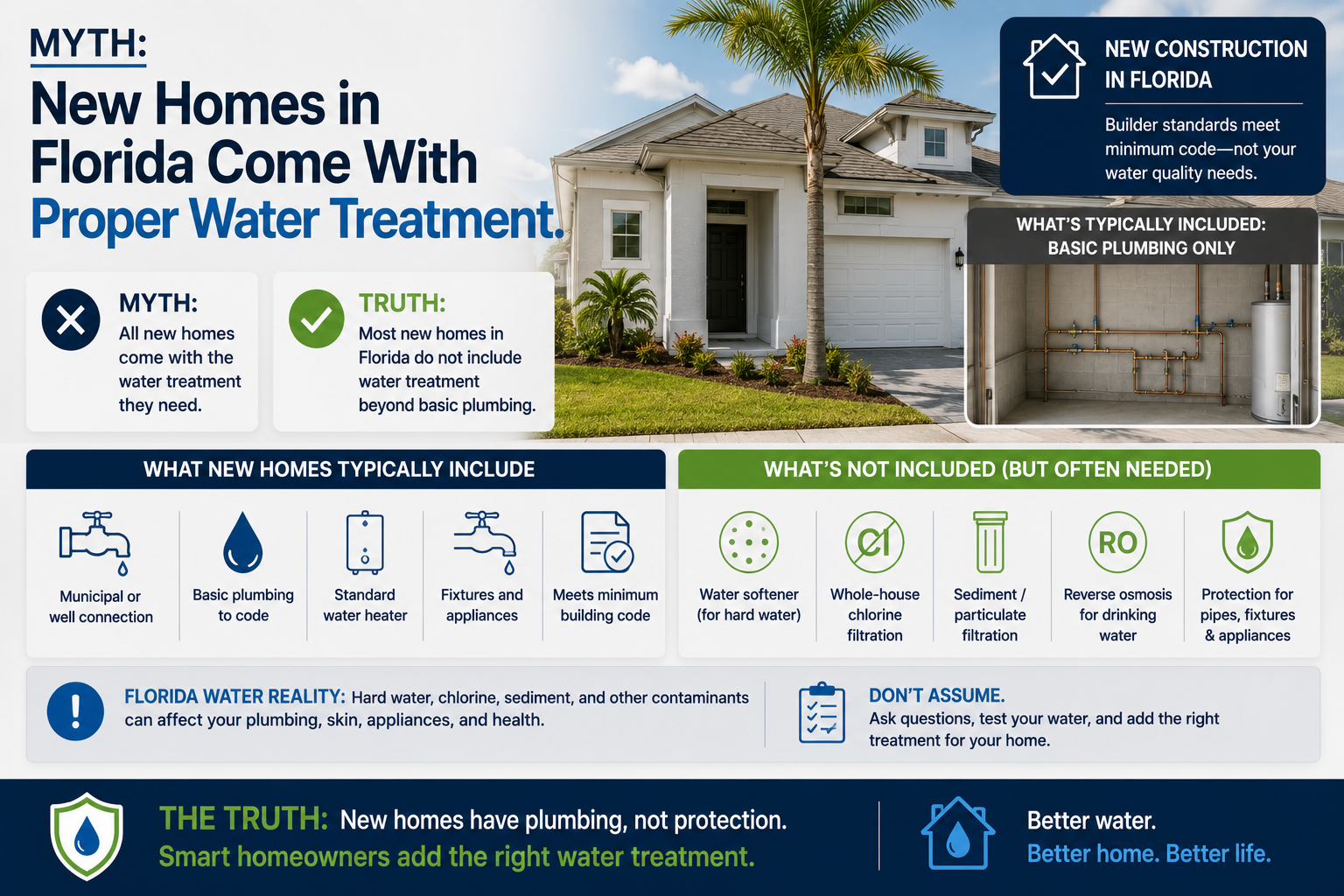
Buying a new construction home comes with a certain expectation of completeness. The appliances are new. The plumbing is new. The electrical is up to code. Everything has been inspected and approved. It's easy — and understandable — to assume that water quality has been handled as part of that process. It hasn't.
This myth costs Florida homeowners real money, because by the time they realize their brand new home has untreated hard water, the damage to their brand new appliances has already begun.
The Myth
The assumption is that a new construction home — particularly one that's passed all its inspections and has been built to code — comes with water that's been properly addressed. If something as important as water quality were a problem, surely the builder would have taken care of it.
What Builders Are Actually Required to Do
Florida building codes require builders to connect homes to an approved water source and install plumbing that meets code. That's it. There is no requirement to install water softeners, carbon filters, iron filters, or any other water treatment equipment beyond what's needed to pass a basic safety check.
Hard water is not a code violation. Iron staining is not a building defect. Chloramines in the water are not a construction issue. From a regulatory standpoint, a builder can hand you the keys to a home with aggressively hard water — water that will immediately begin damaging your brand new water heater and appliances — and be in full compliance with every applicable requirement.
Water treatment is considered an optional upgrade, not a standard feature. And in production homebuilding, where costs are controlled tightly at every stage, optional things that aren't required don't get included.
The "New Plumbing" Misconception
Many new homeowners assume that because the pipes and appliances are new, they don't need protection yet. There's time to think about water treatment later, once the home has settled in.
This misunderstands how hard water damage works. The moment hard water begins flowing through your brand new water heater, scale starts forming on the heating element. The first cycle of your dishwasher deposits minerals on its components. Your brand new washing machine, your brand new ice maker, your brand new showerheads — all begin accumulating mineral deposits from day one.
New appliances at move-in are at a critical point. Protecting them from the start gives you their full designed lifespan. Waiting even a year or two means that lifespan is already being shortened, and some of that early damage is permanent.
What the Builder's Water Test Actually Covers
When a builder installs a well for a new home, a basic water test is typically required — but that test is a safety screen, not a comprehensive water quality analysis. It checks for coliform bacteria and a limited set of regulated contaminants. It does not measure hardness, iron, sulfur, pH, or the other characteristics that determine what water treatment your home actually needs.
For homes on municipal water, there's often no home-specific testing at all — just a connection to the municipal supply, which itself may be hard and chemically treated.
In either case, the builder's process tells you nothing useful about whether your home's water needs treatment.
The Design Center Upgrade Trap
Some builders do offer water softeners or filtration systems as optional upgrades through their design center. If you've purchased new construction recently, you may have seen this during your selections process.
These upgrades are frequently priced at a significant markup over what an independent water treatment company would charge for the same or better system. Design centers are profit centers, and buyers selecting finishes and upgrades are not typically in price-comparison mode. Markups of 30 to 50 percent above market rate are common.
If you're still in the buying process and considering a water treatment upgrade through the builder, get independent quotes first. If you've already closed and skipped the upgrade, having a system installed independently is almost certainly less expensive than what the builder would have charged.
What New Construction Florida Homeowners Should Do
The steps are straightforward:
Get a comprehensive water test. Don't rely on the builder's results. An independent test measures hardness, iron, pH, sulfur, bacteria, chlorine or chloramines, and other factors that determine what your home actually needs.
Install water treatment at or before move-in. Every day without treatment is a day your new appliances are accumulating scale and wear. The sooner treatment is in place, the more of your investment you protect.
Don't assume the upgrade wasn't necessary because you skipped it. Many new homeowners skip the builder's water treatment upgrade not because they evaluated it but because it seemed like an extra expense they'd deal with later. Later is now.
The Bottom Line
New homes in Florida come with new plumbing, new appliances, and untreated water. The brand-new status of everything in your home makes water treatment more important, not less — because protecting new appliances from day one gives you the full return on that investment.
A new home is the best time to install a water softener and filtration system. It costs less than most people expect, and it starts protecting your investment from the first day water flows through your pipes.
Moving into a new Florida home? Dependable Water Treatment tests your water and installs the right system at move-in so your appliances and plumbing are protected from day one. Contact us before or after closing.