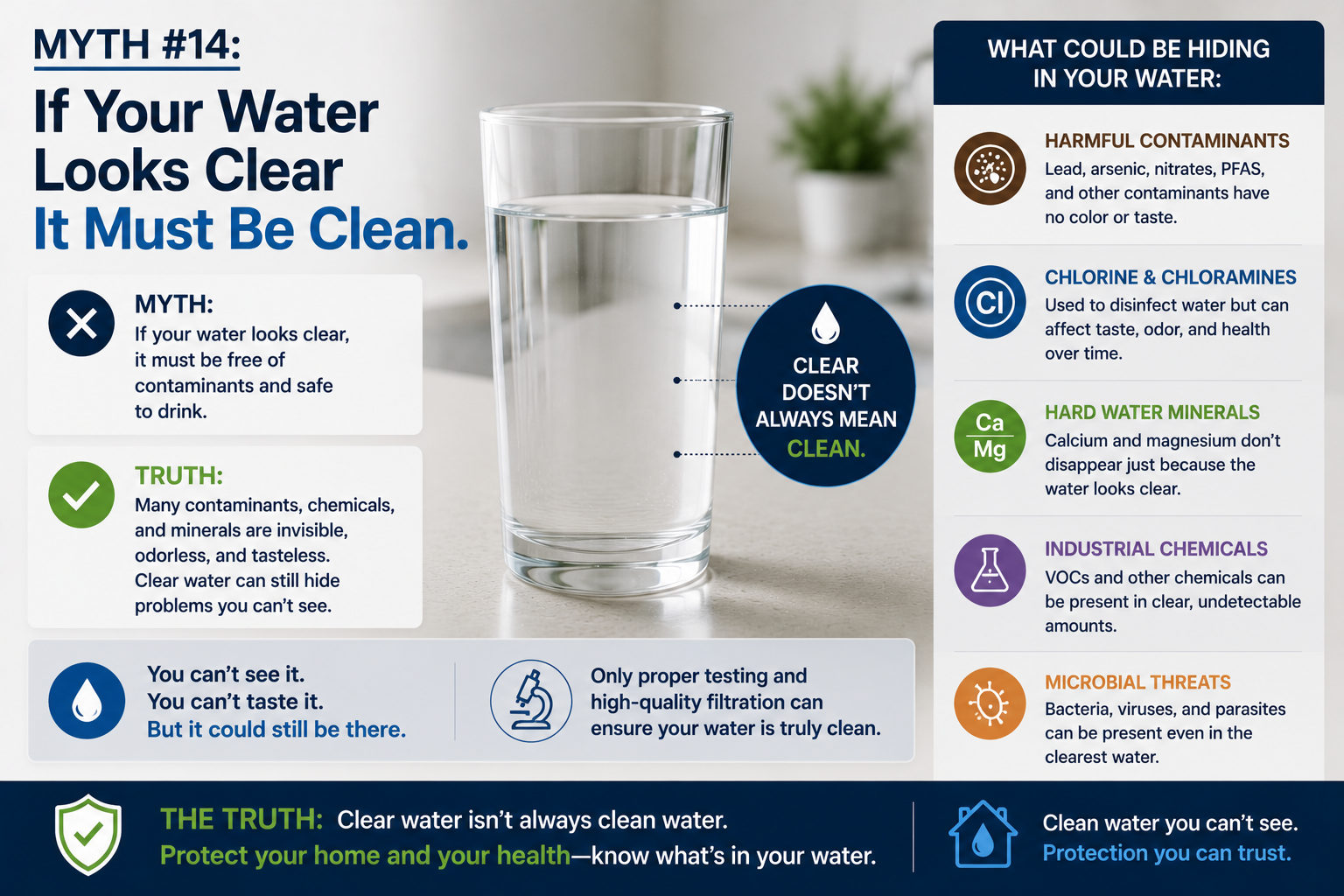
There's a deeply rooted instinct that tells us clear water is clean water and cloudy or discolored water is dangerous water. It makes sense on the surface — visible problems suggest a problem exists, and the absence of visible problems suggests everything is fine. But when it comes to water quality, that instinct is unreliable, and trusting it can leave real issues completely unaddressed.
The Myth
The reasoning goes: if I fill a glass with water from my tap and it looks clear, with no color, no cloudiness, no particles — then my water must be safe and free of significant contaminants. Visible water problems are the ones worth worrying about. Clear water gets a pass.
What Visual Clarity Actually Tells You
Visual clarity tells you about one narrow category of water characteristics: suspended particles. Sediment, debris, certain types of bacteria growth, and oxidized iron or manganese can all make water look cloudy, discolored, or visibly "off." If your water has these issues, you'll likely see them.
But the overwhelming majority of water quality concerns that matter — for your health, your plumbing, and your appliances — are completely invisible to the naked eye.
What's Invisible in "Clear" Water
Hardness minerals. Calcium and magnesium dissolve completely in water and produce no visible change whatsoever. Water at 25 grains per gallon hardness looks identical to water at 1 grain per gallon. The damage hardness does to your plumbing, appliances, skin, and hair happens regardless of how clear the water looks pouring out of the tap.
Bacteria. Many types of bacteria — including coliform bacteria and E. coli, which are tested for specifically in well water safety screens — produce no visible cloudiness, color, or odor at concentrations that matter for health. Clear water can carry bacterial contamination that only a laboratory test reveals.
Nitrates. Common in agricultural areas of Florida, nitrates are colorless, odorless, and tasteless in water. They pose a particular risk to infants and pregnant women, and there is no way to detect their presence by looking at or smelling the water.
Heavy metals. Lead, arsenic, and other heavy metals dissolve into water without producing any visible change. Lead contamination from old pipes or solder joints is invisible — and was a significant factor in major water crises precisely because the water looked completely normal.
PFAS (forever chemicals). These increasingly detected contaminants are entirely undetectable by sight, taste, or smell. Specialized laboratory testing is the only way to identify their presence.
Dissolved chlorine and chloramines. While these can sometimes be detected by smell at higher concentrations, lower levels that still affect water quality and plumbing can go unnoticed by the senses.
Low-level iron and manganese. At lower concentrations, dissolved (not yet oxidized) iron and manganese don't change the water's appearance, even though they're actively contributing to staining and damage over time as they oxidize within your plumbing.
Why This Matters So Much in Florida
Florida's combination of hard groundwater, agricultural land use in many regions, and a mix of municipal and private well water sources means several of these invisible issues are genuinely common across the state. A homeowner who relies on visual inspection alone to judge their water quality is essentially flying blind on most of what actually matters.
This is particularly important for private well owners, who bear sole responsibility for their water's safety. Unlike municipal water, which is regularly tested and reported under EPA regulation, private wells are not regulated, and no one is testing your water for you. If you're judging your well water's safety by how it looks in a glass, you're missing the vast majority of what a proper test would reveal.
The Danger of False Confidence
The real risk of this myth isn't just that people miss problems — it's that clear water creates false confidence that actively discourages testing. If your water looks fine, there's little internal motivation to spend money and effort on a water test. The visible absence of a problem feels like reassurance that none exists.
This is exactly backwards. The contaminants that matter most for health and home protection are precisely the ones you can't see. Visual inspection should never be treated as a substitute for actual testing.
What Visible Symptoms Do (and Don't) Tell You
To be clear, visible symptoms are useful information when they're present — orange staining points toward iron, cloudy water might indicate sediment or air in the lines, blue-green staining suggests acidic water leaching copper from pipes. These visual cues can guide what to test for.
But the absence of visible symptoms tells you nothing definitive. It doesn't rule out hardness, bacteria, nitrates, heavy metals, or any of the other contaminants that produce no visible signal. Clear water is a blank slate, not a clean bill of health.
What Actually Tells You Your Water Is Clean
The only reliable way to know what's in your water is laboratory or professional testing. A comprehensive water test measures the specific parameters that matter for your situation — hardness, pH, bacteria, nitrates, iron, and depending on your area, potentially other contaminants relevant to local geology and land use.
For well water owners, this kind of testing should happen at move-in and then periodically — annually for bacteria, and every few years for a broader panel, or more frequently if anything changes in your water's taste, smell, or appearance, or if there's nearby land use change like new agricultural or industrial activity.
For municipal water customers, your utility's annual Consumer Confidence Report provides system-wide data, but testing your own home's water can reveal issues specific to your plumbing, such as lead from older fixtures or solder.
The Bottom Line
Clear water and clean water are not the same thing. The visual clarity of your tap water tells you almost nothing about hardness, bacteria, nitrates, heavy metals, or the many other factors that actually determine water quality and safety. Trusting your eyes alone leaves the most significant risks completely unaddressed.
If you've never had your water professionally tested because it "looks fine," that's exactly the situation testing exists to address. What you can't see is often exactly what matters most.
Dependable Water Treatment offers comprehensive water testing for Florida homeowners on both well and municipal water. Contact us to find out what's actually in your water — not just what you can see.