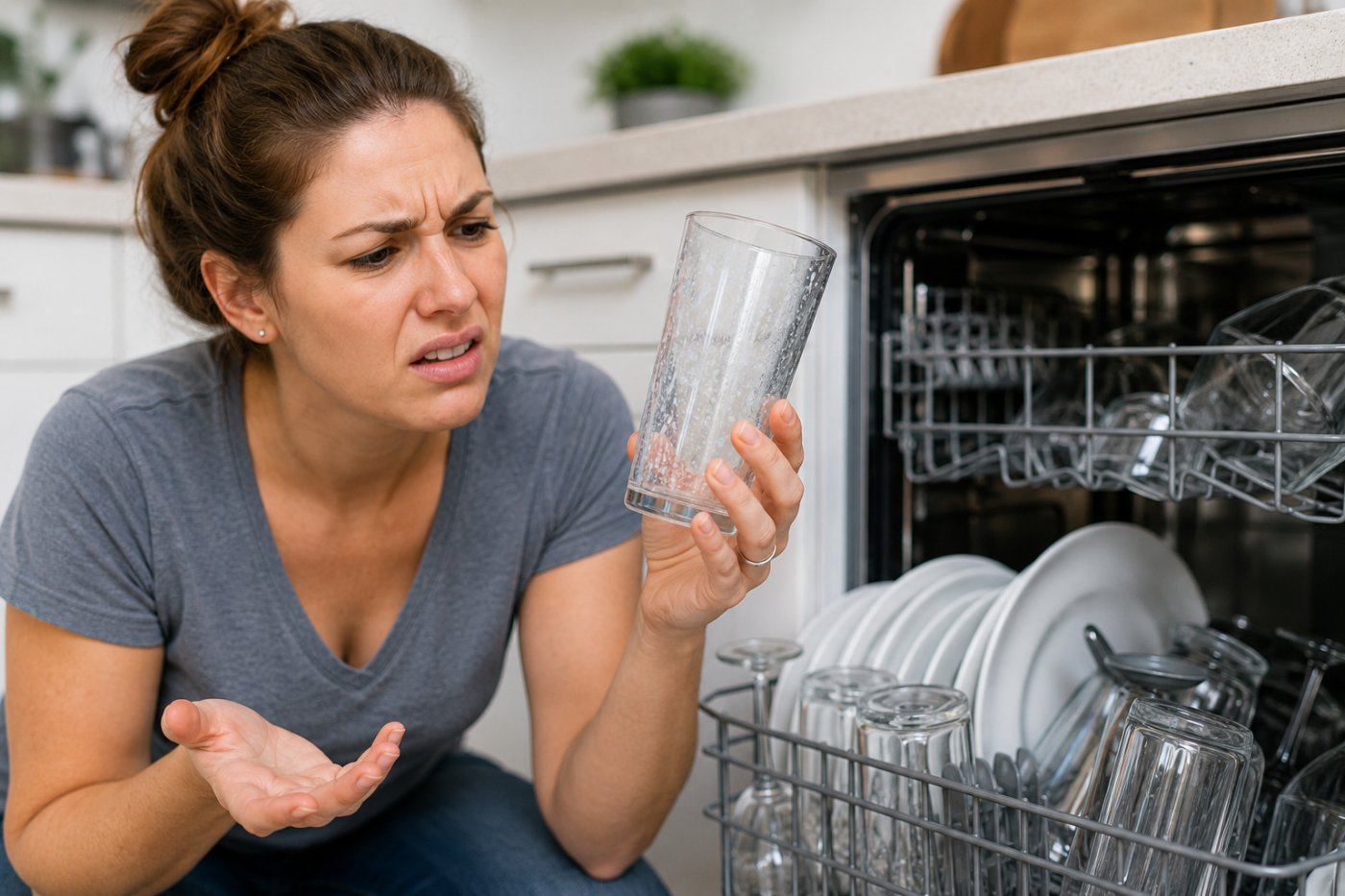
You run a full cycle, the dishwasher finishes, and you open the door expecting clean dishes. Instead you get spotted glasses, filmy plates, and a white haze on everything that's supposed to be sparkling. You add more detergent pods. You try a rinse aid. You run it again. Same result.
If this is your dishwasher routine, hard water is almost certainly the reason — and no amount of dishwasher detergent is going to fully overcome it.
What's Actually Happening Inside Your Dishwasher
Every time your dishwasher runs a cycle, it fills with your home's tap water. In Florida, that water carries a significant load of dissolved calcium and magnesium minerals. The dishwasher heats that water to improve cleaning performance — but heat actually accelerates mineral deposit formation.
As the hot water sprays across your dishes and then evaporates during the drying cycle, the minerals don't evaporate with it. They stay behind, bonding to whatever surface they were sitting on — your glasses, your plates, your silverware, and the interior of the dishwasher itself.
Do this hundreds of times over months and years and the results become impossible to ignore.
The Specific Problems Hard Water Creates in a Dishwasher
Spotted and Filmy Glassware
This is the most visible symptom. Glasses that come out of the dishwasher with white spots, a cloudy film, or a general haziness that won't wipe away — that's mineral deposits. The spots form wherever a water droplet sat and evaporated, leaving its mineral content behind on the glass surface.
Over time, this film can become permanent. Repeatedly etched by mineral deposits, glassware develops a frosted appearance that can't be reversed even with treated water later. Catching it early matters.
White Residue on Dishes and Silverware
The same process that spots your glasses leaves a duller, more diffuse film on plates, bowls, and silverware. It doesn't always look like obvious spots — sometimes it's a general lack of shine or a slightly gritty feeling on the surface of dishes that should be smooth and clean.
Detergent That Doesn't Dissolve Properly
Hard water interferes with dishwasher detergent the same way it interferes with laundry detergent and hand soap. Calcium and magnesium minerals react with the cleaning agents before they can fully do their job, reducing effectiveness and sometimes leaving detergent residue on dishes rather than rinsing it completely away.
This is why adding more detergent doesn't solve the problem — it can actually make the residue issue worse.
Scale Buildup on the Dishwasher Interior
Look inside your dishwasher — at the spray arms, the interior walls, the heating element, and around the door seal. If you see white or grayish buildup, that's limescale accumulating with every cycle. The spray arm nozzles are particularly vulnerable; as they clog with mineral deposits, the spray pattern becomes uneven, which means some dishes get properly cleaned while others don't.
Reduced Dishwasher Lifespan
This is the part that costs real money. The internal components of your dishwasher — the pump, the valves, the heating element, the spray arms — are all exposed to hard water with every cycle. Scale accumulates on the heating element, forcing it to work harder to reach the right temperature. Valves and seals degrade faster when mineral deposits build up around them.
The average dishwasher in a hard water home fails significantly sooner than one running on treated water. In Florida, where water hardness levels regularly run two to three times the threshold for "hard," that wear accelerates even further.
Why Rinse Aid Helps But Doesn't Fix It
Rinse aid works by reducing the surface tension of water so it sheets off dishes rather than forming droplets that sit and evaporate. Fewer droplets means fewer spots — which is why rinse aid genuinely helps with the spotting problem.
But it doesn't remove the minerals from your water. It just changes how the water behaves as it leaves your dishes. The calcium and magnesium are still flowing through your dishwasher with every cycle, still building up on internal components, still reacting with your detergent, still slowly degrading everything they touch.
Rinse aid is a management tool, not a solution.
What Dishwasher Manufacturers Actually Recommend
Here's something most people never think to check: many dishwasher manufacturers include water hardness guidelines in their installation and care documentation. Several major brands explicitly recommend water softening for homes with hard water — not just for dish quality, but to maintain warranty coverage and protect the appliance.
When scale buildup causes a dishwasher component to fail prematurely, hard water is often cited as a contributing factor — and in some cases, warranty claims have been denied when it's determined that untreated hard water caused the damage.
Running a high-end dishwasher on untreated Florida water is a bit like buying an expensive car and never changing the oil. The appliance can only perform as well as what you're putting through it.
How Florida's Water Makes This Worse
Water hardness is measured in grains per gallon. Anything above 7 is considered hard. Many Florida communities — particularly those in Central Florida drawing from the Floridan Aquifer — regularly test between 10 and 20 grains per gallon or higher.
That's not marginally hard water. That's extremely hard water running through your dishwasher multiple times a week, every week, year after year.
For homeowners on private wells, the situation is often even more pronounced. Well water pulls directly from the aquifer with no municipal treatment, meaning the full mineral load goes straight into your home's plumbing — and straight into your dishwasher.
The Difference Softened Water Makes
When a whole-home water softener removes calcium and magnesium before water reaches your dishwasher, the results are immediate and dramatic.
Glasses come out clear. Dishes come out without film or residue. Detergent works the way it's designed to work, which means you need less of it. The interior of the dishwasher stays cleaner with less manual maintenance. And the internal components stop accumulating the scale that shortens the appliance's working life.
Most homeowners who switch to softened water report that their dishwasher results improve within the first few cycles. It's one of the most immediately satisfying changes that comes with treating your water.
Cleaning Out Existing Scale
If your dishwasher already has significant scale buildup, treating your water going forward will stop new deposits from forming — but it won't automatically remove existing buildup. Running a cleaning cycle with a citric acid-based dishwasher cleaner can help dissolve existing mineral deposits on the interior and heating element. Check and clean the spray arm nozzles manually if they've become partially clogged.
Once your water is treated, ongoing maintenance becomes minimal. Without hard water constantly adding new deposits, the interior of your dishwasher stays in much better shape with normal use.
Your Dishes Shouldn't Look Like That
Spotted glasses and filmy dishes aren't a dishwasher problem or a detergent problem. They're a water problem — and in Florida, it's one of the most common complaints homeowners have without realizing what's actually behind it.
At Dependable Water Treatment, we help Florida homeowners identify exactly what their water is doing to their home and find the right solution to stop it. If your dishwasher results have never been what you expected, your water is almost certainly why.
Reach out to us at 407-242-7150 — we'll take a look at your water and show you what a difference treated water actually makes.