If you've decided it's time to get a water softener for your Florida home, one of the first questions you'll run into is: what size do I need? Walk into any water treatment store or browse online and you'll find softeners ranging from small single-person units all the way up to large whole-home systems — and the price difference between them is significant.
Getting the size right matters more than most people realize. Too small and your softener can't keep up with your household's demand, leaving you with hard water during peak usage times. Too large and you're wasting salt, water, and money on a system that regenerates more than it needs to. Here's how to think through it correctly.
What "Size" Actually Means for a Water Softener
When water treatment professionals talk about softener size, they're referring to the system's grain capacity — the total amount of hardness minerals the softener can remove before it needs to regenerate.
Grain capacity is measured in grains — specifically, grains of hardness per gallon of water. A softener rated at 32,000 grains can remove 32,000 grains of hardness before it needs to flush and recharge. A 48,000 grain system can remove 48,000 grains before regenerating.
The right size for your home depends on two things: how hard your water is, and how much water your household uses. Put those two numbers together and you can calculate how many grains your softener needs to handle between regeneration cycles.
Step One: Know Your Water Hardness
You can't size a softener without knowing your water hardness level. This is measured in grains per gallon (GPG) or parts per million (PPM) — one grain per gallon equals 17.1 PPM.
Florida water is notoriously hard. Depending on where you live and whether you're on well water or city water, hardness levels across the state commonly range from 10 to 30+ grains per gallon. That's significantly higher than the national average and well above the threshold where softening becomes essential rather than optional.
If you don't know your water hardness, a water test will give you the exact number. Don't guess — your hardness level is the foundation of the entire sizing calculation.
Step Two: Account for Iron
If your water contains iron — which is very common in Florida well water — you need to factor that into your sizing calculation. Iron competes with calcium and magnesium for space on the resin beads, and it's harder on the resin than hardness minerals alone.
A common rule of thumb used by water treatment professionals is to add 4 GPG to your hardness number for every 1 PPM of iron in your water. So if your water tests at 15 GPG hardness and 2 PPM iron, you'd size based on an effective hardness of 23 GPG.
This is one reason why a comprehensive water test — not just a hardness test — is important before selecting a system.
Step Three: Calculate Your Daily Softening Requirement
Once you know your effective hardness level, you need to estimate your household's daily water usage. The standard estimate used in the industry is 75 gallons per person per day for a typical household. This accounts for showers, laundry, dishwasher use, cooking, drinking, and other daily water consumption.
Here's the basic calculation:
Daily softening requirement = Number of people × 75 gallons × Water hardness in GPG
For example: A family of 4 with water hardness of 20 GPG: 4 people × 75 gallons × 20 GPG = 6,000 grains per day
Step Four: Choose the Right Capacity
With your daily softening requirement calculated, you can select the appropriate grain capacity. The general recommendation is to choose a softener that can go 7 to 10 days between regeneration cycles under normal usage — regenerating too frequently wastes salt and water, while waiting too long between cycles risks running the resin bed to exhaustion.
Using the example above — 6,000 grains per day:
- 7 days × 6,000 grains = 42,000 grains minimum capacity needed
- A 48,000 grain softener would be the appropriate choice
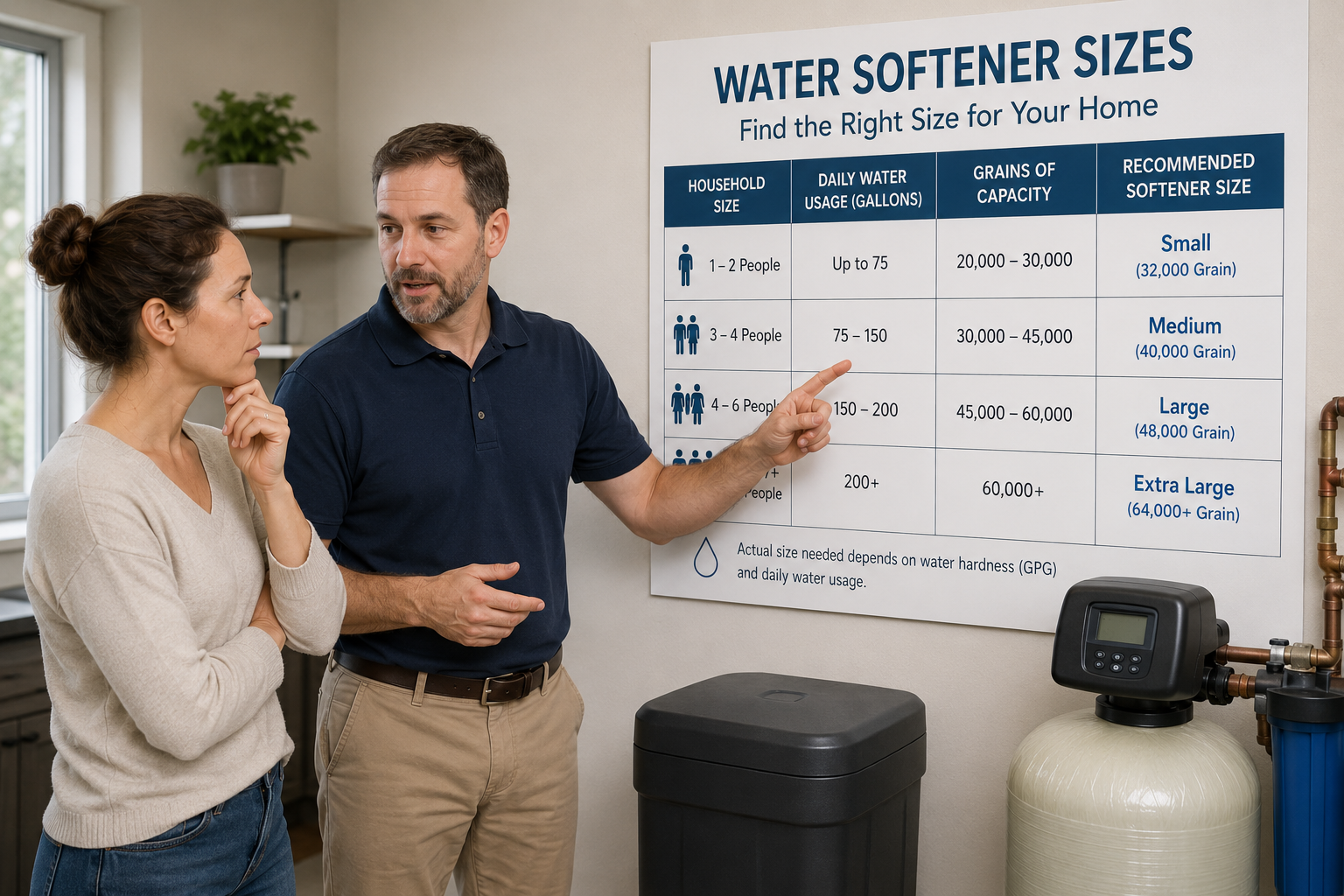
Here's a general sizing guide for Florida homes:
1 to 2 people, low to moderate hardness (10-15 GPG): 24,000 to 32,000 grains 2 to 3 people, moderate hardness (15-20 GPG): 32,000 to 48,000 grains 3 to 4 people, moderate to hard (20-25 GPG): 48,000 grains 4 to 5 people, hard water (25-30 GPG): 48,000 to 64,000 grains 5+ people or very hard water (30+ GPG): 64,000 grains or dual-tank system
Keep in mind these are general guidelines. Your specific water chemistry, iron levels, and actual usage patterns may push the recommendation higher.
The Efficiency Factor — Not All Softeners Are Created Equal
Grain capacity tells you how much hardness a softener can remove, but it doesn't tell you how efficiently it does so. Two softeners with the same rated grain capacity can use very different amounts of salt per regeneration cycle.
Older, less efficient softeners regenerate on a fixed timer schedule — regenerating every set number of days regardless of how much water has actually been used. Modern demand-initiated regeneration (DIR) softeners track actual water usage and only regenerate when the resin bed actually needs it. This can reduce salt and water consumption by 30 to 50 percent compared to timer-based systems.
When evaluating softeners, look at the salt efficiency rating — how many grains of hardness the system removes per pound of salt used. Higher efficiency means lower operating costs over the life of the system.
The Consequences of Getting the Size Wrong
Too small: A softener that's undersized for your household runs out of softening capacity before it regenerates. During that period, hard water flows through your home — defeating the purpose of having a softener at all. The system also regenerates more frequently than it should, using more salt and water.
Too large: An oversized softener doesn't regenerate often enough. Resin beads that sit unused for too long without regenerating can develop channeling — where water finds preferred paths through the resin rather than flowing evenly through it. This reduces efficiency and can allow some hard water to pass through. Oversized systems also waste salt and water on unnecessary regeneration cycles.
The salt bridge problem with oversized systems: When the brine tank is very large relative to actual usage, salt can sit undisturbed for extended periods and form bridges or mush — which interferes with proper regeneration.
Should You Consider a Dual-Tank System?
For larger households, homes with very hard water, or situations where a continuous supply of soft water is critical, a dual-tank system is worth considering.
A dual-tank softener has two resin tanks that alternate — while one is softening water, the other is regenerating. This means soft water is available 24 hours a day, 7 days a week, with no hardness breakthrough during regeneration cycles. For a family that does laundry at all hours or runs multiple showers at once, this continuous availability can be important.
What About Whole-House Flow Rate?
Grain capacity addresses how much hardness a softener can handle over time. Flow rate addresses how much water it can soften at once — measured in gallons per minute (GPM).
If your softener can't keep up with peak demand — multiple showers running, the dishwasher going, a load of laundry in progress — it may deliver partially unsoftened water during those high-demand periods.
For most Florida homes, a softener with a flow rate of 10 to 12 GPM is sufficient. Larger homes or homes with multiple simultaneous high-demand uses may need higher flow rates. Your water treatment professional should factor this into the system recommendation.
Why Professional Sizing Matters
The calculations above give you a solid framework for understanding softener sizing — but there's real value in having a water treatment professional assess your specific situation.
A professional will:
- Test your water for hardness, iron, pH, and other factors that affect sizing
- Evaluate your actual water usage patterns
- Assess your home's plumbing and peak flow requirements
- Recommend the right system type, capacity, and efficiency rating for your specific needs
- Size the brine tank appropriately for your usage level
Getting the sizing right from the start means better performance, lower operating costs, and a longer system lifespan. It's worth the conversation before you buy.
The Bottom Line
Sizing a water softener isn't complicated once you understand the variables — but it does require knowing your actual water hardness, accounting for iron if present, and matching capacity to your household's real water usage.
In Florida, where hardness levels are high and water usage runs year-round, getting the size right matters more than it does in states with milder water conditions. Too small and you won't have consistently soft water. Too large and you'll waste money on salt and risk resin performance issues.
Start with a water test, do the math, and don't hesitate to get a professional assessment. The right size softener, properly installed, will serve your home efficiently for 15 to 20 years.
Not sure what size water softener your Florida home needs? Dependable Water Treatment tests your water and recommends the right system for your household. Contact us for a water test and a no-pressure recommendation.